Learning a new sense: Scientists observe as humans learn to sense like a rat, with 'whiskers'
November 5, 2012 in Neuroscience
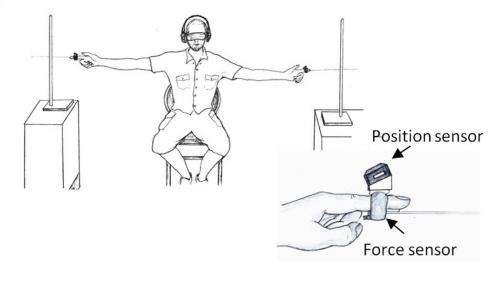
This shows the experimental set-up. Credit: Prof. Ehud Ahissar
A Weizmann Institute experiment in which volunteers learned to sense objects' locations using just "rat whiskers" may help improve aids for the blind.
Rats use a sense that humans don't: whisking. They move their facial whiskers back and forth about eight times a second to locate objects in their environment. Could humans acquire this sense? And if they can, what could understanding the process of adapting to new sensory input tell us about how humans normally sense? At the Weizmann Institute, researchers explored these questions by attaching plastic "whiskers" to the fingers of blindfolded volunteers and asking them to carry out a location task. The findings, which recently appeared in the Journal of Neuroscience, have yielded new insight into the process of sensing, and they may point to new avenues in developing aids for the blind.
The scientific team, including Drs. Avraham Saig and Goren Gordon, and Eldad Assa in the group of Prof. Ehud Ahissar and Dr. Amos Arieli, all of the Neurobiology Department attached a "whisker" – a 30 cm-long elastic "hair" with position and force sensors on its base – to the index finger of each hand of a blindfolded subject. Then two poles were placed at arm's distance on either side and slightly to the front of the seated subject, with one a bit farther back than the other. Using just their whiskers, the subjects were challenged to figure out which pole – left or right – was the back one. As the experiment continued, the displacement between front and back poles was reduced, up to the point when the subject could no longer distinguish front from back.
On the first day of the experiment, subjects picked up the new sense so well that they could correctly identify a pole that was set back by only eight cm. An analysis of the data revealed that the subjects did this by figuring the spatial information from the sensory timing. That is, moving their bewhiskered hands together, they could determine which pole was the back one because the whisker on that hand made contact earlier.
When they repeated the testing the next day, the researchers discovered that the subjects had improved their whisking skills significantly: The average sensory threshold went down to just three cm, with some being able to sense a displacement of just one cm. Interestingly, the ability of the subjects to sense time differences had not changed over the two days. Rather, they had improved in the motor aspects of their whisking strategies: Slowing down their hand motions – in effect lengthening the delay time – enabled them to sense a smaller spatial difference.
Saig: "We know that our senses are linked to muscles, for example ocular and hand muscles. In order to sense the texture of cloth, for example, we move our fingers across it, and to seeing stationary object, our eyes must be in constant motion. In this research, we see that changing our physical movements alone – without any corresponding change in the sensitivity of our senses – can be sufficient to sharpen our perception."
Based on the experiments, the scientists created a statistical model to describe how the subjects updated their "world view" as they acquired new sensory information – up to the point at which they were confident enough to rely on that sense. The model, based on principles of information processing, could explain the number of whisking movements needed to arrive at the correct answer, as well as the pattern of scanning the subjects employed – a gradual change from long to short movements . With this strategy, the flow of information remains constant. "The experiment was conducted in a controlled manner, which allowed us direct access to all the relevant variables: hand motion, hand-pole contact and the reports of the subjects themselves," says Gordon. "Not only was there a good fit between the theory and the experimental data, we obtained some useful quantitative information on the process of active sensing."
"Both sight and touch are based on arrays of receptors that scan the outside world in an active manner," says Ahissar, "Our findings reveal some new principles of active sensing, and show us that activating a new artificial sense in a 'natural' way can be very efficient." Arieli adds: "Our vision for the future is to help blind people 'see' with their fingers. Small devices that translate video to mechanical stimulation, based on principles of active sensing that are common to vision and touch, could provide an intuitive, easily used sensory aid."
Journal reference:
Journal of Neuroscience
Provided by
Weizmann Institute of Science
-
New model of whiskers provides insight into sense of touch
Apr 07, 2011 |
not rated yet |
0
-
Whiskers marked milestone in evolution of mammals from reptiles
Nov 10, 2011 |
not rated yet |
0
-
What a rat can tell us about touch
Feb 18, 2011 |
not rated yet |
0
-
Scientists Reveal How Signals Travel Through Rats' Whiskers
May 17, 2006 |
not rated yet |
0
-
Researchers unveil whiskered robot rat
Jun 30, 2009 |
not rated yet |
0
-
Motion perception revisited: High Phi effect challenges established motion perception assumptions
Apr 23, 2013 |
3 / 5 (2) |
2
-
Anything you can do I can do better: Neuromolecular foundations of the superiority illusion (Update)
Apr 02, 2013 |
4.5 / 5 (11) |
5
-
The visual system as economist: Neural resource allocation in visual adaptation
Mar 30, 2013 |
5 / 5 (2) |
9
-
Separate lives: Neuronal and organismal lifespans decoupled
Mar 27, 2013 |
4.9 / 5 (8) |
0
-
Sizing things up: The evolutionary neurobiology of scale invariance
Feb 28, 2013 |
4.8 / 5 (10) |
14
-
Pressure-volume curve: Elastic Recoil Pressure don't make sense
May 18, 2013
-
If you became brain-dead, would you want them to pull the plug?
May 17, 2013
-
MRI bill question
May 15, 2013
-
Ratio of Hydrogen of Oxygen in Dessicated Animal Protein
May 13, 2013
-
Alcohol and acetaminophen
May 13, 2013
-
Marie Curie's leukemia
May 13, 2013
- More from Physics Forums - Medical Sciences
More news stories
Neurons that can multitask greatly enhance the brain's computational power, study finds
Over the past few decades, neuroscientists have made much progress in mapping the brain by deciphering the functions of individual neurons that perform very specific tasks, such as recognizing the location ...
Neuroscience
2 hours ago |
5 / 5 (2) |
0
|
For combat veterans suffering from post-traumatic stress disorder, 'fear circuitry' in the brain never rests
Chronic trauma can inflict lasting damage to brain regions associated with fear and anxiety. Previous imaging studies of people with post-traumatic stress disorder, or PTSD, have shown that these brain regions can over-or ...
Neuroscience
May 18, 2013 |
5 / 5 (1) |
0
|
Temporal processing in the olfactory system
The neural machinery underlying our olfactory sense continues to be an enigma for neuroscience. A recent review in Neuron seeks to expand traditional ideas about how neurons in the olfactory bulb might encode information about ...
Neuroscience
May 17, 2013 |
4 / 5 (1) |
0
|
Melon focus headband turns to Kickstarter for rollout plans
(Medical Xpress)—What if the quality of your work depends more on your focus on the piano keys or canvas or laptop than your musical or painting or computing skills? If target users can be convinced, they ...
Neuroscience
May 17, 2013 |
3.7 / 5 (3) |
0
|
Deep brain stimulation: A fix when the drugs don't work
Neurological disorders can have a devastating impact on the lives of sufferers and their families.
Neuroscience
May 17, 2013 |
5 / 5 (1) |
0
|
First long-term study reveals link between childhood ADHD and obesity
A new study conducted by researchers at the Child Study Center at NYU Langone Medical Center found men diagnosed as children with attention-deficit/hyperactivity disorder (ADHD) were twice as likely to be obese in a 33-year ...
Computer model predicts when viruses become infectious
A new computer model could help scientists predict when a particular strain of avian influenza might become infectious from bird to human, according to a report to be published in the International Journal Data Mining an ...
Atherosclerotic disease heredity mapped in nationwide study
Researchers at Lund University in Sweden have mapped the significance of heredity for common forms of atherosclerotic disease. No studies have previously examined whether different forms of the disease share heredity.
Impossible to predict outcome in China's bird flu outbreak, WHO says
It is impossible to predict the evolution of China's human H7N9 bird flu outbreak as researchers are still trying to understand the source of human transmission, the head of the World Health Organisation said Monday.
FDA has safety concerns on Merck insomnia drug
Federal health regulators say an experimental insomnia drug from Merck can help patients fall asleep, but it also carries worrisome side effects, including daytime drowsiness and suicidal thinking.
Women with severe injuries are less likely than men to be treated in a trauma center
Women are less likely than men to receive care in a trauma center after severe injury, according to a new study of almost 100,000 Canadian patients.
Nov 05, 2012
Rank: 1 / 5 (2)
Nov 05, 2012
Rank: not rated yet
And a brain able to accommodate the gain or loss.
Nov 05, 2012
Rank: not rated yet
ahhh... actually humans have five main senses
Sight -- uses eyes
Sound -- uses ears
Smell -- uses nose
Taste -- uses tongue and nose
Touch -- uses hair
--- we had to list these in pre-school -- how do you get touch as a sixth sense??
if anything perception of time is the sixth sense.
Nov 06, 2012
Rank: not rated yet
Actually there are a lot more "senses" to us humans. There is temperature senses, sensoric cells for a lot of chemicals or levels of chemicals in our body, sense of balance and much more.
Nov 06, 2012
Rank: not rated yet