Scientists report a potential new treatment to prevent strokes
November 22, 2012 in Cardiology

Scientists report a potential new treatment to prevent strokes

Enlarge

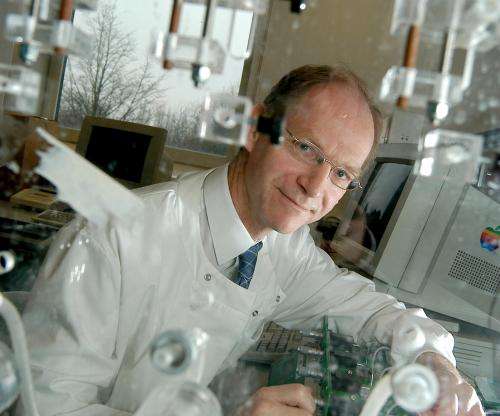
(Medical Xpress)—Scientists may have discovered a new way to prevent strokes in high risk patients, according to research from the University of Warwick and University Hospitals Coventry and Warwickshire (UHCW).

Work by a new research group, led by Professor Donald Singer, Professor of Therapeutics at Warwick Medical School and Professor Chris Imray from UHCW, has now been published in US journal Stroke.

The group is using ultrasound scanning to look at with disease, one of the major causes of stroke. Clots can form on diseased carotid arteries in the neck. Small parts of these clots can released to form microemboli, which can travel to block key brain arteries and lead to weakness, disturbed speech, loss of vision and other serious stroke syndromes. Standard anti-platelet drugs such as aspirin may not prevent the formation of harmful microemboli.

The scanning process can be used to find patients at very high risk of stroke because microemboli have formed despite prior anti-platelet drugs. Using scanning, the team has found that tirofiban, another anti-platelet drug designed to inhibit the formation of blood clots, can suppress microemboli where previous treatment such as aspirin has been ineffective. In their study, tirofiban was more effective than other 'rescue' treatment.

Professor Singer said: "These findings show that the choice of rescue medicine is very important when carotid patients develop microemboli despite previous treatment with powerful anti-platelet drugs such as aspirin. We now need to go on to further studies of anti-microemboli rescue treatments, to aim for the right balance between protection and risk for our patients."

Professor Imray said: "These findings show the importance of ultrasound testing for micro-emboli in disease patients. These of high cannot be predicted just from assessing the severity of risk factors such as smoking history, cholesterol and blood pressure."

More information: Saedon, M. et al., Registry Report on Kinetics of Rescue Antiplatelet Treatment to Abolish Cerebral Microemboli After Carotid Endarterectomy. Stroke, ISSN: 0039-2499. stroke.ahajournals… 338.full.pdf

Journal reference: Stroke search and more info website

Provided by University of Warwick search and more info website

5 /5 (2 votes)  

Rank 5 /5 (2 votes)
Relevant PhysicsForums posts

More news stories

Free fatty acids linked to cardiac risk in late adulthood

(HealthDay)—Blood levels of free fatty acids are associated with insulin resistance during young adulthood and cardiovascular risk factors in later adulthood, according to a study published online May 13 ...

Cardiology created May 17, 2013 | popularity not rated yet | comments 0 | with audio podcast

Diagnosing heart attacks: There's an app for that

An experimental, inexpensive iPhone application transmitted diagnostic heart images faster and more reliably than emailing photo images, according to a research study presented at the American Heart Association's Quality ...

Cardiology created May 17, 2013 | popularity not rated yet | comments 0

Study suggests new role for ECMO in treating patients with cardiac arrest and profound shock

Extracorporeal membrane oxygenation (ECMO), a procedure traditionally used during cardiac surgeries and in the ICU that functions as an artificial replacement for a patient's heart and lungs, has also been used to resuscitate ...

Cardiology created May 17, 2013 | popularity not rated yet | comments 0

Stroke patients respond similarly to after-stroke care, despite age difference

Age has little to do with how patients should be treated after suffering a stroke, according to new research from the University of Georgia.

Cardiology created May 17, 2013 | popularity not rated yet | comments 0 | with audio podcast

Depression linked to almost doubled stroke risk in middle-aged women

Depressed middle-aged women have almost double the risk of having a stroke, according to research published in Stroke: Journal of the American Heart Association.

Cardiology created May 16, 2013 | popularity not rated yet | comments 0


Researchers identify a potential new risk for sleep apnea: Asthma

Researchers at the University of Wisconsin have identified a potential new risk factor for obstructive sleep apnea: asthma. Using data from the National Institutes of Health (Heart, Lung, and Blood Institute)-funded Wisconsin ...

Study finds that sleep apnea and Alzheimer's are linked

A new study looking at sleep-disordered breathing (SDB) and markers for Alzheimer's disease (AD) risk in cerebrospinal fluid (CSF) and neuroimaging adds to the growing body of research linking the two.

Ginger compounds may be effective in treating asthma symptoms

Gourmands and foodies everywhere have long recognized ginger as a great way to add a little peppery zing to both sweet and savory dishes; now, a study from researchers at Columbia University shows purified components of the ...

Computational tool translates complex data into simplified 2-dimensional images

In their quest to learn more about the variability of cells between and within tissues, biomedical scientists have devised tools capable of simultaneously measuring dozens of characteristics of individual ...

New theory on genesis of osteoarthritis comes with successful therapy in mice

Scientists at Johns Hopkins have turned their view of osteoarthritis (OA) inside out. Literally. Instead of seeing the painful degenerative disease as a problem primarily of the cartilage that cushions joints, ...

'Gap' for HIV vaccine efforts after latest setback

The hunt for an HIV vaccine has gobbled up $8 billion in the past decade, and the failure of the most recent efficacy trial has delivered yet another setback to 26 years of efforts.