Grief is not a disease, but cancer is: What about erectile dysfunction or gambling addiction?
"Understanding peoples' attitudes about whether states of being should be considered diseases can inform social discourse regarding a number of contentious social and health public policy issues," says Kari Tikkinen, MD, PhD, corresponding author of the FIND Survey.
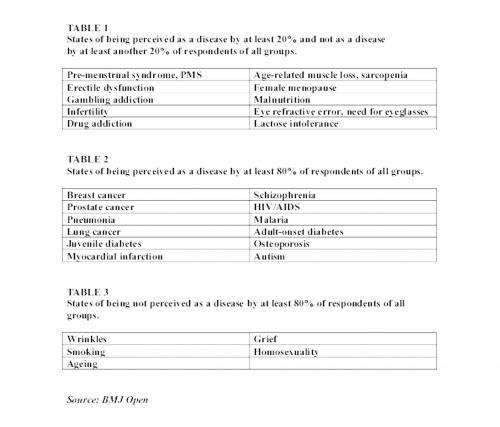
All Finns think that myocardial infarction, breast cancer, malaria and pneumonia are diseases. People are equally unanimous that wrinkles, grief and homosexuality are not diseases. What about drug addiction or absence of sexual desire? Or erectile dysfunction, infertility or obesity?
"The word disease seems to be as difficult to define as beauty, truth or love, although the concept of disease lies at the heart of medicine," Tikkinen says.
Currently on leave from the Helsinki University Central Hospital, Tikkinen works as a visiting research fellow at McMaster University in Hamilton, Ontario, Canada.
The FIND Survey examined, across a wide range of conditions, which should be classified as a disease. The respondents included four relevant stakeholders: laypeople, doctors, nurses and legislators.
Perceptions of disease were surveyed using a questionnaire that listed 60 states of being related to health and well-being, from breast cancer and pneumonia to burnout, grief and wrinkles. Using a 5-point Likert-scale ranging from "strongly disagree" to "strongly agree", the respondents were asked to evaluate whether states of being should be considered diseases and be funded through public revenue.
The survey was sent to 6,200 Finns: 1,500 doctors, 1,500 nurses, 3,000 laypeople and the 200 members of the Parliament of Finland. The doctors and nurses were randomly selected from the databases of their professional organisations and the laypeople from the Finnish Population Register. A total of 3,280 people responded to the survey (53%).
The 60 states of being presented in this survey included 12 that at least 80 percent of the respondents considered to be diseases. Five states were considered not to be diseases by at least 80 percent of the respondents. The responses to the remainder of the states showed large disagreement whether they should be considered, or not, diseases.
Public funding only for the treatment of "real" diseases
Doctors were the most inclined to consider states of being diseases. Laypeople were the least inclined, and nurses and legislators were in between. However, the differences between the groups were not large, and were very small in comparison to the disagreement within each group.
In all groups, willingness to pay for treatment from public funds was very strongly correlated with the perception of disease (that is, whether respondents regarded a particular state of being as a disease).
"The substantial disagreement we found in classifying of states of being as diseases, and the parallel disagreement regarding the legitimacy of public funding for those that warrant treatment provides insight into the attitudes underlying a number of current high profile social debates. The solutions and management of drug addictions, for example, may vary greatly depending on whether addiction is seen as a disease or as a moral failing." Tikkinen says.
More information: Kari, A.O., et al, What is a disease? Perspectives of the public, health professionals, and legislators. BMJ Open 2012;2:e001632.
doi:10.1136/bmjopen-2012-001632
Journal reference:
BMJ Open
Provided by
University of Helsinki
-
The concept of 'overactive bladder' serves better commercial rather than patient interests
Jan 13, 2012 |
not rated yet |
0
-
Survey finds wide public support for nationwide study of genes, environment and lifestyle
Nov 12, 2008 |
not rated yet |
0
-
Canada needs a policy for rare disease treatment
Jul 12, 2010 |
not rated yet |
0
-
United States continues to have highest level of health spending
Sep 11, 2007 |
not rated yet |
0
-
International survey highlights great public desire to seek early diagnosis of Alzheimer's
Jul 20, 2011 |
not rated yet |
0
-
Motion perception revisited: High Phi effect challenges established motion perception assumptions
Apr 23, 2013 |
3 / 5 (2) |
2
-
Anything you can do I can do better: Neuromolecular foundations of the superiority illusion (Update)
Apr 02, 2013 |
4.5 / 5 (11) |
5
-
The visual system as economist: Neural resource allocation in visual adaptation
Mar 30, 2013 |
5 / 5 (2) |
9
-
Separate lives: Neuronal and organismal lifespans decoupled
Mar 27, 2013 |
4.9 / 5 (8) |
0
-
Sizing things up: The evolutionary neurobiology of scale invariance
Feb 28, 2013 |
4.8 / 5 (10) |
14
-
Classical and Quantum Mechanics via Lie algebras
Apr 15, 2011
- More from Physics Forums - Independent Research
More news stories
New research identifies risks, interventions for children's GI health
An increasing number of U.S. children are experiencing gastrointestinal issues that require interventions to resolve, according to research presented at Digestive Disease Week (DDW).
Health
May 18, 2013 |
not rated yet |
0
|
Youth who have their first drink during puberty have higher levels of later drinking
Research shows that the earlier the age at which youth take their first alcoholic drink, the greater the risk of developing alcohol problems. Thus, age at first drink (AFD) is generally considered a powerful predictor of ...
Health
May 17, 2013 |
not rated yet |
0
British MPs concerned about parliamentary boozing
One quarter of British lawmakers believe there is an "unhealthy" drinking culture in the Houses of Parliament, according to a survey published on Friday.
Health
May 17, 2013 |
not rated yet |
0
Patient openness to research can depend on race and sex of study personnel
Researchers at the University of Cincinnati (UC) have found that the race and sex of study personnel can influence a patient's decision on whether or not to participate in clinical research.
Health
May 17, 2013 |
not rated yet |
0
Clinical support for patient self-management is rhetoric rather than reality
The processes to allow people to self-manage their own illness are not being used appropriately by health professionals to the benefit of their patients, new research suggests.
Health
May 17, 2013 |
not rated yet |
0
Researchers identify a potential new risk for sleep apnea: Asthma
Researchers at the University of Wisconsin have identified a potential new risk factor for obstructive sleep apnea: asthma. Using data from the National Institutes of Health (Heart, Lung, and Blood Institute)-funded Wisconsin ...
Study finds that sleep apnea and Alzheimer's are linked
A new study looking at sleep-disordered breathing (SDB) and markers for Alzheimer's disease (AD) risk in cerebrospinal fluid (CSF) and neuroimaging adds to the growing body of research linking the two.
Ginger compounds may be effective in treating asthma symptoms
Gourmands and foodies everywhere have long recognized ginger as a great way to add a little peppery zing to both sweet and savory dishes; now, a study from researchers at Columbia University shows purified components of the ...
Computational tool translates complex data into simplified 2-dimensional images
In their quest to learn more about the variability of cells between and within tissues, biomedical scientists have devised tools capable of simultaneously measuring dozens of characteristics of individual ...
New theory on genesis of osteoarthritis comes with successful therapy in mice
Scientists at Johns Hopkins have turned their view of osteoarthritis (OA) inside out. Literally. Instead of seeing the painful degenerative disease as a problem primarily of the cartilage that cushions joints, ...
'Gap' for HIV vaccine efforts after latest setback
The hunt for an HIV vaccine has gobbled up $8 billion in the past decade, and the failure of the most recent efficacy trial has delivered yet another setback to 26 years of efforts.