Changes in the gut bacteria protect against stroke
December 5, 2012 in Medical research

Changes in the gut bacteria protect against stroke

Enlarge

(Medical Xpress)—Researchers at Chalmers University of Technology and University of Gothenburg demonstrate that an altered gut microbiota in humans is associated with symptomatic atherosclerosis and stroke. These findings are presented in a study published in Nature Communications.

​The human body contains ten times more than , most of which are found in the gut. These bacteria contain an enormous number of genes in addition to our , and are collectively known as the gut metagenome.

How does the metagenome affect our health? This question is currently being addressed by researchers in the rapidly expanding field of metagenomic research. Several diseases have been linked to variations in the metagenome. Researchers at Chalmers University of Technology and Gothenburg University now also show that changes in the gut metagenome can be linked to atherosclerosis and stroke.

The researchers compared a group of with a group of healthy subjects and found major differences in their gut . In particular, they showed that genes required for the production of carotenoids were more frequently found in gut microbiota from healthy subjects. The healthy subjects also had significantly higher levels of a certain carotenoid in the blood than the .

Changes in the gut bacteria protect against stroke

The study showed that genes required for the production of carotenoids were more frequently found in gut microbiota from healthy subjects.

Carotenoids are a type of antioxidant, and it has been claimed for many years that they protect against angina and stroke. Thus, the increased incidence of -producing bacteria in the gut of healthy subjects may offer clues to explain how the gut metagenome affects disease states.

Carotenoids are marketed today as a dietary supplement. The market for them is huge, but clinical studies of their efficacy in protecting against angina and stroke have produced varying results. Jens Nielsen, Professor of at Chalmers, says that it may be preferable to take probiotics instead – for example dietary supplements containing types of bacteria that produce carotenoids.
Changes in the gut bacteria protect against stroke

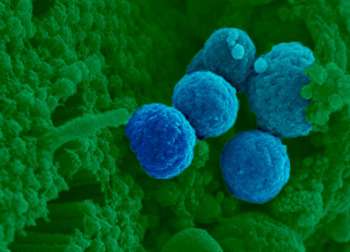
Bacteria (blue) sitting on a mucosal cell (green) in the gut. Credit: Frida Fåk

"Our results indicate that long-term exposure to carotenoids, through production by the bacteria in the digestive system, has important health benefits. These results should make it possible to develop new probiotics. We think that the bacterial species in the probiotics would establish themselves as a permanent culture in the gut and have a long-term effect".

"By examining the patient's bacterial microbiota, we should also be able to develop risk prognoses for cardiovascular disease", says Fredrik Bäckhed, Professor of Molecular Medicine at Gothenburg University. "It should be possible to provide completely new disease-prevention options".

The researchers have now started a company, Metabogen, to further develop their discoveries relating to the metagenome. Their success is based on close cooperation between engineers, microbiologists and doctors.

Jens Nielsen and Fredrik Bäckhed both agree that one of the challenges in the rapidly developing area of metagenomics is its multidisciplinary facets, requiring novel collaborations and merging of research fields.

More information: Read the paper "Symptomatic atherosclerosis is associated with an altered gut metagenome."

Journal reference: Nature Communications search and more info website

Provided by Chalmers University of Technology search and more info website

5 /5 (4 votes)  

Filter


Move the slider to adjust rank threshold, so that you can hide some of the comments.


Display comments: newest first

tadchem
Dec 05, 2012

Rank: not rated yet
Another point not to be missed: everything we eat and drink that is not water or water soluble (minerals, alcohol, sugars) is processed first by our gut biota before it can enter our bloodstream. All proteins, fats, complex carbohydrates, fiber, and inert material is either passed or passed over by our commensals. In addition all of the by-products and waste products of these organisms are available to be absorbed directly into our bloodstreams.
There are over 1000 known bacteria, yeasts, fungi, protozoa, etc. that thrive in the human digestive system, and they can be beneficial, neutral, or pathogenic. Some diseases (Type II diabetes, hypertension, atherosclerosis, obesity) may be very responsive to alterations in the microbial composition of the intestinal contents.
Already certain diseases (IBS, for example) can be treated with adjustments to the population distribution of digestive tract organisms.
AFAIK there is no data at all on the synergism between different species.
alq131
Dec 05, 2012

Rank: not rated yet
likewise, I saw somewhere that there were patients in hospitals who after having been prescribed strong antibiotics had unintentionally killed off the good gut microbiota. This often leads to other severe health problems through infection and growth of the bad bacteria, and in some cases resulted in destruction of parts of the digestive tract and resulting surgery to remove those parts.

A simple, and effective treatment has been used (at the University of Minnesota, I believe, amongst a few others). It is a fecal transplant. While sounding not too pleasant, it is essentially returning the gut to it's good equilibrium. It also shows how important the good bacteria are for a first line of defense for our immune system--very symbiotic indeed.
DavidW
Dec 05, 2012

Rank: 1 / 5 (1)
This overlooks everything that is the cause of the problem from having improper ratios to eating what we are not genetically made to digest in the first place from natural sources to unnatural sources.

This is a mindset to sell something to fix a problem while not addressing the problem at its roots.

Sure, there are a lot of poisons in processed foods, but overall, the usually largest part of an unhealthful person's diet really not suppose to be there under conditions of plenty are animals and animal products. The bacteria and microbes in flesh, milk and eggs are not something that we should be stocking up on if we have a choice.

Additionally, studies have shown that IBS is frequently caused by overproduction of certain bile to digest dairy products. Being as it is now accepted scientific fact that a vegan diet is sufficient for our nutritional needs, everything else that is unnecessary should go, which includes animal products, pesticides, hormones, and the like.
Rank 5 /5 (4 votes)
Relevant PhysicsForums posts

More news stories

Study reveals new mechanism for estrogen suppression of liver lipid synthesis

By discovering the new mechanism by which estrogen suppresses lipid synthesis in the liver, UC Irvine endocrinologists have revealed a potential new approach toward treating certain liver diseases.

Medical research created 21 hours ago | popularity not rated yet | comments 0 | with audio podcast

MRI-based measurement helps predict vascular disease in the brain

Aortic arch pulse wave velocity, a measure of arterial stiffness, is a strong independent predictor of disease of the vessels that supply blood to the brain, according to a new study published in the June issue the journal ...

Medical research created 21 hours ago | popularity not rated yet | comments 0

Antibiotics: A new understanding of sulfonamide nervous system side effects

Since the discovery of Prontosil in 1932, sulfonamide antibiotics have been used to combat a wide spectrum of bacterial infections, from acne to chlamydia and pneumonia. However, their side effects can include serious neurological ...

Medical research created 23 hours ago | popularity not rated yet | comments 0 | with audio podcast

Scientists discover molecule triggers sensation of itch

Scientists at the National Institutes of Health report they have discovered in mouse studies that a small molecule released in the spinal cord triggers a process that is later experienced in the brain as ...

Medical research created 23 hours ago | popularity 5 / 5 (2) | comments 0 | with audio podcast

Discarded immune cells induce the relocation of stem cells

Spanish researchers have discovered that the daily clearance of neutrophils from the body stimulates the release of hematopoietic stem cells from the bone marrow into the bloodstream, according to a report published today ...

Medical research created May 23, 2013 | popularity 5 / 5 (2) | comments 0


Hormone levels may provide key to understanding psychological disorders in women

Women at a particular stage in their monthly menstrual cycle may be more vulnerable to some of the psychological side-effects associated with stressful experiences, according to a study from UCL.

Storm chasers: born to be wild?

(HealthDay)—We've all seen them: the surfers who race to the beach when a hurricane hits, the guy who decides to ride out the storm in his overmatched boat, the tornado chasers who fearlessly steer their ...

Bulletin provides guidelines for second-trimester abortion

(HealthDay)—New evidence-based guidelines provide guidance on medical and surgical methods for second-trimester abortion and management of associated complications, according to a practice bulletin published ...

Modulating the immune system to combat metastatic cancer

Cancer cells spread and grow by avoiding detection and destruction by the immune system. Stimulation of the immune system can help to eliminate cancer cells; however, there are many factors that cause the immune system to ...

New fluorescent tools for cancer diagnosis

In recent years, microRNAs (miRNAs) and other non-coding RNAs are small molecules that help control the expression of specific proteins. In recent years they have emerged as disease biomarkers. miRNA profiles have been used ...

Top-ranked golfer beats scoliosis

(HealthDay)—As a world-class golfer, Stacy Lewis' accomplishments are remarkable. But it was a physical challenge in her childhood that defined her ascent to the top of her sport.