Hairdressers reluctant to claim workers comp, study finds
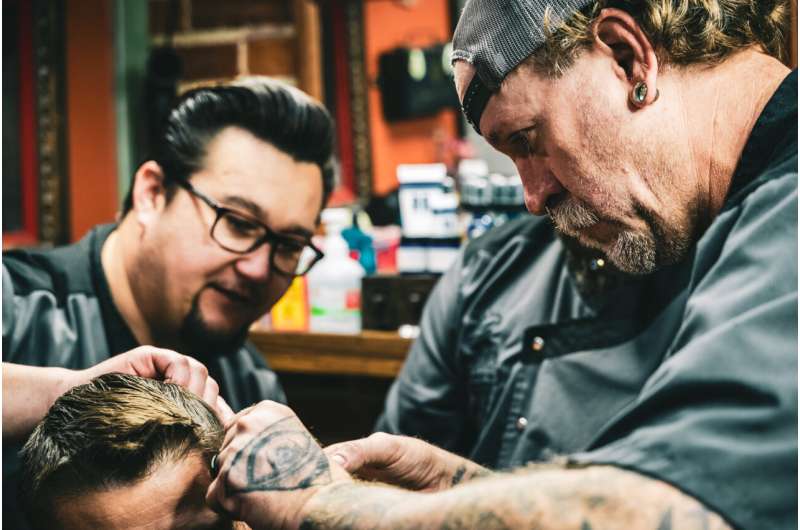
Occupational contact dermatitis is one of the most common work-related diseases in the developed world. Credit: iStock
A large number of hairdressers do not claim workers compensation for occupational contact dermatitis, according to a recent study.
Occupational contact dermatitis is one of the most common work-related diseases in the developed world and is caused by a range of workplace exposures such as frequent hand-washing or exposure to irritating or allergic substances.
Conducted by Dr Tessa Keegel from Monash University and doctors Georgina Lyons and Rosemary Nixon from the Skin and Cancer Foundation, the study compared diagnosed disease data for occupational contact dermatitis in hairdressers from 1993 to 2009 in Victoria, Australia.
The study was funded through an Institute for Safety, Compensation and Recovery Research (ISCRR) development grant.
Dr Keegel, from the Monash Department of Epidemiology and Preventive Medicine, said that over a 17 year period 157 hairdressers and hairdressing apprentices were diagnosed with occupational contact dermatitis.
"During this same time period, data from ISCRR's Compensation Research Database showed only 46 worker compensation claims for occupational contact dermatitis, less than one third of diagnosed cases," Dr Keegel said.
"Given that only a small percentage of hairdressers with this problem are referred to and attend a consultant dermatologist, the true discrepancy of claims to confirmed cases is likely to be much greater."
The study found the discrepancy between the high number of diagnosed cases and the low number of claims filed for occupational contact dermatitis is similar to findings in the United Kingdom and Denmark.
Hairdressers are particularly susceptible due to the amount of time spent with their hands in water, exposed to chemicals such as perming solutions or bleaches in hair dyes, as well as sweating caused by wearing water-proof gloves for long periods of time.
"Skin problems are high in young hairdressers suggesting that many are unaware of and ill-equipped to manage them," Dr Keegel said.
"Hairdressers may accept dermatitis as 'part of the job', be unaware of their compensation entitlements or be put off by paperwork."
Past research suggests occupational contact dermatitis is more common in women than men, however when looking across all occupations, the majority of claims are made by men.
A number of hairdressers may also be self-employed and therefore not be represented in workers' compensation statistics. Fear of job loss may also influence reporting particularly among apprentices and part-time workers.
"Increased efforts are needed to reduce the incidence of occupational contact dermatitis in hairdressers, particularly younger workers, and to ensure that hairdressers with occupational contact dermatitis are aware of their entitlements," Dr Keegel said.
Provided by
Monash University
-
Tooting your horn can raise risk for skin condition
Mar 16, 2012 |
not rated yet |
0
-
New evidence of occupational cancers: fruit and veg growers, hairdressers among those at risk
Feb 04, 2008 |
not rated yet |
0
-
Workers make fewer claims for psychological illnesses
Aug 23, 2012 |
not rated yet |
0
-
Filaggrin mutations up risk of irritant contact dermatitis
Oct 14, 2012 |
not rated yet |
0
-
Allergy treatment may cause new allergy
Dec 14, 2010 |
not rated yet |
0
-
Motion perception revisited: High Phi effect challenges established motion perception assumptions
Apr 23, 2013 |
3 / 5 (2) |
2
-
Anything you can do I can do better: Neuromolecular foundations of the superiority illusion (Update)
Apr 02, 2013 |
4.5 / 5 (11) |
5
-
The visual system as economist: Neural resource allocation in visual adaptation
Mar 30, 2013 |
5 / 5 (2) |
9
-
Separate lives: Neuronal and organismal lifespans decoupled
Mar 27, 2013 |
4.9 / 5 (8) |
0
-
Sizing things up: The evolutionary neurobiology of scale invariance
Feb 28, 2013 |
4.8 / 5 (10) |
14
-
Classical and Quantum Mechanics via Lie algebras
Apr 15, 2011
- More from Physics Forums - Independent Research
More news stories
About one in four uninsured could be excluded from ACA
(HealthDay)—More than one in four of those eligible for new premium assistance tax credits under the Affordable Care Act (ACA) do not have a checking account and will not be able to receive premiums from ...
Health
1 hour ago |
not rated yet |
0
Audiologists recommend smart phone apps to monitor noise levels
After studying noise in one French Quarter neighborhood of New Orleans to determine whether or not noise levels exceeded municipal ordinances, Annette Hurley, PhD, Assistant Professor of Audiology at LSU Health Sciences Center ...
Health
2 hours ago |
not rated yet |
0
Young children who miss well-child visits are more likely to be hospitalized
Young children who missed more than half of recommended well-child visits had up to twice the risk of hospitalization compared to children who attended most of their visits, according to a study published today in the American Jo ...
Health
2 hours ago |
not rated yet |
0
Do doctors understand the individualisation of treatments?
The individualisation of drug treatments to support patients to self-manage their conditions is a concept that sits at the heart of policy, but a recent study in BMJ Open shows that there is no concrete defini ...
Health
5 hours ago |
3 / 5 (1) |
0
Keep summer water fun safe with training and supervision
Fun in the summer often means kids spending time in the water, whether at a pool, the beach, a lake or river. A pediatric safety expert at the University of Alabama at Birmingham (UAB) stresses proper training ...
Health
5 hours ago |
not rated yet |
0
Comorbidities common with alopecia areata
(HealthDay)—Comorbid conditions often accompany alopecia areata, according to a study published online May 22 in JAMA Dermatology.
Pollen count apps for smartphones are nothing to sneeze at
Kate O'Reilly's spring allergy survival kit includes the usual stuff - nasal sprays, allergy pills and a box of tissues. This season, she's added a new weapon to her line of defense: an app on her smartphone.
Hormone levels may provide key to understanding psychological disorders in women
Women at a particular stage in their monthly menstrual cycle may be more vulnerable to some of the psychological side-effects associated with stressful experiences, according to a study from UCL.
Engineered cytomegalovirus protects monkeys from HIV equivalent
(Medical Xpress)—A new study by researchers in the US has shown that an ancient virus can be modified to help in the fight against the simian immunodeficiency virus SIV, which is the equivalent in monkeys ...
Going live: Immune cell activation in multiple sclerosis
Biological processes are generally based on events at the molecular and cellular level. To understand what happens in the course of infections, diseases or normal bodily functions, scientists would need to ...
Bulletin provides guidelines for second-trimester abortion
(HealthDay)—New evidence-based guidelines provide guidance on medical and surgical methods for second-trimester abortion and management of associated complications, according to a practice bulletin published ...
Dec 13, 2012
Rank: not rated yet
This maybe due to loyalty to their employer or not wanting to acknowledge they have a condition that affects their apperance.