Researchers identify role for protein linked to obesity, type 2 diabetes
December 17, 2012 in Medical research
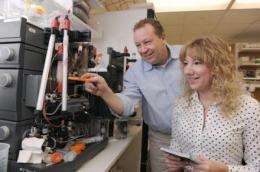
By successfully manipulating a specific protein, researchers like Drs. Phillip Scherer and Christine Kusminski have made headway in unlocking obesity's metabolic functioning and its connection to type 2 diabetes. Credit: UT Southwestern Medical Center
Researchers at UT Southwestern Medical Center have taken another step toward better understanding the metabolic functions of obesity and its connection to type 2 diabetes.
Dr. Philipp Scherer, Director of the Touchstone Center for Diabetes Research at UT Southwestern, led a group of researchers in a recent multicenter study published in Nature Medicine that successfully identified ways to manipulate the protein mitoNEET. This is the first time the protein has been effectively altered to expand fat tissue in a way that allows subjects – in this case, mice – to remain metabolically healthy.
MitoNEET is a key component of a cell's mitochondrion, which serves as the cell's energy powerhouse. When the levels of MitoNEET protein were elevated inside the fat cells of rodents, more fat was stored in the adipose tissue, thereby keeping toxic lipids away from other types of cells. This sequestration resulted in extremely obese yet metabolically healthy mice that displayed no signs of type 2 diabetes. In contrast, when MitoNEET levels were decreased, the mice became lean but unhealthy, and developed pre-diabetic conditions such as failure to metabolize glucose properly.
"The manipulation of mitochondrial activity in fat tissue is a very powerful approach to control how much excess energy we store in our bodies and where we store it. We have heretofore underestimated the importance of mitochondrial pathways in our fat cells and their influence on how we manage our weight," said Dr. Scherer, senior author of the three-year study and Professor of Internal Medicine and Cell Biology at UTSW.
The body stores fat in the white adipose tissue, and, ideally, individuals burn any excess calories through exercise and a healthy diet. The current research findings suggest that manipulating components of mitochondria in fat cells can be an effective way to funnel excess calories into "good" locations. This storage then thwarts their negative effect on other internal organs like the liver in which excess fat accumulation is toxic.
The obese mice in this study weighed 120 to 130 grams (4.23 to 4.58 ounces), whereas a normal adult mouse weighs 25 to 30 grams (.88 to 1.06 ounces). This difference is the equivalent of a 150-pound person increasing his or her weight to 700 pounds.
The researchers were careful to clarify that the findings were not meant to encourage obesity, even though the obese mice were considered metabolically healthy. The study instead provides a clearer understanding of the mitochondrion's importance to the metabolic dysfunction – that is characteristic of obese patients and those with type 2 diabetes.
"These results taught us a great deal about how fat cells sense, store, and burn energy," said Dr. Christine Kusminski, a postdoctoral researcher in Internal Medicine who served as the study's first author. "By learning more about the underlying mechanisms, we hope to develop ways to target these pathways for future drug development."
The researchers now hope to translate these findings into a clinical setting. The staff of the Touchstone Center is devoted to the study of cells and tissues that either contribute to or are affected by diabetes and related diseases, including the physiology of adipose tissue.
Journal reference:
Nature Medicine
Provided by
UT Southwestern Medical Center
-
Researchers identify protein that may explain 'healthy' obesity
Jan 29, 2009 |
not rated yet |
0
-
How and where fat is stored predicts disease risk better than weight
Apr 16, 2008 |
not rated yet |
0
-
Fat-free diet reduces liver fat in fat-free mice
Feb 03, 2009 |
not rated yet |
0
-
Enzyme action could be target for diabetes, heart disease treatments
Nov 16, 2010 |
not rated yet |
0
-
Researchers Discover Fat Gene
Jan 20, 2005 |
not rated yet |
0
-
Motion perception revisited: High Phi effect challenges established motion perception assumptions
Apr 23, 2013 |
3 / 5 (2) |
2
-
Anything you can do I can do better: Neuromolecular foundations of the superiority illusion (Update)
Apr 02, 2013 |
4.5 / 5 (11) |
5
-
The visual system as economist: Neural resource allocation in visual adaptation
Mar 30, 2013 |
5 / 5 (2) |
9
-
Separate lives: Neuronal and organismal lifespans decoupled
Mar 27, 2013 |
4.9 / 5 (8) |
0
-
Sizing things up: The evolutionary neurobiology of scale invariance
Feb 28, 2013 |
4.8 / 5 (10) |
14
-
Why is zone 1 in liver more prone to ischemic injury?
1 hour ago
-
How can there be villous adenoma in colon, if there are no villi there
21 hours ago
-
How can there be a term called "intestinal metaplasia" of stomach
May 21, 2013
-
Pressure-volume curve: Elastic Recoil Pressure don't make sense
May 18, 2013
-
If you became brain-dead, would you want them to pull the plug?
May 17, 2013
-
MRI bill question
May 15, 2013
- More from Physics Forums - Medical Sciences
More news stories
Baby's life saved with groundbreaking 3-D printed device that restored his breathing
Every day, their baby stopped breathing, his collapsed bronchus blocking the crucial flow of air to his lungs. April and Bryan Gionfriddo watched helplessly, just praying that somehow the dire predictions ...
Medical research
11 hours ago |
5 / 5 (2) |
0
Research shows how immune system peacefully co-exists with 'good' bacteria
The human gut is loaded with commensal bacteria – "good" microbes that, among other functions, help the body digest food. The gastrointestinal tract contains literally trillions of such cells, and yet the ...
Medical research
15 hours ago |
5 / 5 (3) |
0
|
Slowing the aging process—only with antibiotics
Swiss scientists reveal the mechanism responsible for aging hidden deep within mitochondria—and dramatically slow it down in worms by administering antibiotics to the young.
Medical research
15 hours ago |
4.9 / 5 (7) |
0
|
How healthy are you for your age?
On May 22, JoVE will publish details of a technique to measure the health of human genetic material in relation to a patient's age. The method is demonstrated by the laboratory of Dr. Gil Atzmon at New York's Albert Einste ...
Medical research
19 hours ago |
not rated yet |
0
A molecular explanation for age-related fertility decline in women
(Medical Xpress)—Scientists supported by the National Institutes of Health have a new theory as to why a woman's fertility declines after her mid-30s. They also suggest an approach that might help slow ...
Medical research
20 hours ago |
not rated yet |
0
|
Researchers complete largest genetic sequencing study of human disease
Researchers from Queen Mary, University of London have led the largest sequencing study of human disease to date, investigating the genetic basis of six autoimmune diseases.
Brain can be trained in compassion, study shows
Until now, little was scientifically known about the human potential to cultivate compassion—the emotional state of caring for people who are suffering in a way that motivates altruistic behavior.
Rate of bicycle-related fatalities significantly lower in states with helmet laws
Existing research shows that bicyclists who wear helmets have an 88 percent lower risk of brain injury, but researchers at Boston Children's Hospital found that simply having bicycle helmet laws in place showed a 20 percent ...
Having both migraines, depression may mean smaller brain
(HealthDay)—Migraines and depression can each cause a great deal of suffering, but new research indicates the combination of the two may be linked to something else entirely—a smaller brain.
Novel approach for influenza vaccination shows promise in early animal testing
A new approach for immunizing against influenza elicited a more potent immune response and broader protection than the currently licensed seasonal influenza vaccines when tested in mice and ferrets. The vaccine ...
Enzyme-activating antibodies revealed as marker for most severe form of rheumatoid arthritis
In a series of lab experiments designed to unravel the workings of a key enzyme widely considered a possible trigger of rheumatoid arthritis, researchers at Johns Hopkins have found that in the most severe ...