Cognitive deficits from concussions still present after two months
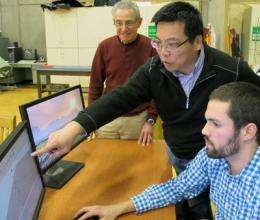
The ability to focus and switch tasks readily amid distractions was compromised for up to two months following brain concussions suffered by high school athletes, according to a study at the University of Oregon.
Research team members, in an interview, said the discovery suggests that some athletes may need longer recovery periods than current practices dictate to lower the risk of subsequent concussions. Conventional wisdom, said lead author David Howell, a graduate student in the UO Department of Human Physiology, has typical recovery at seven to 10 days.
"The differences we detected may be a matter of milliseconds between a concussed person and a control subject, but as far as brain time goes that difference for a linebacker returning to competition too soon could mean the difference between another injury or successfully preparing to safely tackle an oncoming running back," Howell said.
The findings are based on cognitive exercises used five times over the two months with a pair of sensitive computer-based measuring tools—the attentional network test and the task-switching test. The study focused on the effects of concussions to the frontal region of the brain, which is responsible for working, or short-term, memory and executive function, said Li-Shan Chou, professor of human physiology and director of the UO Motion Analysis Laboratory.
The study was published online ahead of print by Medicine & Science in Sports & Exercise, the official journal of the American College of Sports Medicine.
"If a person goes back to the playing field without a full recovery, that person is put into great danger of being re-injured," Chou said. "In any given season, if you suffer a concussion, the chances of your suffering a second one is three to six times higher and suffering a third is eight times higher. There are accumulations in this kind of injury. It doesn't go away easily."
A big unknown, the researchers said, is just how serious such injuries are for adolescents, whose brains are still developing. It could be the brain can recover more easily, or such injuries could continue to produce deficits that last a lifetime. "We just don't know," Chou said, adding that most previous studies have involved college-aged athletes and older adults.
Each year, there are 300,000 to 500,000 mild traumatic brain injury incidents, or concussions, with 100,000 tied to football, Chou said. He also cited a 2011 report from the Centers for Disease Control and Prevention that called such injuries a silent epidemic, with sports-related concussions in youths rising by 60 percent in the last decade. Another source of concussions, he added, is improvised explosive devices used in warfare.
Through an arrangement with Eugene-area schools, 20 high school athletes who had suffered a concussion—primarily football players but also others from soccer, volleyball and wrestling—were assessed within 72 hours of injury and then again one week, two weeks, a month and two months later. Each of the subjects, whose diagnosis was made by a certified athletic trainer and/or physician, was matched with a healthy control subject of the same sex, body size, age and sport.
"After two months following the concussions, these individuals were still significantly impaired in their executive function, compared to age-matched, activity-matched and gender-matched control populations," said co-author Louis Osternig, professor emeritus of human physiology and a fellow of the American College of Sports Medicine.
Osternig, also a certified athletic trainer, noted that self-reports by the subjects about how they were feeling sometimes were at odds with test results, which continued to show subtle deficits in cognitive functioning. The researchers also noted anecdotal reports from concussed athletes and their parents of declines in academic performance during the two-month period.
Additional data linking the deficits found in cognitive testing to the subjects' gait—their task-shifting abilities while walking—currently are being analyzed in the ongoing project, which is funded by the Department of Defense Telemedicine & Advanced Technology Research Center (W81XWH-11-1-0717), National Athletic Trainers Association, Veterans Administration and a translational research award from a joint UO-PeaceHealth Oregon Region collaboration program.
"By using tools from cognitive psychology, neuroscience and human physiology, this interdisciplinary team of scientists is improving our understanding of how brain trauma affects reaction time, and they are helping to create better outcomes for athletes, soldiers and others who are affected by concussions," said Kimberly Andrews Espy, vice president for research and innovation and dean of the graduate school. "UO researchers are working to improve the health and well-being of people in our local communities and throughout the world."
"The brain is the controller of our body movement," Chou said. "If you have a brain injury, are there any differences that we can pick up in the way a subject moves the body? In this lab, we are using motion analysis as a way to detect any deficiencies or abnormalities of body movement."
Chou said that his lab's goal, for now, is to disseminate the findings to the public and to talk to parents, athletic trainers and, perhaps, coaches directly to say: "These are the facts. We may not be able to draw any line on what clinically should or shouldn't be done. However, these are our observations based on our scientific testing."


