Concurrent breast augmentation / mastopexy deemed safe
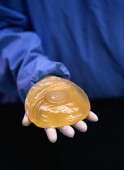
The overall complication and reoperation rate for a one-stage simultaneous breast augmentation/mastopexy procedure is about 23 percent, according to research published in the January issue of Plastic and Reconstructive Surgery.
(HealthDay)—The overall complication and reoperation rate for a one-stage simultaneous breast augmentation/mastopexy procedure is about 23 percent, according to research published in the January issue of Plastic and Reconstructive Surgery.
To examine the challenges and safety concerns associated with simultaneous breast augmentation/mastopexy, M. Bradley Calobrace, M.D., of the University of Louisville School of Medicine in Kentucky, and colleagues conducted a five-year retrospective case analysis of 430 mastopexy operations, which included 332 simultaneous augmentations/mastopexies.
The researchers found that the overall complication rate was 22.9 percent for simultaneous procedures, which most commonly included capsular contracture, poor scarring, and recurrent ptosis. Of the complications, 15.1 percent were tissue-related and 7.8 percent were implant-related. The overall reoperation rate was 23.2 percent, with 13.3 percent of these for tissue-related reasons and 9.9 percent for implant-related reasons. The tissue-related rate of reoperation was similar to the 10.2 percent reoperation rate observed in mastopexy-only procedures.
"Although a 23.2 percent reoperation rate may be considered too high for a purely cosmetic procedure, staging the operation, which is commonly posed as the alternative, does not appear to offer any advantages of safety in the majority of cases in this study," the authors write. "We acknowledge the inherent difficulty posed in a combined approach, and a potential reoperation should be part of preoperative counseling with appropriate candidates for the procedure."
One author disclosed financial ties to the pharmaceutical industry.
More information: Full Text
Journal reference:
Plastic and Reconstructive Surgery
Copyright © 2013 HealthDay. All rights reserved.
-
One in five women with breast cancer has a reoperation after breast conserving surgery
Jul 12, 2012 |
not rated yet |
0
-
Meniscal repair failure about 23 percent after five years
Jan 09, 2013 |
not rated yet |
0
-
Variation in bowel reoperation rates prompts call for better quality measures
Aug 17, 2011 |
not rated yet |
0
-
Study examines postdischarge complications after general surgery
Nov 19, 2012 |
not rated yet |
0
-
Acellular dermal matrix safe, useful in breast reconstruction
Jun 02, 2012 |
not rated yet |
0
-
Motion perception revisited: High Phi effect challenges established motion perception assumptions
Apr 23, 2013 |
3 / 5 (2) |
2
-
Anything you can do I can do better: Neuromolecular foundations of the superiority illusion (Update)
Apr 02, 2013 |
4.5 / 5 (11) |
5
-
The visual system as economist: Neural resource allocation in visual adaptation
Mar 30, 2013 |
5 / 5 (2) |
9
-
Separate lives: Neuronal and organismal lifespans decoupled
Mar 27, 2013 |
4.9 / 5 (8) |
0
-
Sizing things up: The evolutionary neurobiology of scale invariance
Feb 28, 2013 |
4.8 / 5 (10) |
14
-
Current leading voltage or vice versa concept
1 hour ago
-
Angular Frequency of AC voltage
5 hours ago
-
Modeling Rigid Body - Unsure about Euler angles and angular velocity
5 hours ago
-
Function for a bullet's path
6 hours ago
-
Elementary questions relating to Newton's laws of motion
8 hours ago
-
Magnetic Energy of Solenoid With/Without Core
8 hours ago
- More from Physics Forums - Classical Physics
More news stories
Study supports 'aggressive' treatment for posterior fossa hematoma in newborns
Posterior fossa subdural hematoma (PFSDH) is a serious and rare condition in newborns, generally occurring after difficult deliveries. But with appropriate treatment, there's an excellent chance of good long-term outcomes ...
Surgery
13 hours ago |
not rated yet |
0
More than one-third of Texas women still receive unnecessary breast biopsy surgery
Many women in Texas who are found to have an abnormality on routine mammogram or discover a lump in one of their breasts end up having an old-fashioned surgical biopsy to find out whether the breast abnormality is malignant. ...
Surgery
May 17, 2013 |
not rated yet |
0
Majority of surgical residents object to regulated hours
(HealthDay)—About 65 percent of surgical residents report that they disapprove of the 2011 Accreditation Council for Graduate Medical Education (ACGME) Common Program requirements, which place restrictions ...
Surgery
May 16, 2013 |
not rated yet |
0
Tissue damage from metal-on-metal hip implants appears before pain symptoms appear
Metal-on-metal hip implants can cause inflammation of the joint lining (synovitis) long before symptoms appear, and magnetic resonance imaging (MRI) can be used to identify this inflammation, according to ...
Surgery
May 15, 2013 |
not rated yet |
0
Robotic transplant an option for obese kidney patients
Obese patients who received robotic kidney transplants had fewer wound complications than patients who received traditional "open" transplant surgery, according to surgeons at the University of Illinois Hospital ...
Surgery
May 15, 2013 |
not rated yet |
0
Early-life traffic-related air pollution exposure linked to hyperactivity
Early-life exposure to traffic-related air pollution was significantly associated with higher hyperactivity scores at age 7, according to new research from the University of Cincinnati (UC) and Cincinnati Children's Hospital ...
New immune system discovered
(Medical Xpress)—A research team, led by Jeremy Barr, a biology post-doctoral fellow, unveils a new immune system that protects humans and animals from infection.
Resistance to last-line antibiotic makes bacteria resistant to immune system
Bacteria resistant to the antibiotic colistin are also commonly resistant to antimicrobial substances made by the human body, according to a study in mBio, the online open-access journal of the American Society for Microb ...
The compound in the Mediterranean diet that makes cancer cells 'mortal'
New research suggests that a compound abundant in the Mediterranean diet takes away cancer cells' "superpower" to escape death. By altering a very specific step in gene regulation, this compound essentially re-educates cancer ...
Scientists identify molecular trigger for Alzheimer's disease
Researchers have pinpointed a catalytic trigger for the onset of Alzheimer's disease – when the fundamental structure of a protein molecule changes to cause a chain reaction that leads to the death of neurons ...
Do salamanders hold the solution to regeneration?
Salamanders' immune systems are key to their remarkable ability to regrow limbs, and could also underpin their ability to regenerate spinal cords, brain tissue and even parts of their hearts, scientists have ...
Jan 14, 2013
Rank: not rated yet
Dr Rhys Branman
Little Rock Cosmetic Surgery Center