Expert warning: Resistance to antibiotics to be apocalyptic
January 25, 2013 by Lin Edwards in Diseases, Conditions, Syndromes report

antibiotics

Enlarge

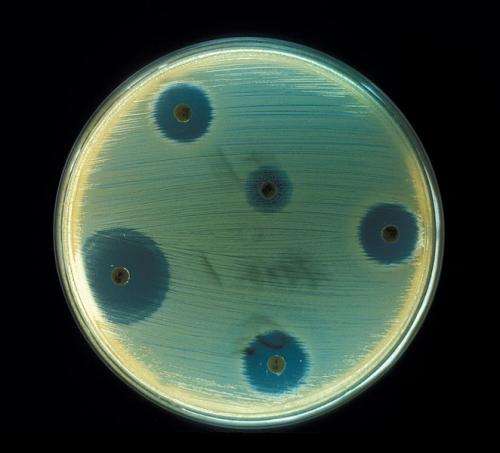
Staphylococcus aureus - Antibiotics Test plate. Credit: CDC

(Medical Xpress)—The chief medical officer for Britain's Department of Health has issued a warning that resistance to bacteria is a more urgent threat to humanity than global warming, with bacteria becoming resistant to current antibiotics at an alarming rate, and there are almost no new antibiotics in the pipeline.

Professor Dame Sally Davies spoke to British members of parliament on a science and technology committee and told them the increasing resistance of bacteria could soon make even a routine operation a deadly option because of the possibility of an infection that would have no effective treatment. She said that the real "apocalyptic scenario" was that within a couple of decades people will die from infections because we will have "run out of antibiotics" and there are no wonder drugs in the pipeline. She added that it is a serious global problem and antibiotics are not being used effectively.

The development of antibiotics in the 1940s was one of the greatest advances in medicine, but they are becoming increasingly ineffective as bacteria become resistant to them. Prof. Davies said there is only one effective antibiotic left for and 80% of cases are resistant to tetracycline. Tuberculosis is becoming increasingly resistant and there are around 150,000 deaths globally from multi-antibiotic each year. Staphylococcal and are now resistant to penicillin, and MRSA (methicillin-resistant staphylococcus aureus) is increasingly prevalent, especially in .

Prof. Davies said there is "a broken market model" for the development of new antibiotics, which means there could be no new antibiotics in the future. The pharmaceutical industry is concentrating its efforts on more profitable treatments such as drugs for , which has led to a reduction in research aiming to find or develop .

The has also warned of a coming post-antibiotic era in which common ailments cured by antibiotics will once again be fatal. Director-General Margaret Chan said a post-antibiotic era would mean even a common scratch or a strep throat could again lead to uncurable infections and death.

In March, Prof. Davies will be releasing her annual report, which will include strategies to solve this global problem. She said it was a serious issue that needs to be tackled urgently, and will be asking the Cabinet Office to add it to the national risk register. She also urged doctors to be more cautious about how they prescribe antibiotics and patients to be more responsible in taking them (by taking the entire course when antibiotics are prescribed).

© 2013 Medical Xpress

4.9 /5 (36 votes)  

Filter


Move the slider to adjust rank threshold, so that you can hide some of the comments.


Display comments: newest first

triplehelix
Jan 25, 2013

Rank: 2.5 / 5 (11)
Excellent article, outlining the exact case as we see it. I was quite shocked only a few years ago at University when my lecturer stated in the UK people are beginning to die from consumption with TB, or organ failure from being pumped full of antibiotics and sulphas etc.

"The chief medical officer for Britain's Department of Health has issued a warning that resistance to bacteria is a more urgent threat to humanity than global warming"

Whole-heartedly agree, the issue however, is that the GW bunch will be rubbing their hands with glee at this article, because a sudden severe drop in population as this article accurately describes is exactly what they want. Less people = less pollution.

I once went to my dentist with puss oozing out my mouth and my entire jaw was swollen and was refused antibiotics. I just went to my Doctor, said I had a cold, and got a bucketload of them. It is ridiculous what our health care system is doing. Almost as if it is purposeful
scienceguided
Jan 25, 2013

Rank: 5 / 5 (2)
Perhaps a way to look at the problem is to consider that the so-called 'bad' bacteria is resisting being attacked for good reason. Good in the sense that it can be pursuaded in a better way than by attacking its life; so as to attack the person with better (preventative) lifestyle changes. Money then becomes less relevant, because our species has lost or is losing to the survival instincts of bacteria. Give bacteria a better option than causing illness and possible death to humans. Start working to eat vegetables and fruit and feed the hungry is an option.
Birger
Jan 25, 2013

Rank: 4.5 / 5 (10)
The resistance to antibiotics is only partly driven by hospitals and doctors.
A huge part is the fault of agribussiness that is keeping livestock and poultry in crowded, appalling conditions that can only be sustained by giving antibiotics in the feed.
The inevitable effect is turning animal husbandry into huge factories for churning out antibiotic-resistant bacteria.
This problem has already been recognised in Europe, but in USA the immense lobbying power of agribussines is blocking any attempts at remedies.
NikFromNYC
Jan 25, 2013

Rank: 2.1 / 5 (8)
Synthetic organic chemists are suffering a terrible job market as billions of dollars are pumped into green energy boondoggles supported by the biggest scientific fraud in human history. Creating and testing new classes of antibiotics is trivial nowadays compared to the past since flash chromatography, computerized literature databases, combinatorial chemistry and and a century worth of new catalysts are available. The deaths of millions, possibly billions might be avoided if the media started doing their job.
dogbert
Jan 25, 2013

Rank: 3.9 / 5 (8)
Yet we continue to:

* Give antibiotics to healthy livestock in order to get faster growth -- creating resistant bacteria.

* Give multiple front line antibiotics to Immunosuppressed individuals who cannot fight off their infections but who can serve as perfect growth media for the production of multiply resistant organisms.

We have created TB which is resistant to all known TB antibiotics.
We have created staph, strep and c diff which are resistant to most or all antibiotics.

We are knowingly creating these super bugs.

We can stop doing it.

We won't stop doing it.
DavidW
Jan 25, 2013

Rank: 2 / 5 (7)
The resistance to antibiotics is only partly driven by hospitals and doctors.
A huge part is the fault of agribussiness that is keeping livestock and poultry in crowded, appalling conditions that can only be sustained by giving antibiotics in the feed.
The inevitable effect is turning animal husbandry into huge factories for churning out antibiotic-resistant bacteria.
This problem has already been recognised in Europe, but in USA the immense lobbying power of agribussines is blocking any attempts at remedies.


The punishing result of needlessly enslaving and killing other sentient life. I've been telling people to stop killing for many years now.

Eventually, the needless animal slaughter will stop. Which side of the greatest holocaust in history are we each going to be on?
Tom_Hennessy
Jan 27, 2013

Rank: 5 / 5 (2)
The government has been told by the World Health Organisation to put the metal iron into all of our foods and this foolhardy advice has led to a population unable to fight off infections , because , infections require iron to take and proliferate in the body.
"Iron is critical for the growth of bacteria and for their ability to form biofilms, slime-encased colonies of microbes that cause many chronic infections."
"The adverse effect of iron repletion on the course of certain infections."
"Host defence against these infections was better during iron deficiency than during iron repletion."
"The addition of a variety of non-chelated forms of iron to milled grains and cereals may be the most serious mistake in the history of human nutrition"

igorus
Jan 28, 2013

Rank: 1 / 5 (2)
A bit harsh, but world population needs to decrease anyway. So I will root for the bacteria.
mrlewish
Jan 28, 2013

Rank: 5 / 5 (2)
A bit harsh, but world population needs to decrease anyway. So I will root for the bacteria.


Okay lets start with you. Next time you get some sort of infection please refuse antibiotics.
igorus
Jan 29, 2013

Rank: not rated yet
Okay lets start with you. Next time you get some sort of infection please refuse antibiotics.


Sarcasm is difficult on the internet, so that's my fault.

Thankfully I haven't taken antibiotics for over 15 years now.

But I guess antibiotics resistance could be some kind of nature's way to balance out over-population. On the other hand, isn't there a lot of progress being made with nanotechnology drugs, so perhaps this won't turn out that bad as this paper predicts.
_urtis_ohn_
Jan 29, 2013

Rank: 1 / 5 (2)
Some of these comments about the way antibiotics are used in livestock are pure ignorance. Ranchers are very diligent when it comes to the use of such drugs. If you don't know, first-hand, about the subject, you shouldn't comment on it. The ones that make such ignorant comments are the same as the Global Warming crowd. The problem with mishandling of drugs is in human care. Many Doctors do a poor job educating their patients or caregivers, in the hazards of improper use of the drugs.

There are some very good comments; like the one by Tom Hennessy, on iron. I'm glad some people get it!
                                                                       
Polymath137
Jan 29, 2013

Rank: not rated yet
The public "sanitary" sewers provide a great place for bacteria to acquire resistance by exposure to diluted antibiotics which have been flushed or simply excreted from patients. Partial resistance to outright poisons including bleach & caustics may be acquired. Bacteria acquire resistance when stressed, both directly and via plasmid exchange with other bacteria -- even other species of bacteria -- which have previously acquired resistance. In the sewers, all are mingled at random and exposed to various stressors, which promotes plasmid exchange. Then at the sewage treatment plant the waste of whole cities is mixed & de-watered (increasing concentration of toxins & antibiotics), then air is blown through the foul broth, which can launch live microbes into the air. As if all that were not bad enough, the sewers receive our hormones natural & synthetic and insecticides, which all end up passing through the treatments plants into rivers, thus sickening amphibians, fish, everybody. End it!
Tom_Hennessy
Jan 30, 2013

Rank: not rated yet
Meat eaters defecating in our water supply , is the reason.
Meat eaters have higher levels of body iron.
"Iron from animal sources tends to accumulate"
"Plant irons are most beneficial to the body because their absorption remains safely regulated"
Because of this higher level of iron , meat eaters acquire and harbour virus' , bacteria , parasites , fungus' , which they pass around by touching you , touching surfaces , coughing and so on. They have to use drugs to control the parasites , bacteria , virus', fungus' , which they excrete into our water supply alongside their parasites , virus' , bacteria and fungus'.
"Iron could, in addition to inducing pathogenic overgrowth, also increase the virulence of prevalent enteric pathogens"
The key word there is 'pathogen'. Iron encourages pathogens.
"Pathogens increase growth rate by up to 8,000 times when exposed to increased levels of iron."
WizzKid
Jan 30, 2013

Rank: 5 / 5 (1)
Preventative medicine is the future. Enough said. But I believe scientists should focus more on solving problems concerning our primitive "economic" based society where profit is considered before the the progress of humanity. This disfunction is the cause of most diseases on this planet.
amayerson
Jan 30, 2013

Rank: not rated yet
Meat eaters defecating in our water supply , is the reason.
Meat eaters have higher levels of body iron.
"Iron from animal sources tends to accumulate"
"Plant irons are most beneficial to the body because their absorption remains safely regulated"
Because of this higher level of iron , meat eaters acquire and harbour virus' , bacteria , parasites , fungus' , which they pass around by touching you , touching surfaces , coughing and so on.

Tom, a few questions for you.

1. What makes 'plant iron' different from 'animal iron'?

2. How do these differences between 'plant iron' and 'animal iron' make a difference in terms of bacterial,algial, etc growth?

No offense but your commentary sounds a little tin-foil hattish.
kochevnik
Jan 30, 2013

Rank: 5 / 5 (1)
Mixing antibiotics in feed is normal practice. Anything that adds pounds to a carcass will be tried by ranchers, and it is proven that feeding antibiotics increases growth. So long as their is a net profit ranchers will continue feeding antibiotics to the point of diminishing returns on cost. Profit, not health, is the consideration. Anyone questioning or investigating feedstock operations can be arrested as a terrorist. Look it up

Second, iron is essential to prevent anemia. The kooks are out in force today

Third, it is more profitable to string patients along an extended death spiral than to cure them of illness. Ryandian big pharma will likely kill billions with decades between research and development, even if conservatives were weeded out of healthcare tomorrow
Tom_Hennessy
Jan 30, 2013

Rank: not rated yet
1. What makes 'plant iron' different from 'animal iron'?

2. How do these differences between 'plant iron' and 'animal iron' make a difference in terms of bacterial,algial, etc growth?

No offense but your commentary sounds a little tin-foil hattish.


'Meat factor' is what they call the way in which iron from meat is absorbed all the time and causes other iron , nonheme iron , too to be absorbed.
"Enhancing effect of fish on nonheme iron uptake"
"Specific carbohydrates contribute to the enhancing effect of meat on iron uptake "
They are not quite sure why meat iron absorption is not controlled as well as the iron from vegetables and other plants.
"Absorption of Nonheme, But Not Heme Iron, Is Substantially Reduced with High Iron Stores"
This leads to high iron , oxidation , oxidative stress , rust and this iron feeds virus' , bacteria , fungus' , parasites and is presently being targeted in cancer.
Tom_Hennessy
Jan 31, 2013

Rank: not rated yet
Quote: How do these differences between 'plant iron' and 'animal iron' make a difference in terms of bacterial,algial, etc growth?

Answer: The difference lies in the absorption RATE of the iron , meat iron / heme iron is absorbed all the time and this leads to higher iron levels and susceptibility to catch disease.
"Decreased Susceptibility to Plasmodium falciparum Infection in Pregnant Women with Iron Deficiency"
SURFIN85
Jan 31, 2013

Rank: 5 / 5 (1)
The truly massive quantities of antibiotics fed to feedlot animals (over the years, certainly many orders of magnitude more antibiotics than fed to the entire global human population) is the prime suspect of microbiologists studying the problem of the evolution of antibiotic-resistant bacterial strains.

I can't help but think that the government's silence, big business complicity, and ongoing practice add up to criminal conspiracy.
amayerson
Jan 31, 2013

Rank: not rated yet
'Meat factor' is what they call the way in which iron from meat is absorbed all the time and causes other iron , nonheme iron , too to be absorbed.
Not really. The 'meat factor' is the hypothesized increased uptake of iron from meat as it is more bioavailable due to the presence of assisting binding proteins from the meat. Those binding proteins, if not already bound will pick up non-bound iron.
"Enhancing effect of fish on nonheme iron uptake"
"Specific carbohydrates contribute to the enhancing effect of meat on iron uptake "
As they contain agents that assist in the uptake of iron.
They are not quite sure why meat iron absorption is not controlled as well as the iron from vegetables and other plants.
Yeah and here's why that sounds tinfoil hattish. You have it backwards. If your body doesn't absorb the iron, it passes through you and winds up in your excretia. If you can absorb it readily (like the iron in meat) then less iron passes into the water table.
Tom_Hennessy
Jan 31, 2013

Rank: not rated yet
Yeah and here's why that sounds tinfoil hattish. You have it backwards. If your body doesn't absorb the iron, it passes through you and winds up in your excretia. If you can absorb it readily (like the iron in meat) then less iron passes into the water


The iron which you excrete isn't a problem , the iron which is absorbed is the problem or not. Normally , as shown , the non heme iron is downregulated when it is not required , but , the meat iron / heme iron is STILL absorbed / "not substantially reduced" , and since the body has no effective method to excrete it once it IS absorbed it causes iron to build progressively higher and higher , age related iron accumulation , increasing susceptibility to harbouring virus' , parasites , fungus' , bacteria.
rkolter
Jan 31, 2013

Rank: 5 / 5 (1)
@Tom Hennessy: The body can excrete iron. Eating meat may prevent you from having an iron deficency, but eating meat does not cause a reliable "progressively higher and higher" build-up of iron in your body that can not be excreted.

What you are describing is a disease process that would affect people who ate meat, or at least red meat. That would mean that meat-eating countries like the USA would have an endemic level of hemochromatosis. This is simply not the case.

I am a good example. I eat quite a bit of meat - certainly more than my ancestors would have gotten to eat. I had my blood tested two weeks ago, my hemoglobin and hematocrit were on the low side of normal.

The evidence does not support your claims. It's up to you what you do with that information. Deal with it, or get a new tinfoil hat.
Tom_Hennessy
Jan 31, 2013

Rank: not rated yet
@Tom Hennessy: The body can excrete iron.


"There are no natural means for the body to eliminate iron"
http://grants.nih...013.html

phi-stee
Feb 01, 2013

Rank: 3 / 5 (2)
It won't matter in two decades anyway, we'll be well on our way to the singularity
monger
Feb 01, 2013

Rank: 5 / 5 (1)
Granted, antibiotic resistant diseases are a problem, but it's an incredible stretch to say that this is apocalyptic. Even if we had no antibiotics to treat Tb, at worst we would go back to what it was like 100 years ago. But we would likely still have all sorts of treatments and the general health and nutrition of people now is much higher than back then.

On the scale of all the problems facing humanity, I'd put this in the bottom 10%. Something to keep an eye on and try to avoid, definitely. But definitely not the end of the world.
rkolter
Feb 01, 2013

Rank: not rated yet
Me:
@Tom Hennessy: The body can excrete iron.

@Tom Hennessy:
"There are no natural means for the body to eliminate iron"
http://grants.nih...013.html

Did you read the document you quoted, or did you just assume that I wouldn't?

The linked document talks about people suffering from Cooley's Anemia. They don't produce hemoglobin. They require regular transfusions. They also have no natural means to eliminate iron, and so it builds up to toxic levels in their bodies unless they take agents to cleanse their bodies of excess iron.

Curiously, this document specifically says that people who build up iron like this, with no natural means to eliminate it, will DIE within two decades. Your argument that humans cannot excrete iron suggests humanity went extinct shortly after becoming human tens to hundreds of thousands of years ago. The existance of humans is fairly conclusive evidence that you are wrong.
axemaster
Feb 01, 2013

Rank: not rated yet
Whole-heartedly agree, the issue however, is that the GW bunch will be rubbing their hands with glee at this article, because a sudden severe drop in population as this article accurately describes is exactly what they want. Less people = less pollution.

What a horrible thing to say.
Tom_Hennessy
Feb 01, 2013

Rank: not rated yet
Your argument that humans cannot excrete iron suggests humanity went extinct shortly after becoming human tens to hundreds of thousands of years ago.


It is well known , iron , cannot be excreted once it is absorbed .

"The inability to excrete iron is the primary problem — we can excrete only around 1.2 mg per day no matter how much we absorb"
http://www.ohsawa...view.pdf
antonima
Feb 01, 2013

Rank: not rated yet
Alarmist claptrap. There are so many antibiotics in the world it is pointless to try and develop any more. There are literally thousands of antibiotics known to man and many, many more to be found in nature.
Tom_Hennessy
Feb 01, 2013

Rank: not rated yet
Alarmist claptrap. There are so many antibiotics in the world it is pointless to try and develop any more. There are literally thousands of antibiotics known to man and many, many more to be found in nature.


True , but , what IF , by mistake , humans ARTIFICIALLY 'added something to the mix' , and that ONE thing , NOW CAUSES sooo many different diseases it becomes sooo obvious what is happening that one NOW realises the EXTENT of INVOLVEMENT of this discovery. Sort of a 'human model of disease' ? If one wishes to discover what happens in a disease state one simply creates an animal model of that disease. In humans it has been the addition of the metal iron to our foods and its resulting effect. The resulting effect being , the meat as evidenced , the fish causes OTHER iron to be absorbed and so a breaded fish steak is going to cause all that iron added to the bread to be absorbed at a high rate.
Tom_Hennessy
Feb 01, 2013

Rank: not rated yet
what IF , by mistake , humans ARTIFICIALLY 'added something to the mix' ? a breaded fish steak is going to cause all that iron added to the bread to be absorbed at a high rate.


"Iron as yet another novel determinant of multidrug resistance"
http://www.ncbi.n...1635214/
axemaster
Feb 02, 2013

Rank: not rated yet
Alarmist claptrap. There are so many antibiotics in the world it is pointless to try and develop any more. There are literally thousands of antibiotics known to man and many, many more to be found in nature.

Why then are we fast running out? Why is the medical establishment panicking? And don't say it's to make more money, because it isn't. Antibiotics are not the most profitable thing out there, which is why there isn't enough research into developing new ones.
antonima
Feb 03, 2013

Rank: not rated yet

True , but , what IF , by mistake , humans ARTIFICIALLY 'added something to the mix' , and that ONE thing , NOW CAUSES sooo many different diseases it becomes sooo obvious what is happening that one NOW realises the EXTENT of INVOLVEMENT of this discovery.


So you are saying that a surplus of iron in our diets is making some microbes especially virulent? That isn't impossible, although I would think the human body has a way of regulating the amount of iron in the bloodstream and the organs. Iron in itself is quite poisonous and only a little rusty water can make a person very ill.
antonima
Feb 03, 2013

Rank: not rated yet
"Why then are we fast running out? Why is the medical establishment panicking? And don't say it's to make more money, because it isn't. Antibiotics are not the most profitable thing out there, which is why there isn't enough research into developing new ones."


Why are you certain that it isn't to secure more funding for research in the biosciences? The chief medical officer of Britain's Department of Health is a political figure and is just as likely as other politicians to try to secure funding for their state/city/agency. By scaring the gov into thinking superbugs are a real threat more money will be spent on biosciences projects.
Tom_Hennessy
Feb 03, 2013

Rank: not rated yet
So you are saying that a surplus of iron in our diets is making some microbes especially virulent?


Yes.
"Treating anemic tuberculosis patients with iron salts exacerbated the disease"

That isn't impossible, although I would think the human body has a way of regulating the amount of iron in the bloodstream and the organs.


Humans do have a method to TRY to limit iron to the pathogen , anemia of chronic disease , iron withholding mechanism.
The body attempts to sequester , store away available iron , attempting to keep it from the invader. The body will upregulate hepcidin , which attempts to stop the absorption of iron.
Tom_Hennessy
Feb 03, 2013

Rank: not rated yet
By scaring the gov into thinking superbugs are a real threat more money will be spent on biosciences projects.


Canadians are reporting the same antibiotic resistance though , so are the Russians. The antibiotics we use now work with iron, either removing it from the pathogen or causing the iron to oxidise , thereby destroying the pathogen. An example of the two methods being , malaria , Quinine binds iron , Artemesian causes an increase in iron oxidation , two different methods but both shown to work.
The artificial addition of the metal iron to our foods has now raised the iron levels in the population to the point iron binding drugs such as ciprofloxacin no longer are able to remove ENOUGH iron to make a difference.
"Ciprofloxacin-induced tissue iron depletion"
rkolter
Feb 04, 2013

Rank: not rated yet
@Tom -
The excretion of iron, which DOES occur (contrary to your prior statements), does NOT lead to "progressively higher levels" of Iron in the body (contrary to your prior statements).

Let me fix this one too - the amount that we do excrete, while small, is sufficient to ensure that the majority of people do not have high levels of iron in their bodies.

Again, you have to go with the evidence... high iron is not endemic.
Tom_Hennessy
Feb 04, 2013

Rank: not rated yet
the amount that we do excrete, while small, is sufficient to ensure that the majority of people do not have high levels of iron in their bodies.
Again, you have to go with the evidence... high iron is not endemic.


"It is well accepted that iron accumulates"
rkolter
Feb 05, 2013

Rank: not rated yet
the amount that we do excrete, while small, is sufficient to ensure that the majority of people do not have high levels of iron in their bodies.
Again, you have to go with the evidence... high iron is not endemic.


"It is well accepted that iron accumulates"


"There is no logical arguement that will sway someone who does not accept logic as a basis for an arguement."

... so I guess you win.
Tom_Hennessy
Feb 05, 2013

Rank: not rated yet
[
"There is no logical arguement that will sway someone who does not accept logic as a basis for an arguement."

... so I guess you win.


Yes , actually , I do 'win' due to cites which you fail to use a'tall , and the evidence , rates of disease which YOU seem to be unable to explain , 'logically'. Do you know what the word logic means ? It means using all available evidence , evidence , of which you used .. no evidence whatsoever other than your 'opinion' which seem to go contrary to all available scientific evidence , quoted , by the way.
So , in the big scheme of things , it isn't ME who 'wins' but all those people who are ill due to their ciprofloxacin not working any longer and so it doesn't treat their urinary bladder infection or plague.
Rank 4.9 /5 (36 votes)
Relevant PhysicsForums posts

More news stories

FDA warns of infections tied to Tennessee pharmacy

(AP)—Government health officials are investigating several health problems reported with potentially contaminated medications made by a Tennessee specialty pharmacy.

Diseases, Conditions, Syndromes created 3 hours ago | popularity not rated yet | comments 0

Comorbidities common with alopecia areata

(HealthDay)—Comorbid conditions often accompany alopecia areata, according to a study published online May 22 in JAMA Dermatology.

Diseases, Conditions, Syndromes created 4 hours ago | popularity not rated yet | comments 0

Top-ranked golfer beats scoliosis

(HealthDay)—As a world-class golfer, Stacy Lewis' accomplishments are remarkable. But it was a physical challenge in her childhood that defined her ascent to the top of her sport.

Diseases, Conditions, Syndromes created 4 hours ago | popularity not rated yet | comments 0

Saudi to send animal samples to US in coronavirus probe (Update)

Saudi Arabia said Friday it would send samples taken from animals possibly infected with a deadly SARS-like virus to the United States for testing in a bid to find the source of disease.

Diseases, Conditions, Syndromes created 7 hours ago | popularity not rated yet | comments 0

WHO voices deep concern over spread of SARS-like virus

The World Health Organization voiced deep concern Thursday over the SARS-like virus that has killed 22 people in less than a year, saying it might potentially spread more widely between humans.

Diseases, Conditions, Syndromes created 11 hours ago | popularity 5 / 5 (1) | comments 0


Engineered cytomegalovirus protects monkeys from HIV equivalent

(Medical Xpress)—A new study by researchers in the US has shown that an ancient virus can be modified to help in the fight against the simian immunodeficiency virus SIV, which is the equivalent in monkeys ...

Hormone levels may provide key to understanding psychological disorders in women

Women at a particular stage in their monthly menstrual cycle may be more vulnerable to some of the psychological side-effects associated with stressful experiences, according to a study from UCL.

Going live: Immune cell activation in multiple sclerosis

Biological processes are generally based on events at the molecular and cellular level. To understand what happens in the course of infections, diseases or normal bodily functions, scientists would need to ...

Researchers identify first drug targets in childhood genetic tumor disorder

Two mutations central to the development of infantile myofibromatosis (IM)—a disorder characterized by multiple tumors involving the skin, bone, and soft tissue—may provide new therapeutic targets, according to researchers ...

Driving and hands-free talking lead to spike in errors, study shows

Talking on a hands-free device while behind the wheel can lead to a sharp increase in errors that could imperil other drivers on the road, according to new research from the University of Alberta.

Depression raises diabetics' risk of severe low blood sugar episodes

(Medical Xpress)—Patients with diabetes who are depressed are much more likely to develop episodes of dangerously low blood sugars, or hypoglycemia, than are those who are not depressed, a new study has ...