Fecal 'transplant' to cure gut infection?
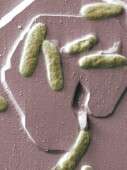
(HealthDay)—Here's a new twist on the old idea of not letting anything go to waste. According to a small new Dutch study, human stool—which contains billions of useful bacteria—can be donated from one person to another to cure a severe, common and recurrent bacterial infection.
People who have the infection, called Clostridium difficile (or C. difficile), experience long bouts of severe diarrhea, abdominal pain, nausea and vomiting. For many, antibiotics are ineffective. To make matters worse, taking antibiotics for months and months wipes out a large percentage of bacteria that would normally be helpful in fighting the infection.
"Clostridium difficile only grows when normal bacteria are absent," explained study author Dr. Josbert Keller, a gastroenterologist at Hagaziekenhuis Hospital, in The Hague.
The stool from a donor, mixed with a salt solution called saline, can be instilled into the sick person's intestinal system, almost like parachuting a team of commandos into enemy territory. The healthy person's abundant and diverse gut bacteria go to work within days, wiping out the stubborn C. difficile that the antibiotics have failed to kill, according to the study.
"Everybody makes jokes about this, but for the patients it really makes a big difference," Keller said. "People are desperate."
The research, published Jan. 16 in the New England Journal of Medicine, showed that the infusion of donor stool was significantly more effective in treating recurrent C. difficile infection than was vancomycin, an antibiotic. Of the 16 study participants, 13 (81 percent) of the patients had resolution of their infection after just one infusion of stool and two others were cured with a follow-up treatment.
The approach is not new, but this research is the first controlled trial ever done, according to Dr. Ciaran Kelly, a professor of medicine at Harvard Medical School and the author of an editorial accompanying the research. Previous reports have been simple case studies, which are considered less conclusive.
C. difficile is the most commonly identified cause of hospital-acquired infectious diarrhea in the United States, according to Kelly.
The process of giving and receiving a stool donation is relatively simple. Study author Keller said participants typically asked family members to donate part of a bowel movement, thinking it would be more comfortable to receive such a donation of such a substance from someone they knew. Some anonymous donors were also involved.
Keller explained that donors can be of any age, and do not need to be related to the recipient. Donor stool does need to be free of any infectious diseases and parasites, and the donor's blood must also be screened.
The stool mixture, which was described by Keller as looking something like chocolate milk, can be given into the intestinal tract in three different ways. It can be given by colonoscopy, through a nasal-duodenal tube that is threaded out of the stomach into the upper duodenum, or by enema. Kelly said the procedure is currently done at about 50 centers now in the United States, typically using the colonoscopy method.
In the study, conducted at the Academic Medical Center in Amsterdam, investigators randomly assigned the patients to three groups and compared the infusion of donor stool after vancomycin therapy and bowel cleansing (lavage) with either just vancomycin therapy or with just bowel lavage.
So why has "fecal transplantation," as some people call it, not taken off? Before this study was published, there was a lack of data from randomized, controlled trials to prove it works, Kelly said. Also holding the procedure back, he added, was that the very idea of taking someone's stool into your body was unappealing, and the fact that steps in the process—such as finding and screening donors, and processing the stool —can be logistically difficult to execute.
What will it cost to be a stool recipient? Editorialist Keller said that for the patients who suffer from C. difficile, "it doesn't matter how much it costs because the cost of hospitalization and the pain and discomfort" are so significant.
But Keller estimates that the procedure would cost more than the average colonoscopy because the physician must be involved in donor selection and counseling. "The procedure takes about one-and-a-half to two hours, but I schedule only 30 minutes for a colonoscopy," he explained.
For those for whom the whole idea of stool donation remains difficult to embrace, Keller sums it up: "It's the most powerful probiotic you can imagine, introducing healthy flora [into an unhealthy environment]."
The research may offer promising solutions to a wide range of gastrointestinal problems. "This study suggests an exciting new branch of human therapeutics, called microbiome research, which may help treat people with inflammatory bowel disease, metabolic disorders like obesity and irritable bowel syndrome," Kelly said.
More information: Learn more about C. difficile intestinal infections from the U.S. National Library of Medicine.
Copyright © 2013 HealthDay. All rights reserved.


