Fighting a global menace: Cancer's impact in poorer nations
January 31, 2013 by Alvin Powell in Cancer
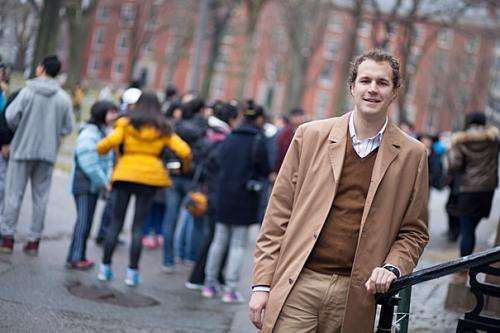
“There is a lot of difference between what happens in low-income countries and what happens in high-income countries,” said Harvard School of Public Health student Sebastián Rodríguez Llamazares, who worked with 19 other HSPH students and Professor Felicia Knaul to plan an event on Friday marking World Cancer Day. Credit: Rose Lincoln/Harvard Staff Photographer
If the focus on cancer sometimes tilts toward its impact in rich, industrialized nations, statistics show that the disease is a scourge all around the world, with 95 percent of cancer deaths occurring in developing countries.
Children in poor countries aren't spared. An estimated 90 percent of children with cancer die in the world's 25 poorest countries, compared with just 12 percent in a wealthy country such as Canada, according to statistics from the Global Task Force on Expanded Access to Cancer Care and Control in Developing Countries.
That glaring disparity has mobilized a group of Harvard School of Public Health (HSPS) students. The students, together with the HSPH student government, the student group Students in Latino Public Health, and the Harvard Global Equity Initiative, have put together a half-day event to raise awareness and dispel myths about cancer as a global health issue. The event, scheduled for Friday at the School of Public Health's Kresge Building, marks World Cancer Day on Monday. As part of their commitment, students are also gathering signatures for the World Cancer Declaration by the Union for International Cancer Control, which contains a list of 11 cancer-related health priorities.
"There is a lot of difference between what happens in low-income countries and what happens in high-income countries," said HSPH student Sebastián Rodríguez Llamazares.
Rodriguez said the effort calls attention to the fact that cancer is a serious problem in poor nations and that steps to prevent or treat it—routine in richer countries—should be part of the global health agenda.
Associate Professor of Medicine Felicia Knaul, who heads the Harvard Global Equity Initiative, which supports student World Cancer Day efforts, said there are few cancers whose outcomes are similar in both developed and developing countries. Pancreatic cancer is one, because it's equally deadly everywhere.
"For every other cancer that can be treated, the outcomes are very different," said Knaul, a breast cancer survivor.
There are several reasons for the disparity. People in poor countries seldom hear messages about lifestyle changes—don't smoke, eat a healthy diet, exercise—that have been shown to prevent cancer. Similarly, a vaccine that can prevent one cancer fatal to women, cervical cancer, is not widely distributed. As a result, 90 percent of cervical cancer cases are found in developing countries, Knaul said.
"It has very much become a cancer of poor women and a cancer for which poor women die," she said.
Disparities in mortality extend to highly treatable cancers, such as acute lymphoblastic leukemia, fatal to just 10 percent of patients in wealthy countries but deadly 90 percent of the time in poor countries.
Knaul said there are several myths about global cancer that need to be exploded, including that there's nothing that can be done, that tackling the problem would cost too much, and that bigger health issues plague the developing world. All are false, she said, adding that institutions like HSPH are key to gathering affordable, innovative solutions from around the world that can be used toward new strategies to meet the challenge.
Students are a big part of the solution, Knaul said, because they'll be designing the health solutions of tomorrow. In addition to organizing Friday's event, students who have been touched by cancer planned to participate and share their stories of surviving or supporting a family member's struggles with the disease.
Toni Kuguru, one of the student organizers, became interested in the subject when her husband, David, became ill with multiple myeloma. He was treated in the United States and is currently in remission, but the episode got Toni Kuguru thinking about the health care system in his native Kenya, where the outcome could have been different.
Kuguru said she hopes that more students will get involved after hearing about the problem and the personal testimony of those touched by cancer.
"What we're hoping for the student body is that they'll be inspired. We're hoping students understand there's lots of possibilities out there to become involved," Kuguru said.
Provided by
Harvard University
This story is published courtesy of the Harvard Gazette, Harvard University's official newspaper. For additional university news, visit Harvard.edu.
-
Affordable cancer treatments available
Oct 31, 2011 |
not rated yet |
0
-
Poor countries see troubling rise in breast cancer
Nov 02, 2009 |
not rated yet |
0
-
Lifestyle changes can help prevent 30% of cancers: WHO
Feb 03, 2012 |
not rated yet |
0
-
Global health leaders advocate for expanding cancer care in developing countries
Aug 16, 2010 |
not rated yet |
0
-
Only 1 in 5 women in developing world receive effective cervical cancer screening
Jun 17, 2008 |
not rated yet |
0
-
Motion perception revisited: High Phi effect challenges established motion perception assumptions
Apr 23, 2013 |
3 / 5 (2) |
2
-
Anything you can do I can do better: Neuromolecular foundations of the superiority illusion (Update)
Apr 02, 2013 |
4.5 / 5 (11) |
5
-
The visual system as economist: Neural resource allocation in visual adaptation
Mar 30, 2013 |
5 / 5 (2) |
9
-
Separate lives: Neuronal and organismal lifespans decoupled
Mar 27, 2013 |
4.9 / 5 (8) |
0
-
Sizing things up: The evolutionary neurobiology of scale invariance
Feb 28, 2013 |
4.8 / 5 (10) |
14
-
How can there be villous adenoma in colon, if there are no villi there
2 hours ago
-
How can there be a term called "intestinal metaplasia" of stomach
May 21, 2013
-
Pressure-volume curve: Elastic Recoil Pressure don't make sense
May 18, 2013
-
If you became brain-dead, would you want them to pull the plug?
May 17, 2013
-
MRI bill question
May 15, 2013
-
Ratio of Hydrogen of Oxygen in Dessicated Animal Protein
May 13, 2013
- More from Physics Forums - Medical Sciences
More news stories
Small increase in cancer risk following CT scans in childhood and adolescence
Study leader, Professor John Mathews from the University of Melbourne said this small increase in cancer risk must be weighed against the undoubted benefits from CT scans in diagnosing and monitoring disease.
Cancer
17 minutes ago |
not rated yet |
0
Cancer survivors need more support to stop smoking and drinking
Cancer survivors are no more likely to stop smoking, cut down on alcohol, or exercise more often than the general population, according to new research published in the British Journal of Cancer today (Wednesday)
Cancer
1 hour ago |
not rated yet |
0
Beta-blockers may boost chemo effect in childhood cancer
Beta-blockers, normally used for high blood pressure, could enhance the effectiveness of chemotherapies in treating neuroblastoma, a type of children's cancer, according to a new study published in the British Jo ...
Cancer
2 hours ago |
not rated yet |
0
Japan hospital tests powerful breast cancer therapy
A Japanese cancer specialist said Wednesday she has started the world's first clinical trial of a powerful, non-surgical, short-term radiation therapy for breast cancer.
Cancer
2 hours ago |
not rated yet |
0
Small cancer risk following CT scans in childhood and adolescence confirmed
The gap between life expectancy in patients with a mental illness and the general population has widened since 1985 and efforts to reduce this gap should focus on improving physical health, suggest researchers in a paper ...
Cancer
15 hours ago |
not rated yet |
0
Alcohol sales fall due to ban on multi-buy promotions
(Medical Xpress)—A report published today shows a 2.6% decrease in the amount of alcohol sold per adult in Scotland in the year following the introduction of the Alcohol etc. (Scotland) Act in October 2011.
Facing the chill wind of blood pressure
(Medical Xpress)—High blood pressure is something that has traditionally been a problem in Scotland, but might there be a link to our climate?
US health care: Does more spending yield better health?
(Medical Xpress)—Health care spending is much higher for older Americans than for younger adults and children, on average, and analysts have said that increasing spending leads to longer life expectancy.
Study shows low rate of late lumen loss with bioresorbable DESolve device
The DESolve bioresorbable coronary scaffold system achieves good efficacy and safety with low rates of late lumen loss and major coronary adverse events at six months, show first results from the pivotal DESolve Nx trial ...
Study finds COPD is over-diagnosed among uninsured patients
More than 40 percent of patients being treated for COPD at a federally funded clinic did not have the disease, researchers found after evaluating the patients with spirometry, the diagnostic "gold standard" for chronic obstructive ...
Registry questions superiority of bivalirudin over heparin
Results from a large observational study reported at EuroPCR 2013 today question whether bivalirudin is superior to heparin in the absence of GPIIb/IIIa blockade, showing similar 30-day mortality in patients with non-ST segment ...