Jocks beat bookworms on brain test
January 31, 2013 in Psychology & Psychiatry
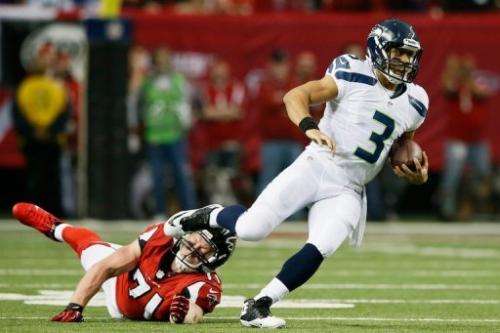
Russell Wilson of the Seattle Seahawks escapes the tackle of Kroy Biermann of the Atlanta Falcons during an NFC Divisional playoff Game at Georgia Dome in Atlanta, Georgia on January 13, 2013. Professional athletes learn quicker than university students to unravel complex visual data, said a study Thursday that challenges the age-old brains-vs-brawn cliche.
English Premier League soccer players, NHL hockey players, France's Top 14 club rugby players, and even elite amateur athletes have better developed cognitive functions than the average university student, according to a perception study undertaken by Professor Jocelyn Faubert of the University of Montreal's School of Optometry.
The study demonstrates a possible outcome of the increased cortical thickness that has been found in areas of trained athletes' brains. It also offers researchers new avenues for exploring the treatment of people who have issues with attention, such as the elderly.
"Study participants were asked to describe a series of simulated objects moving through three dimensions. Although the context had nothing to do with any specific sport, we found that professional athletes were able to process the visual scenes much better than amateur athletes who were in turn better than the students," Faubert explained. The cognitive requirements for correctly interpreting the abstract moving scenes parallel situations such as driving, crossing the street or, case in point, performing sport. "It would appear that athletes are able to hyper-focus their attention to enhance learning, which is key to their abilities."
The researcher worked with 102 professional players from the groups mentioned above, 173 elite amateur athletes – who were recruited from the NCAA American university sports program and a European Olympic training centre, and 33 non-athlete university students. The participants undertook the "3D-MOT" task fifteen times to evaluate several skills that scientists believe are critical to visual perceptual and cognitive abilities when viewing complex scenes: distribution of attention between a number of moving targets amongst distracters, large field of vision, maximum speed of objects that one is able to follow, and the ability to perceive depth. The scene is "neutral", meaning that sport specific familiarity such as play knowledge or experience will not influence the score as the movements and interactions are totally random. The 3D-MOT task was in fact developed by Professor Faubert and can be evaluated by using a graphical simulation machine he invented, known as the Neurotracker, and it has been used by teams such as Manchester United and teams in the NFL and NHL.
The tests revealed that the professional athletes were able to learn how to track fast moving objects at a much superior rate than the other groups, although all three groups improved their score over the 15 training sessions. "Clearly, mental processing and learning skills are key to the excellent performance of the professional athletes. However, it is unclear whether this superior learning ability is unique to professional athletes, and moreover whether these are innate skills that led them to be selected by these teams, or whether these skills have been acquired through extensive training," Faubert said. "It will therefore be interesting to see how individuals of all athletic abilities improve their perception score as they train with this system."
The study has been published in the journal Scientific Reports.
Journal reference:
Scientific Reports
Provided by
University of Montreal
-
Study finds head impacts in contact sports may reduce learning in college athletes
May 16, 2012 |
not rated yet |
0
-
The ace perceptual skills of tennis pros
Jun 11, 2008 |
not rated yet |
0
-
Strobe eyewear training may improve visual abilities
May 19, 2011 |
not rated yet |
0
-
Former football players prone to late-life health problems, study finds
Nov 09, 2011 |
not rated yet |
0
-
Kids who specialize in one sport may have higher injury risk
May 02, 2011 |
not rated yet |
0
-
Motion perception revisited: High Phi effect challenges established motion perception assumptions
Apr 23, 2013 |
3 / 5 (2) |
2
-
Anything you can do I can do better: Neuromolecular foundations of the superiority illusion (Update)
Apr 02, 2013 |
4.5 / 5 (11) |
5
-
The visual system as economist: Neural resource allocation in visual adaptation
Mar 30, 2013 |
5 / 5 (2) |
9
-
Separate lives: Neuronal and organismal lifespans decoupled
Mar 27, 2013 |
4.9 / 5 (8) |
0
-
Sizing things up: The evolutionary neurobiology of scale invariance
Feb 28, 2013 |
4.8 / 5 (10) |
14
-
Why is zone 1 in liver more prone to ischemic injury?
May 23, 2013
-
How can there be villous adenoma in colon, if there are no villi there
May 22, 2013
-
How can there be a term called "intestinal metaplasia" of stomach
May 21, 2013
-
Pressure-volume curve: Elastic Recoil Pressure don't make sense
May 18, 2013
-
If you became brain-dead, would you want them to pull the plug?
May 17, 2013
-
MRI bill question
May 15, 2013
- More from Physics Forums - Medical Sciences
More news stories
Storm chasers: born to be wild?
(HealthDay)—We've all seen them: the surfers who race to the beach when a hurricane hits, the guy who decides to ride out the storm in his overmatched boat, the tornado chasers who fearlessly steer their ...
Psychology & Psychiatry
23 hours ago |
not rated yet |
0
Hormone levels may provide key to understanding psychological disorders in women
Women at a particular stage in their monthly menstrual cycle may be more vulnerable to some of the psychological side-effects associated with stressful experiences, according to a study from UCL.
Psychology & Psychiatry
23 hours ago |
3.7 / 5 (3) |
4
|
Are there atheists in foxholes? Study says they're the minority
Ernie Pyle – an iconic war correspondent in World War II – reportedly said "There are no atheists in foxholes." A new joint study between two brothers at Cornell and Virginia Wesleyan found that only ...
Psychology & Psychiatry
May 24, 2013 |
2.5 / 5 (4) |
2
Breathing exercises help veterans find peace after war, scholar says
(Medical Xpress)—Research by Stanford scholar Emma Seppala at the Center for Compassion and Altruism Research and Education found that post-traumatic stress disorder decreased in veterans who participated ...
Psychology & Psychiatry
May 24, 2013 |
5 / 5 (1) |
1
Depression raises diabetics' risk of severe low blood sugar episodes
(Medical Xpress)—Patients with diabetes who are depressed are much more likely to develop episodes of dangerously low blood sugars, or hypoglycemia, than are those who are not depressed, a new study has ...
Psychology & Psychiatry
May 24, 2013 |
not rated yet |
0
|
First drug to improve heart failure mortality in over a decade
Coenzyme Q10 decreases all cause mortality by half, according to the results of a multicentre randomised double blind trial presented today at Heart Failure 2013 congress. It is the first drug to improve heart failure mortality ...
Heart failure accelerates male 'menopause'
Heart failure accelerates the aging process and brings on early andropausal syndrome (AS), according to research presented today at the Heart Failure Congress 2013. AS, also referred to as male 'menopause', was four times ...
Researchers identify first drug targets in childhood genetic tumor disorder
Two mutations central to the development of infantile myofibromatosis (IM)—a disorder characterized by multiple tumors involving the skin, bone, and soft tissue—may provide new therapeutic targets, according to researchers ...
Feds fight morning-after pill age ruling in NY
(AP)—Department of Justice lawyers have again asked a federal appeals court in New York to delay lifting age restrictions and prescription requirements on an emergency contraceptive popularly known as the morning-after ...
Death highest in heart failure patients admitted in January, on Friday, and overnight
Mortality and length of stay are highest in heart failure patients admitted in January, on Friday, and overnight, according to research presented today at the Heart Failure Congress 2013. The analysis of nearly 1 million ...
Driving and hands-free talking lead to spike in errors, study shows
Talking on a hands-free device while behind the wheel can lead to a sharp increase in errors that could imperil other drivers on the road, according to new research from the University of Alberta.
Jan 31, 2013
Rank: not rated yet
a misleading, sensationalist title, a misrepresented study.
"distribution of attention between a number of moving targets amongst distracters, large field of vision, maximum speed of objects that one is able to follow, and the ability to perceive depth."
this study clearly tests something that athletes should be better than "average joe", either by training or earlier selection. while technically "cognitive",it's not one that "bookworms" need to care much about.
Jan 31, 2013
Rank: not rated yet
These skills will help you be a better wide receiver or goalie, but they won't help you understand calculus or appreciate Shakespeare.
Jan 31, 2013
Rank: 1 / 5 (1)
Jan 31, 2013
Rank: not rated yet
Were this a true intelligence test, FPS video games and chasing frisbees like a dog would be the epitome of genius
Jan 31, 2013
Rank: 5 / 5 (2)
Feb 03, 2013
Rank: 5 / 5 (1)
This makes sense and seems valid. At some point in life developing eye hand coordination and tracking objects is critical in all child development. The ability to train and develop superior eye hand coordination and visual tracking might be a good indicator ability to visualize in general. It's no accident that professional memory magicians use an imaginary place or physical setting such as a house or even possibly a football field to remember many things correctly. So by that reasoning wouldn't this ability to hyperfocus also apply to general memory and learning crossover. It's kind of like the way playing chess is supposed to make one smarter.
Also, there's a selection bias to be aware of that anyone who makes it up to the ranks of the best performers in any area are going to be smart. It might be more fair to compare professional sports athletes with the top 1% of practicing scientists.