Obama birth control mandates loosens lawsuits
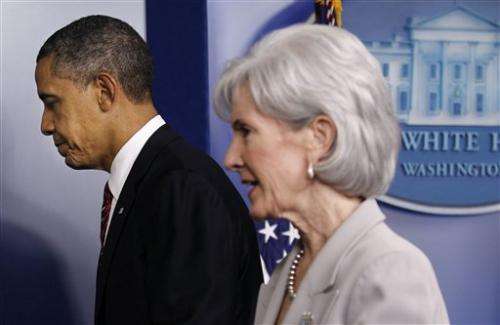
(AP)—The legal challenges over religious freedom and the birth control coverage requirement in President Barack Obama's health care overhaul appear to be moving toward the U.S. Supreme Court.
Faith-affiliated charities, hospitals and universities have filed dozens of lawsuits against the mandate, which requires employers to provide insurance that covers contraception for free. However, many for-profit business owners are also suing, claiming a violation of their religious beliefs.
The religious lawsuits have largely stalled, as the Department of Health and Human Services tries to develop an accommodation for faith groups. However, no such offer will be made to individual business owners. And their lawsuits are yielding conflicting rulings in appeals courts around the U.S.
"The circuits have split. You're getting different, conflicting interpretations of law, so the line of cases will have to go to the Supreme Court," said Carl Esbeck, a professor at the University of Missouri Law School who specializes in religious liberty issues.
Last year, the Supreme Court ruled that Obama's fiercely contested health care overhaul, known as the Affordable Care Act, was constitutional. But differences over the birth control provision in the law have yet to be resolved.
Under the requirement, most employers, including faith-affiliated hospitals and nonprofits, have to provide health insurance that includes artificial contraception, including sterilization, as a free preventive service. The goal, in part, is to help women space pregnancies as a way to promote health.
Religious groups who employ and serve people of their own faith—such as churches—are exempt. But other religiously affiliated groups, such as Catholic Charities, must comply.
Roman Catholic bishops, evangelicals and some religious leaders who have generally been supportive of Obama's policies have lobbied fiercely for a broader exemption. The Catholic Church prohibits the use of artificial contraception. Evangelicals generally permit the use of birth control, but they object to specific methods such as the morning-after contraceptive pill, which they argue is tantamount to abortion.
Obama promised to change the birth control requirement so insurance companies and not faith-affiliated employers would pay for the coverage, but religious leaders said more changes were needed to make the plan work.
The Health and Human Services Department said it could not comment on litigation. A spokeswoman also did not respond to a question about when the latest revisions in the birth control rule would be made public.
However, government attorneys responding to a lawsuit said an announcement was expected by the end of March. In the suit filed by the evangelical Wheaton College in Illinois and Catholic Belmont Abbey in North Carolina, the court ordered government attorneys to provide a progress report on the new rule every 60 days. Whatever its final form, the mandate will take effect for religious groups in August.
At the center of the cases is the Religious Freedom Restoration Act, the 1993 law that bars the government from imposing a substantial burden on the exercise of religion for anything other than a compelling government interest pursued in the least restrictive way. The question of how or whether these criteria apply when owners of for-profit businesses have a religious objection to a government policy hasn't been fully tested.
"It's more natural for people to say Notre Dame exercises religion, but when you say this power tool company exercises religion, you have to explain it a little more, I think the claims are really the same," said Kyle Duncan, general counsel for the Becket Fund for Religious Liberty, which represents many of the plaintiffs.
Brigitte Amiri, senior staff attorney at the American Civil Liberties Union, argued the business owners are trying to use a religious liberty claim to deny benefits to someone else.
"We don't think that religious liberty claims can be used as a way to discriminate against women employees—using those claims to take away someone else's benefits and services," Amiri said.
In the lawsuits from faith-affiliated groups, such as the University of Notre Dame, judges around the country have generally said it would be premature to decide the legal issues until the federal rule for religiously affiliated organizations is finalized.
In the cases involving business owners, judges have granted temporary injunctions to businesses in nine of 14 cases they've heard, while questions about for-profit employers and religious rights are decided, according to a tally by the Becket Fund.
In a case brought by Cyril and Jane Korte, Catholic owners of Korte & Luitjohan Contractors in Illinois, a three-judge panel granted a temporary injunction, ruling 2-1 that providing employees insurance coverage that includes birth control would violate the Kortes' faith.
"It is a family-run business, and they manage the company in accordance with their religious beliefs," the judges wrote.
The dissenting judge argued that the company will not be paying directly for contraception but instead will purchase insurance that covers a wide range of health care that could include birth control, if the woman decides with her physician that she needs it.
"What the Kortes wish to do is to preemptively declare that their company need not pay for insurance which covers particular types of medical care to which they object," the dissenting judge wrote.
Similar reasoning was used by courts denying an injunction requested by the arts and crafts chain Hobby Lobby and religious book-seller Mardel Inc., which are owned by the same evangelical family. Oklahoma-based Hobby Lobby calls itself a "biblically founded business" and is closed on Sundays.
The U.S. district judge who first considered the request said, "Hobby Lobby and Mardel are not religious organizations."
"Plaintiffs have not cited, and the court has not found, any case concluding that secular, for-profit corporations such as Hobby Lobby and Mardel have a constitutional right to the free exercise of religion," the ruling said.
Copyright 2013 The Associated Press. All rights reserved. This material may not be published, broadcast, rewritten or redistributed.


