Oral breast cancer vaccine may offer new prevention tool
January 18, 2013 in Cancer

Oral breast cancer vaccine may offer new prevention tool

Enlarge

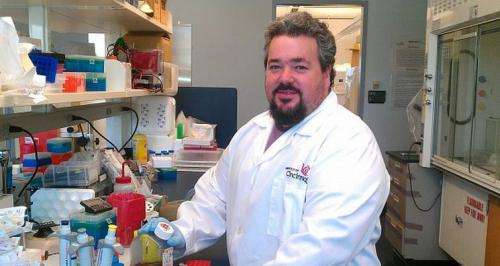
Jason Steel, PhD, is a lung cancer researcher with the UC Cancer Institute.

(Medical Xpress)—A new oral vaccine that produces a novel two-pronged immune system attack on cancer cells could be effective in preventing breast cancer recurrence, according to findings from a collaborative research team from the University of Cincinnati (UC) Cancer Institute and the National Institutes of Health (NIH).

This is the first scientific report of using oral delivery of a unique virus—known as recombinant adeno-associated virus (AAV)—as a cancer vaccine. First author and UC College of Medicine research assistant professor Jason Steel, PhD, and colleagues reported their findings in the Jan. 8. 2013, issue of Molecular Therapy, the journal of the American Society of Gene and Cell Therapy.

Although other oral breast vaccines have been studied in animal models, these vaccines raised human safety concerns because they used bacteria known to have potential harm to human health.

In conjunction with NIH researchers, the UC team sought to develop a vaccine using AAV, a virus that has been shown to have minimal negative effects on human health and is currently being investigated as a gene therapy platform for treating inherited genetic disorders.

"AAV is special because the virus survives the stomach," explains Steel. "Normally, you introduce a virus by mouth and it is broken down in the stomach. This virus is resistant to breakdown, which opened up the possibility of administering it orally as a cancer vaccine."

In this preclinical , the UC team tested two strains of AAV—one that was able to escape the stomach and move into the bloodstream, the other staying in the stomach. Studies were conducted to show both short-term and long-term impact on the reduction of breast cancer tumors. The team also evaluated which delivery method was more effective—oral versus the traditional intramuscular injection.

"The strain that remained in the stomach was more effective at preventing breast cancer tumors than the strain that traveled systemically—100 percent of study subjects had no tumors for over a year following the treatment," says Steel. "Additionally, we showed that (versus intramuscular injection) was more effective, resulting in a stronger immune response with greater than a 100 percent increase in anti-tumor antibodies at the lower doses and increased survival."

Researchers say this AAV-based oral holds potential as a human breast cancer prevention tool in individuals who have been treated for a certain type of or those deemed at increased risk for the disease.

"We have done similar studies with different virus strains that have produced an antibody response," adds Steel. "With this virus, we get both an antibody and a tumor-killer T-cell response. By combining the two mechanisms of action in one vaccine, we are creating a two-pronged immune system attack on the that appears to be more effective."

The UC team expects to begin testing the AAV-based for prevention of other cancers, including lung cancer, in 2013.

Journal reference: Molecular Therapy search and more info website

Provided by University of Cincinnati Academic Health Center search and more info website

5 /5 (3 votes)  

Filter


Move the slider to adjust rank threshold, so that you can hide some of the comments.


Display comments: newest first

pokerdice1
Jan 18, 2013

Rank: not rated yet
This is really promising...
Rank 5 /5 (3 votes)
Relevant PhysicsForums posts

More news stories

Older prostate cancer patients should think twice before undergoing treatment

Older prostate cancer patients with other underlying health conditions should think twice before committing to surgery or radiation therapy for their cancer, according to a multicenter study led by researchers in the UCLA ...

Cancer created 13 hours ago | popularity not rated yet | comments 0 | with audio podcast

Two radiotherapy treatments show similar morbidity, cancer control after prostatectomy

Intensity-modulated radiation therapy has become the most commonly used type of radiation in prostate cancer, but research from the University of North Carolina suggests that the therapy may not be more effective than older, ...

Cancer created 14 hours ago | popularity not rated yet | comments 0

The compound in the Mediterranean diet that makes cancer cells 'mortal'

New research suggests that a compound abundant in the Mediterranean diet takes away cancer cells' "superpower" to escape death. By altering a very specific step in gene regulation, this compound essentially re-educates cancer ...

Cancer created 15 hours ago | popularity 4.8 / 5 (13) | comments 2 | with audio podcast

CT radiation risk less than risk of examination indicator

(HealthDay)—For young adults needing either a chest or abdominopelvic computed tomography (CT), the short-term risk of death from underlying morbidity is greater than the long-term risk of radiation-induced ...

Cancer created 16 hours ago | popularity not rated yet | comments 0

Team finds mechanism linking key inflammatory marker to cancer

In a new study described in the journal Oncogene, researchers reveal how a key player in cell growth, immunity and the inflammatory response can be transformed into a primary contributor to tumor growth.

Cancer created 21 hours ago | popularity not rated yet | comments 0 | with audio podcast


Biomarker trio predicts near-term heart risk

(Medical Xpress)—Cardiologists have identified a trio of biomarkers that may predict which patients with heart disease have a high risk of heart attack or death in the next two years.

Holding drivers' attention

Each day, an average of nine people are killed in the United States and more than 1,000 injured by drivers doing something other than driving.

New theory offers clues to vital 'repair and maintenance' role of sleep

(Medical Xpress)—We spend about a third of our life asleep, but why we need to do so remains a mystery. In a recent publication, researchers at University of Surrey and University College London suggest a new hypothesis, ...

Salt consumption in India: The need for data to initiate population-based prevention efforts

(Medical Xpress)—International researchers are studying the salt intake of Indian adults to provide vital new data to aid the development of a national salt reduction strategy.

Eyes on the sun: Child sunshine exposure and eye development

(Medical Xpress)—Exposure to sunshine as a small child is crucial to the development of a healthy eye according to results of long-term myopia study conducted by University of Sydney researchers.

Genetic predictors of postpartum depression uncovered

Johns Hopkins researchers say they have discovered specific chemical alterations in two genes that, when present during pregnancy, reliably predict whether a woman will develop postpartum depression.