New technology shows diabetes
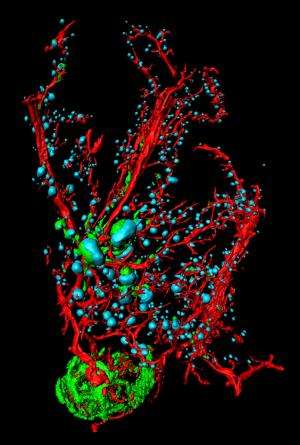
Near-infrared optical projection tomography enables the visualization of several cell types in large preparations. The image of a pancreas from a mouse with type-1 diabetes shows the insulin-producing islets of Langerhans in blue, blood vessels in red, and infiltrating autoimmune cells that break down the insulin-producing cells in green.
A new imaging method for the study of insulin-producing cells in diabetes among other uses is now being presented by a group of researchers at Umeå University in Sweden in the form of a video in the biomedical video journal, The Journal of Visualized Experiments.
The developed techniques have contributed to the reasons why the research team recently received a SEK 4.3 million grant from the EU in a Marie Curie program to link together leading research teams in Europe in the field of diabetes imaging.
Professor Ulf Ahlgren and his associates at the Umeå Center for Molecular Medicine (UCMM) have subsequently elaborated the technology for biomedical imaging with optical projection tomography (OPT). Initially the method could only be used on relatively small preparations, but five years ago the scientists at Umeå were able to adapt the technology to study whole organs including the pancreas from adult mice. The present findings describe a further development of the OPT technology by going from ordinary visible light to the near-infrared spectrum. Near infrared light is light with longer wavelengths that can more easily penetrate tissue. Thereby, the developed imaging platform enables studies of considerably larger samples than was previously possible. This includes the rat pancreas, which is important because rats as laboratory animals are thought to be physiologically more similar to humans.
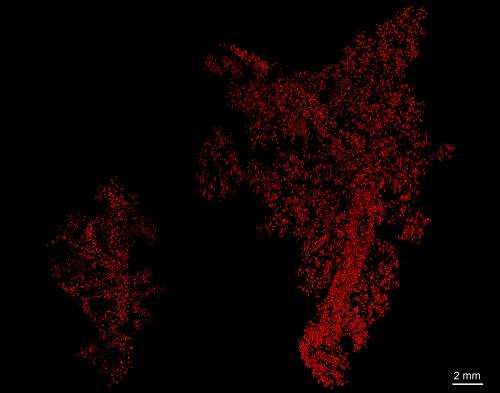
Near-infrared optical projection tomography enables the visualization of considerably larger preparations than were previously possible with OPT. The image shows the insulin-producing islets of Langerhans (red) in a mouse pancreas (left) in relation to those in a rat pancreas (right). The pancreas of a rat is 5-6 times larger than that of a mouse.
This adaptation, to be able to also image in near-infrared light, also means that the researchers gain access to a broader range of the light spectrum, making it possible to study more and different cell types in one organ preparation. In the article the scientists exemplify the possibility of simultaneously tracking the insulin-producing islets of Langerhans as well as the autoimmune infiltrating cells and the distribution of blood vessels in a model system for type-1 diabetes.
Internationally, huge resources are being committed to the development of non-invasive imaging methods for study of the number of remaining insulin cells in patients with developing diabetes. Such methods would be of great importance as only indirect methods for this exist today. However, a major problem in these research undertakings is to find suitable contrast agents that specifically bind to the insulin producing cells of the pancreas to allow imaging. In this context, the developed Near Infrared - OPT technology can play an important role as it enables the evaluation of new contrast agents. It may also be used as a tool to calibrate the non-invasive read out by e.g. magnetic resonance imaging (MRI). This is now going to be tested in the newly launched Marie Curie project "European Training Network for Excellence in Molecular Imaging in Diabetes," which links together five major EU-funded research consortia with different cutting-edge competences in the field.
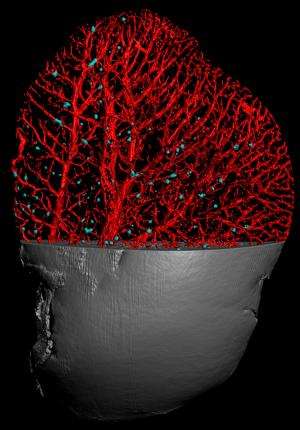
The enhanced technology allows new types of analyses, such as the possibility of evaluating preclinical samples for the purpose of developing better strategies for transplanting islets of Langerhans in diabetics. The image shows a liver from a mouse (gray) into which islets of Langerhans (blue) have been transplanted. By visualizing several markers in an organ it is possible to see directly where the islets of Langerhans wind up in the blood vessel tree.
The study by scientists from Umeå is presented in the Journal of Visualized Experiments, which is the first scientific journal to offer the video format for publication in the life sciences. Visualization in video presentations clearly facilitates the understanding and description of complex experimental technologies. It can help address two major challenges facing bioscience research: the low transparency and poor reproducibility of biological experiments and the large amounts of time and work needed to learn new experimental technologies.More information: Link to the video article.
Journal reference:
Journal of Visualized Experiments
Provided by
Umea University
-
The pancreas as we’ve never seen it before
Aug 26, 2011 |
not rated yet |
0
-
Pancreas stem cell discovery may lead to new diabetes treatments
Nov 14, 2012 |
not rated yet |
0
-
Understanding pancreas size may help unlock cause of Type 1 diabetes
Dec 12, 2012 |
not rated yet |
0
-
Researchers prevent mice from developing diabetes
Jun 29, 2012 |
not rated yet |
0
-
Boosting survival of insulin-cell transplants for Type 1 Diabetes
Jul 07, 2008 |
not rated yet |
0
-
Motion perception revisited: High Phi effect challenges established motion perception assumptions
Apr 23, 2013 |
3 / 5 (2) |
2
-
Anything you can do I can do better: Neuromolecular foundations of the superiority illusion (Update)
Apr 02, 2013 |
4.5 / 5 (11) |
5
-
The visual system as economist: Neural resource allocation in visual adaptation
Mar 30, 2013 |
5 / 5 (2) |
9
-
Separate lives: Neuronal and organismal lifespans decoupled
Mar 27, 2013 |
4.9 / 5 (8) |
0
-
Sizing things up: The evolutionary neurobiology of scale invariance
Feb 28, 2013 |
4.8 / 5 (10) |
14
-
Please check what's in the Ulaby book regarding reflection.
2 hours ago
-
Question in reflection and transmission at oblique incidence.
6 hours ago
-
Is this plasma (picture in thread)
6 hours ago
-
Basic physics understanding. Could someone explain?
8 hours ago
-
Change in flux of a transformer
9 hours ago
-
Electric field between parallel plate capacitor
9 hours ago
- More from Physics Forums - Classical Physics
More news stories
Youth with type 2 diabetes at much higher risk for heart, kidney disease
The news about youth and diabetes keeps getting worse. The latest data from the national TODAY diabetes study shows that children who develop Type 2 diabetes are at high risk to develop heart, kidney and eye problems faster ...
Diabetes
12 hours ago |
not rated yet |
0
Type 2 diabetes progresses faster in kids, study finds
(HealthDay)—Type 2 diabetes is more aggressive in children than adults, with signs of serious complications seen just a few years after diagnosis, new research finds.
Diabetes
May 23, 2013 |
not rated yet |
0
Statin use is linked to increased risk of developing diabetes, warn researchers
Treatment with high potency statins (especially atorvastatin and simvastatin) may increase the risk of developing diabetes, suggests a paper published today in BMJ.
Diabetes
May 23, 2013 |
not rated yet |
0
Diabetes' genetic underpinnings can vary based on ethnic background, studies say
Ethnic background plays a surprisingly large role in how diabetes develops on a cellular level, according to two new studies led by researchers at the Stanford University School of Medicine.
Diabetes
May 23, 2013 |
not rated yet |
0
|
Fish oil supplements may help fight against Type 2 diabetes
Widely-used fish oil supplements modestly increase amounts of a hormone that is associated with lower risk of diabetes and heart disease, according to a study accepted for publication in The Endocrine Society's Journal of ...
Diabetes
May 22, 2013 |
5 / 5 (2) |
1
Engineered cytomegalovirus protects monkeys from HIV equivalent
(Medical Xpress)—A new study by researchers in the US has shown that an ancient virus can be modified to help in the fight against the simian immunodeficiency virus SIV, which is the equivalent in monkeys ...
Researchers identify first drug targets in childhood genetic tumor disorder
Two mutations central to the development of infantile myofibromatosis (IM)—a disorder characterized by multiple tumors involving the skin, bone, and soft tissue—may provide new therapeutic targets, according to researchers ...
Hormone levels may provide key to understanding psychological disorders in women
Women at a particular stage in their monthly menstrual cycle may be more vulnerable to some of the psychological side-effects associated with stressful experiences, according to a study from UCL.
Going live: Immune cell activation in multiple sclerosis
Biological processes are generally based on events at the molecular and cellular level. To understand what happens in the course of infections, diseases or normal bodily functions, scientists would need to ...
Driving and hands-free talking lead to spike in errors, study shows
Talking on a hands-free device while behind the wheel can lead to a sharp increase in errors that could imperil other drivers on the road, according to new research from the University of Alberta.
Depression raises diabetics' risk of severe low blood sugar episodes
(Medical Xpress)—Patients with diabetes who are depressed are much more likely to develop episodes of dangerously low blood sugars, or hypoglycemia, than are those who are not depressed, a new study has ...

