Eye movements reveal impaired reading in schizophrenia
February 19, 2013 in Psychology & Psychiatry
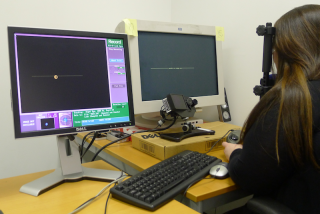
Participants' eye movements were recorded as they read short sentences on a computer screen; head movements were minimized by padded chin- and head-rests. Credit: D. Titone
A study of eye movements in schizophrenia patients provides new evidence of impaired reading fluency in individuals with the mental illness.
The findings, by researchers at McGill University in Montreal, could open avenues to earlier detection and intervention for people with the illness.
While schizophrenia patients are known to have abnormalities in language and in eye movements, until recently reading ability was believed to be unaffected. That is because most previous studies examined reading in schizophrenia using single-word reading tests, the McGill researchers conclude. Such tests aren't sensitive to problems in reading fluency, which is affected by the context in which words appear and by eye movements that shift attention from one word to the next.
The McGill study, led by Ph.D. candidate Veronica Whitford and psychology professors Debra Titone and Gillian A. O'Driscoll, monitored how people move their eyes as they read simple sentences. The results, which were first published online last year, appear in the February issue of the Journal of Experimental Psychology: General.
Eye movement measures provide clear and objective indicators of how hard people are working as they read. For example, when struggling with a difficult sentence, people generally make smaller eye movements, spend more time looking at each word, and spend more time re-reading words. They also have more difficulty attending to upcoming words, so they plan their eye movements less efficiently.
The McGill study, which involved 20 schizophrenia outpatients and 16 non-psychiatric participants, showed that reading patterns in people with schizophrenia differed in several important ways from healthy participants matched for gender, age, and family social status. People with schizophrenia read more slowly, generated smaller eye movements, spent more time processing individual words, and spent more time re-reading. In addition, people with schizophrenia were less efficient at processing upcoming words to facilitate reading.
The researchers evaluated factors that could contribute to the problems in reading fluency among the schizophrenia outpatients – specifically, their ability to parse words into sound components and their ability to skillfully control eye movements in non-reading contexts. Both factors were found to contribute to the reading deficits.
"Our findings suggest that measures of reading difficulty, combined with other information such as family history, may help detect people in the early stages of schizophrenia – and thereby enable earlier intervention," Whitford says.
Moreover, fluent reading is a crucial life skill, and in people with schizophrenia, there is a strong relationship between reading skill and the extent to which they can function independently, the researchers note. "Improving reading through intervention in people with schizophrenia may be important to improving their ability to function in society," Titone adds.
Journal reference:
Journal of Experimental Psychology: General
Provided by
McGill University
-
New way to help schizophrenia sufferers' social skills
Sep 10, 2008 |
not rated yet |
0
-
Eye movements reveal readers' wandering minds
Aug 30, 2010 |
not rated yet |
0
-
Why older people struggle to read fine print
Nov 23, 2012 |
not rated yet |
0
-
Glaucoma study could inspire e-reader apps
Dec 10, 2012 |
not rated yet |
0
-
Eye movements and the search for biomarkers for schizophrenia
Oct 29, 2012 |
not rated yet |
0
-
Motion perception revisited: High Phi effect challenges established motion perception assumptions
Apr 23, 2013 |
3 / 5 (2) |
2
-
Anything you can do I can do better: Neuromolecular foundations of the superiority illusion (Update)
Apr 02, 2013 |
4.5 / 5 (11) |
5
-
The visual system as economist: Neural resource allocation in visual adaptation
Mar 30, 2013 |
5 / 5 (2) |
9
-
Separate lives: Neuronal and organismal lifespans decoupled
Mar 27, 2013 |
4.9 / 5 (8) |
0
-
Sizing things up: The evolutionary neurobiology of scale invariance
Feb 28, 2013 |
4.8 / 5 (10) |
14
-
Why is zone 1 in liver more prone to ischemic injury?
21 hours ago
-
How can there be villous adenoma in colon, if there are no villi there
May 22, 2013
-
How can there be a term called "intestinal metaplasia" of stomach
May 21, 2013
-
Pressure-volume curve: Elastic Recoil Pressure don't make sense
May 18, 2013
-
If you became brain-dead, would you want them to pull the plug?
May 17, 2013
-
MRI bill question
May 15, 2013
- More from Physics Forums - Medical Sciences
More news stories
Motion quotient: IQ predicted by ability to filter motion (w/ video)
A brief visual task can predict IQ, according to a new study. This surprisingly simple exercise measures the brain's unconscious ability to filter out visual movement. The study shows that individuals whose ...
Psychology & Psychiatry
13 hours ago |
4.4 / 5 (9) |
0
|
Anxious men fare worse during job interviews, study finds
Nervous about that upcoming job interview? You might want to take steps to reduce your jitters, especially if you are a man.
Psychology & Psychiatry
14 hours ago |
5 / 5 (1) |
0
Are kids who take music lessons different from other kids?
(Medical Xpress)—Research by U of T Mississauga psychology professor Glenn Schellenberg reveals that two key personality traits – openness-to-experience and conscientiousness—predict better than IQ ...
Psychology & Psychiatry
16 hours ago |
3 / 5 (2) |
1
|
Parents can help preteens with abduction concerns
Parents naturally are concerned for their children's safety, particularly when there is news of a child abduction that happens close to home. Finding the balance between emotions and the "teachable moment" as parents talk ...
Psychology & Psychiatry
16 hours ago |
not rated yet |
0
Ireland needs real-time database for teen and young adult suicides
A new report on suicide in Ireland shows that suicide cases experienced a significant number (and intensity) of life events in the 6 months prior to their death.
Psychology & Psychiatry
16 hours ago |
not rated yet |
0
Controlling mood through the motions of mitochondria
(Medical Xpress)—Regulating the distribution of power in neurons is done by a system that makes the national electric grid look simple by comparison. Each neuron has several thousand mitochondria confined ...
ACP issues recommendations for management of high blood glucose in hospitalized patients
High blood glucose is associated with poor outcomes in hospitalized patients, and use of intensive insulin therapy (IIT) to control hyperglycemia is a common practice in hospitals. But the recent evidence does not show a ...
Multiple research teams unable to confirm high-profile Alzheimer's study
Teams of highly respected Alzheimer's researchers failed to replicate what appeared to be breakthrough results for the treatment of this brain disease when they were published last year in the journal Science.
Scientists discover molecule triggers sensation of itch
Scientists at the National Institutes of Health report they have discovered in mouse studies that a small molecule released in the spinal cord triggers a process that is later experienced in the brain as ...
Researchers find common childhood asthma unconnected to allergens or inflammation
Little is known about why asthma develops, how it constricts the airway or why response to treatments varies between patients. Now, a team of researchers at Weill Cornell Medical College, Columbia University Medical Center ...
Diabetes' genetic underpinnings can vary based on ethnic background, studies say
Ethnic background plays a surprisingly large role in how diabetes develops on a cellular level, according to two new studies led by researchers at the Stanford University School of Medicine.
Feb 19, 2013
Rank: not rated yet