Hope for millions of Germans suffering from periodontitis
Twelve million Germans suffer from periodontitis, an inflammation that can lead to the loss of teeth if left untreated. Bleeding gums during brushing or when biting into an apple could be an indication of periodontitis, an inflammatory disease of the tissues that surround and support the teeth. Bacterial plaque attacks the bone, meaning teeth can loosen over time and in the worst case even fall out, as they are left without a solid foundation to hold them in place. Furthermore, periodontitis also acts as a focal point from which disease can spread throughout the entire body: If the bacteria, which can be very aggressive, enters the bloodstream, they can cause further damage elsewhere. Physicians suspect there is a connection between periodontitis pathogens and the sort of cardiovascular damage that can cause heart attacks or strokes. In order to stop the source of inflammation, dentists remove dental calculus and deposits from the surface of teeth, but this is often not enough; aggressive bacteria can only be eliminated with antibiotics.
Of the estimated 700 species of bacteria found in the mouth cavity, there are only eleven that are known to cause periodontal disease in particular; of these, some are deemed to be severely pathogenic. If these biomarkers are present in the gingival sulcus - the small gap around the base of the tooth - then the patient is at high risk of a severe form of periodontitis. But the only way to find out is by conducting a bacteria test. The problem is that current methods for identifying pathogens are time-consuming and must be carried out in an external contract laboratory. Conventional bacterial analysis using microbial culture carries the risk of bacteria being killed as soon as they come into contact with oxygen.
However, German scientists have developed an innovative mobile diagnostic platform that can be used in a dental office to analyse DNA collected from teeth and identify the 11 most relevant periodontitis pathogens in less than 30 minutes. The mobile diagnostic platform is designed to speed up identification of the eleven most relevant periodontitis pathogens considerably.
Scientists at the Fraunhofer Institute for Cell Therapy and Immunology IZI in Leipzig have collaborated with two companies, BECIT GmbH and ERT-Optik, to develop a lab-on-a-chip module called ParoChip. In future this will allow dentists and medical labs to prepare samples quickly and then analyse the bacteria. All the steps in the process - the duplication of DNA sequences and their detection - take place directly on the platform, which consists of a disk-shaped microfluidic card that is around six centimeters in diameter. 'Until now, analysis took around four to six hours. With ParoChip it takes less than 30 minutes. This means it's possible to analyse a large number of samples in a short amount of time,' says Dr. Dirk Kuhlmeier, a scientist at the IZI.
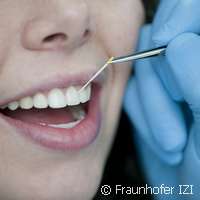
Samples are taken using sterile, toothpick-shaped paper points, after which the bacteria are removed from the point and their isolated DNA injected into reaction chambers containing dried reagents. There are eleven such chambers on each card, each featuring the reagent for one of the eleven periodontal pathogens. The total number of bacteria is determined in an additional chamber, via polymerase chain reaction (PCR). This method allows millions of copies of even tiny numbers of pathogen DNA sequences to be made. In order to generate the extremely quick changes in temperature that are required for PCR, the disk-shaped plastic chip is attached to a metal heating block with three temperature zones and mechanically turned so it passes over these zones. This causes a fluorescent signal to be generated that is measured by a connected optical measuring device featuring a fluorescence probe, a photo detector and a laser diode.
The key benefit is that the signal makes it possible not only to quantify each type of bacterium and thus determine the severity of the inflammation, but also to establish the total number of all the bacteria combined. This enables doctors to fine-tune an antibiotic treatment accordingly.
'As the connected optical measuring system allows us to quantify bacteria, ParoChip is also suited to the identification of other bacterial causes of infection, such as food-borne pathogens or those that lead to sepsis ,' says Kuhlmeier, who goes on to emphasize further advantages of the compact diagnostic platform: 'Using ParoChip does away with many of the manual steps that are a necessary part of current bacteria tests. The synthetic disks can be produced cheaply and disposed of after use in the same way as disposable gloves.'
Already available as a prototype, ParoChip is initially intended for use in clinical laboratories; however it could also be used by dentists to carry out in-house analysis of patient samples in their own practice.
More information:
Fraunhofer Institute for Cell Therapy and Immunology IZI
www.izi.fraunhofer.de/fraunhofer-izi.html?&L=1 /


