Poll: Many Americans don't see their kids as overweight
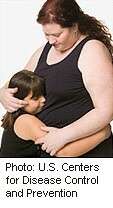
February 25, 2013 in Overweight and Obesity
But national statistics contend that there's an obesity epidemic among children.
(HealthDay)—Many American parents fail to see that their children are overweight or obese, a new poll finds.
Only 15 percent of parents said their children are a little or very overweight, but national statistics suggest that 32 percent of kids are overweight or even obese, according to the researchers.
In addition, only 20 percent of children in the survey had a parent who was worried that his or her child will be overweight as an adult. However, an estimated 69 percent of American adults are overweight, including 36 percent who are obese and 6 percent who are extremely obese.
The poll results suggest that many parents underestimate their children's current risk for being overweight or obese, and how that risk could continue to affect them as adults, the researchers said.
The survey, conducted by the Robert Wood Johnson Foundation, the Harvard School of Public Health and NPR, asked parents about their children, ages 2 to 17.
"We know that nearly one in three kids in America is overweight or obese, and that's a national emergency," Dr. Risa Lavizzo-Mourey, president and CEO of the Robert Wood Johnson Foundation, said in a foundation news release.
"Better nutrition and more physical activity can help turn this epidemic around, and parents have a unique role to play. Knowing the risks of obesity and dealing with the issue proactively can improve kids' health now and prevent serious problems down the road," she said.
Gillian SteelFisher is assistant director of the Harvard Opinion Research Program and a research scientist in the Harvard School of Public Health's Department of Health Policy and Management. She said in the news release: "People often have a hard time making the connection between national problems and their own families. Tackling these blind spots can be a difficult, even if necessary, element of public education."
Even though nearly all the parents in the poll agreed that it's important for their children to have eating and exercise habits that help them maintain or achieve a healthy weight, 44 percent of parents said it was difficult to make sure their children have a healthy diet and 36 percent of parents said it was a challenge to make sure their children get enough exercise.
The poll also found that between 3 p.m. and bedtime, 60 percent of children ate or drank something that can lead to unhealthy weight gain.
Parents listed a number of challenges they face in trying to help their children maintain or achieve a healthy weight: food advertising (43 percent); foods offered at lunch at school (33 percent); the costs of team sports, gym memberships or exercise equipment (33 percent); lack of good sidewalks near home (31 percent); too few places that serve healthy foods where children can spend time with friends (31 percent).
Seventy percent of children in the survey live in households where the family eats dinner together at home on a given night, but 24 percent of the families had the TV on during dinner, or someone used a cellphone, laptop or an iPod during dinner. Only 46 percent of the children live in homes where the family eats together without these distractions. Research suggests that meals without TV and other distractions are associated with lower obesity rates.
Nearly all—96 percent—of the children in the survey had attended family events in the past year where foods with high levels of fat or sugar (such as chips, fried foods, fast foods and sweets) were served. Among those children, 48 percent live in homes where the parent feels that "family celebrations are a time to take a break from being concerned about eating in a way that can lead to unhealthy weight gain," the researchers found.
More information: The Nemours Foundation has more about your child's weight.
Health News Copyright © 2013 HealthDay. All rights reserved.
-
Obesity a concern? Don't use sweets to reward children's behaviour, reduce screen time
Oct 02, 2012 |
not rated yet |
0
-
Experts: Gym gone but not forgotten? Parents want more physical activity at school for kids
Apr 18, 2011 |
not rated yet |
0
-
Mothers, children underestimate obesity in China
Aug 06, 2012 |
not rated yet |
0
-
How to best help your child lose weight: Lose weight yourself
Mar 14, 2012 |
not rated yet |
0
-
Less television and more gathering around the dinner table prevents
Jan 31, 2007 |
not rated yet |
0
-
Motion perception revisited: High Phi effect challenges established motion perception assumptions
Apr 23, 2013 |
3 / 5 (2) |
2
-
Anything you can do I can do better: Neuromolecular foundations of the superiority illusion (Update)
Apr 02, 2013 |
4.5 / 5 (11) |
5
-
The visual system as economist: Neural resource allocation in visual adaptation
Mar 30, 2013 |
5 / 5 (2) |
9
-
Separate lives: Neuronal and organismal lifespans decoupled
Mar 27, 2013 |
4.9 / 5 (8) |
0
-
Sizing things up: The evolutionary neurobiology of scale invariance
Feb 28, 2013 |
4.8 / 5 (10) |
14
-
Calculating Steam Pressure in Closed Container
5 hours ago
-
Learning curve of Electromagnetism?
10 hours ago
-
thin glass in liquid
11 hours ago
-
How many joules expended for a push up?
14 hours ago
-
force to keep the folding doors
14 hours ago
-
Confusion regarding direction of kinetic friction on inclined plane.
15 hours ago
- More from Physics Forums - Classical Physics
More news stories
Young children appear to reject story characters who are obese
(Medical Xpress)—Research by the University of Leeds has shown that very young children appear to reject story book characters who are overweight, but not those who are disabled.
Overweight and Obesity
May 16, 2013 |
3 / 5 (1) |
2
Gene variations may explain weight gain among men, women
(HealthDay)—Weight gain in men and women is predicted by two different genetic variations—so-called polymorphisms, according to a new study from the Netherlands.
Overweight and Obesity
May 15, 2013 |
5 / 5 (1) |
0
|
ECO: Distilled water doesn't up resting energy expenditure
(HealthDay)—Drinking 500 ml of purified water is not associated with increases in resting energy expenditure (REE), according to a study presented at the annual meeting of the European Congress on Obesity, ...
Overweight and Obesity
May 14, 2013 |
2 / 5 (2) |
1
ECO: Industry-funded reviews query sweet drink, obesity tie
(HealthDay)—Reviews that are funded by industry tend to find the evidence weak for a causal link between sugar-sweetened beverages (SSBs) and the increasing prevalence of obesity, while other reviews consider ...
Overweight and Obesity
May 14, 2013 |
not rated yet |
0
The smart phone app that helps weight loss
Researchers at the University of Liverpool have developed a smart phone app that helps users lose weight by carefully recording their food consumption.
Overweight and Obesity
May 13, 2013 |
5 / 5 (1) |
0
New research identifies risks, interventions for children's GI health
An increasing number of U.S. children are experiencing gastrointestinal issues that require interventions to resolve, according to research presented at Digestive Disease Week (DDW).
US psychiatry gets makeover in new manual
The latest makeover to a massive psychiatric tome honored by some, reviled by others and even called the "Bible" of mental disorders is being released Saturday with a host of new changes.
New case of SARS-like virus in Saudi: ministry
A new case of the deadly coronavirus has been detected in Saudi Arabia where 15 people have already died after contracting it, the health ministry announced on Saturday on its Internet website.
AIDS science at 30: 'Cure' now part of lexicon
Big names in medicine are set to give an upbeat assessment of the war on AIDS on Tuesday, 30 years after French researchers identified the virus that causes the disease.
For combat veterans suffering from post-traumatic stress disorder, 'fear circuitry' in the brain never rests
Chronic trauma can inflict lasting damage to brain regions associated with fear and anxiety. Previous imaging studies of people with post-traumatic stress disorder, or PTSD, have shown that these brain regions can over-or ...
New colonoscope provides ground-breaking view of colon
A ground-breaking advance in colonoscopy technology signals the future of colorectal care, according to research presented today at Digestive Disease Week(DDW). Additional research focuses on optimizing the minimal withdrawal ...
Feb 26, 2013
Rank: not rated yet