New website helps parents manage children's pain after surgery
February 21, 2013 by Juliana Bunim in Health
(Medical Xpress)—When a young child has surgery, parents rely on doctors and nurses for advice on how to prepare and support children during the procedure and immediately afterwards. But once that child gets home, parents are left with little guidance on how to best help their children cope with pain.
A new website aims to fill that information gap and give parents the framework for how to be more effective caregivers for children after surgery.
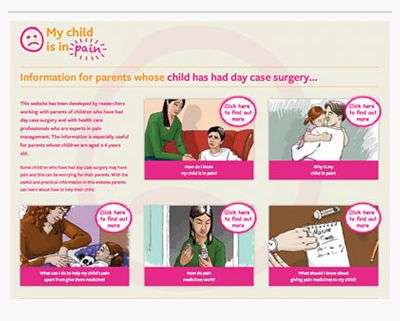
Created with Linda Franck, RN, PhD, chair of Family Health Care Nursing in UC San Francisco's School of Nursing, the website My Child is in Pain targets parents of children between the ages of 2 and 6 who want to know how to help manage their child's post-operative pain.
"There are very few formal resources for parents to learn how to tell if their child is in pain and what they can do to relieve it," said Franck.
More than 80 percent of the more than 3 million children's surgeries in the U.S. are performed on an outpatient basis, leaving parents to manage post-operative pain at home. But returning home can be scary when parents aren't confident about how to determine if their child is in pain, and children aren't equipped with the language skills to fully articulate how they are feeling.
Franck's research has shown that more than 90 percent of children have pain two days after surgery and as much as 25 percent have pain four weeks after. Children with post-operative pain also were more likely to have problematic behaviors such as not sleeping, eating poorly and being very anxious.
"Parents are not getting enough information or feeling comfortable using the information that's out there to manage pain at home," said Franck. "It became clear we needed to put together another resource using the best research evidence available and lots of parent input so that it was practical and useful for parents."
Franck has dedicated her career to pioneering pain assessment and management techniques for acutely and chronically ill infants and children. Her research highlights the information needs of parents when their children are in pain, and suggests innovative strategies for enhancing the partnership between parents and professionals to ensure children receive optimal pain care.
Through a series of videos, text and illustrations, the website helps parents understand how children respond to pain and guides them through how to tell if their child is in pain. It provides detailed information and practical advice on some of the simple but effective things they can do to provide effective comfort and manage their child's pain. The website also explains how pain is signalled to the brain, how common pain medications work, what times are best to administer the medication and what to do if it's not working. The site is funded by the United Kingdom-based non-profit WellChild.
"When a child's pain is well managed, he or she usually recovers more quickly," said Franck. "Simple comfort techniques can be very effective. Gently rocking and stroking their child can be soothing and help their child to relax, and when a child is relaxed and calm, it can help the pain go away. Also, letting their child make some decisions can help them feel less anxious and more in control."
Provided by
University of California, San Francisco
-
Managing pain -- a family affair
Apr 11, 2011 |
not rated yet |
0
-
Children suffer unnecessarily from chronic postoperative pain
Oct 27, 2011 |
not rated yet |
0
-
Some parents weigh 'hastening death' for children in extreme pain with terminal cancer
Mar 01, 2010 |
not rated yet |
0
-
Program benefits children with functional abdominal pain
Jan 04, 2013 |
not rated yet |
0
-
Docs make push to lower kids' pain, stress in ER
Oct 29, 2012 |
not rated yet |
0
-
Motion perception revisited: High Phi effect challenges established motion perception assumptions
Apr 23, 2013 |
3 / 5 (2) |
2
-
Anything you can do I can do better: Neuromolecular foundations of the superiority illusion (Update)
Apr 02, 2013 |
4.5 / 5 (11) |
5
-
The visual system as economist: Neural resource allocation in visual adaptation
Mar 30, 2013 |
5 / 5 (2) |
9
-
Separate lives: Neuronal and organismal lifespans decoupled
Mar 27, 2013 |
4.9 / 5 (8) |
0
-
Sizing things up: The evolutionary neurobiology of scale invariance
Feb 28, 2013 |
4.8 / 5 (10) |
14
-
Classical and Quantum Mechanics via Lie algebras
Apr 15, 2011
- More from Physics Forums - Independent Research
More news stories
One in ten teens using 'study drugs,' but parents aren't paying attention
As high schoolers prepare for final exams, teens nationwide may be tempted to use a "study drug"—a prescription stimulant or amphetamine—to gain an academic edge. But a new University of Michigan poll shows only one in ...
Health
1 minute ago |
not rated yet |
0
Hospital emergency departments gaining in importance, study finds
Hospital emergency departments play a growing role in the U.S. health care system, accounting for a rising proportion of hospital admissions and serving increasingly as an advanced diagnostic center for primary care physicians, ...
Health
2 minutes ago |
not rated yet |
0
Women with severe injuries are less likely than men to be treated in a trauma center
Women are less likely than men to receive care in a trauma center after severe injury, according to a new study of almost 100,000 Canadian patients.
Health
1 hour ago |
not rated yet |
0
Half time warm-ups boost athletic performance
High-intensity, short duration warm up activities at half time intervals boost athletic performance, a study of soccer players has found.
Health
3 hours ago |
not rated yet |
0
Pre-proceedings process fails to reduce length of care proceedings, but can help divert cases from court
A major new report on a procedure that aims to reduce the duration of care proceedings for children has found it made no significant difference to what happened in court, and cases lasted just as long regardless of whether ...
Health
5 hours ago |
not rated yet |
0
New study finds blind people have the potential to use their 'inner bat' to locate objects
New research from the University of Southampton has shown that blind and visually impaired people have the potential to use echolocation, similar to that used by bats and dolphins, to determine the location of an object.
Researchers find far-reaching, microvascular damage in uninjured side of brain after stroke
While the effects of acute stroke have been widely studied, brain damage during the subacute phase of stroke has been a neglected area of research. Now, a new study by the University of South Florida reports that within a ...
Breakup of physician, drug company relationship could improve health care, cut cost
A new report suggests that improved health care and significant reductions in drug costs might be attained by breaking up the age-old relationship between physicians and drug company representatives who promote the newest, ...
Food laboratory accuracy remains a concern
Food microbiology laboratories continue to submit false negative results and false positive results on a routine basis. A retrospective study of nearly 40,000 proficiency test results over the past 14 years, presented today ...
Study supports 'aggressive' treatment for posterior fossa hematoma in newborns
Posterior fossa subdural hematoma (PFSDH) is a serious and rare condition in newborns, generally occurring after difficult deliveries. But with appropriate treatment, there's an excellent chance of good long-term outcomes ...
Which women should be screened for high cholesterol?
National guidelines recommend that at-risk women be screened for elevated cholesterol levels to reduce their chances of developing cardiovascular disease. But who is 'at risk?' The results of a study by investigators ...