Cancer-slowing compound also combats malaria, researchers find
March 8, 2013 in Medical research

Cancer-slowing compound also combats malaria, researchers find

Enlarge

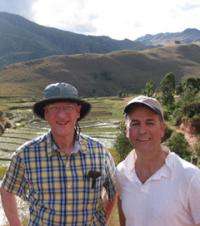
David Kingston (left), University Distinguished Professor of chemistry, and Joshua Rosenthal, National Institutes of Health Fogarty International Center Program Officer, work to advance natural drug discovery projects in Madagascar.

An extract from a shrub often used for medicinal purposes in tropical Africa may have lethal effects against a dangerous parasite that transmits malaria, according to a multi-institutional team of scientists led by researchers at Virginia Tech.

The discovery, published online in the , shows that a compound isolated from this common plant with low branches and creamy, white fragrant flowers appears to be useful for the development of drugs targeting the parasite . The same was previously shown to slow the growth of , researchers say.

"The next step in the research is to prepare analogs of the active compounds in hopes of finding some more stable compounds with even better activity. The compound we've identified already appears to have better anti-malarial activity than , a standard drug on the market," said David G.I. Kingston, a University Distinguished Professor of chemistry in the College of Science, researcher affiliated with the Fralin Life Science Institute, and director of the Virginia Tech Center for .

For the study, Kingston partnered with Maria Belen Cassera, an assistant professor of biochemistry in the College of Agriculture and Life Sciences, and Jessica Bowman of Lynchburg, Va., a graduate student in biochemistry in the College of Agriculture and Life Sciences, working with Cassera.

The biochemists conducted bioassays on Kingston's collection of plants from Madagascar, collected as part of the Madagascar International Cooperative Biodiversity Group. In 2011, Kingston received a grant from the National Center for , part of the National Institutes of Health, to test the plants for anti-malarial activity.

"Natural product compounds seem to be full of surprising benefits to cure human disease," Bowman said. "To be a part of the on-going research for transmission blocking agents is very rewarding."

With the help of Liva Harinantenaina, a research scientist working with Kingston, the team honed in on an ethanol extract of Mallotus oppositfolius, a West African tropical flowering plant often used as a chewing stick in Nigeria but not fully studied in the scientific world. Then, they worked together to isolate three antimalarial compounds from the extract.

Studies conducted by Cassera and Paul Roepe, professor of chemistry and professor of biochemistry and cellular and molecular biology at Georgetown University, showed that one of the three compounds kills the malaria parasite in its asexual stage as well as its gametocyte stage, which is when transmission to mosquitoes occurs.

"Finding new drugs that will also target the gametocyte stages of the malaria parasite are essential to reduce its transmission," Cassera said.

More information: pubs.acs.org/doi/a… 21/np300750q

Journal reference: Journal of Natural Products search and more info website

Provided by Virginia Tech search and more info website

not rated yet  

Rank not rated yet
Relevant PhysicsForums posts

More news stories

Computational tool translates complex data into simplified 2-dimensional images

In their quest to learn more about the variability of cells between and within tissues, biomedical scientists have devised tools capable of simultaneously measuring dozens of characteristics of individual ...

Medical research created 15 hours ago | popularity 5 / 5 (3) | comments 0 | with audio podcast

Now we know why old scizophrenia medicine works on antibiotics-resistant bacteria

In 2008 researchers from the University of Southern Denmark showed that the drug thioridazine, which has previously been used to treat schizophrenia, is also a powerful weapon against antibiotic-resistant bacteria such as ...

Medical research created May 17, 2013 | popularity 4 / 5 (4) | comments 0 | with audio podcast

SUMO wrestling cells reveal new protective mechanism target for stroke

Scientists investigating the interaction of a group of proteins in the brain responsible for protecting nerve cells from damage have identified a new target that could increase cell survival.

Medical research created May 17, 2013 | popularity 5 / 5 (1) | comments 0

How serotonin receptors can shape drug effects, from LSD to migraine medication

New findings by researchers carrying out experiments at the U.S. Department of Energy Office of Science's Advanced Photon Source (APS) help explain why some drugs that interact with two kinds of human serotonin ...

Medical research created May 17, 2013 | popularity 4 / 5 (1) | comments 0 | with audio podcast

Preventing blood poisoning

Peptide molecules derived from the body's natural immune system can help boost the body's defence against life-threatening blood poisoning, joint University research has uncovered.

Medical research created May 17, 2013 | popularity 4 / 5 (1) | comments 0 | with audio podcast


Treatment of sleep apnea improves glucose levels in prediabetes

Optimal treatment of sleep apnea in patients with prediabetes improves blood sugar (glucose) levels and thus can reduce cardiometabolic risk, according to a study to be presented at the ATS 2013 International Conference in ...

Whole-cell vaccine was more effective than acellular vaccine during CA pertussis outbreak

Whole-cell pertussis vaccines were more effective at protecting against pertussis than acellular pertussis vaccines during a large recent outbreak, according to a new Kaiser Permanente study published in Pediatrics.

Blame your parents for bunion woes

A novel study reports that white men and women of European descent inherit common foot disorders, such as bunions (hallux valgus) and lesser toe deformities, including hammer or claw toe. Findings from the Framingham Foot ...

Genetic diversity within tumors predicts outcome in head and neck cancer

A new measure of the heterogeneity – the variety of genetic mutations – of cells within a tumor appears to predict treatment outcomes of patients with the most common type of head and neck cancer. In the May 20 issue ...

Molecular marker from pancreatic 'juices' helps identify pancreatic cancer

Researchers at Mayo Clinic have developed a promising method to distinguish between pancreatic cancer and chronic pancreatitis—two disorders that are difficult to tell apart. A molecular marker obtained from pancreatic ...

Commonly used catheters double risk of blood clots in ICU and cancer patients

Touted for safety, ease and patient convenience, peripherally inserted central catheters have become many clinicians' go-to for IV delivery of antibiotics, nutrition, chemotherapy, and other medications.