How chronic stress accelerates Alzheimer's disease
March 14, 2013 in Alzheimer's disease & dementia
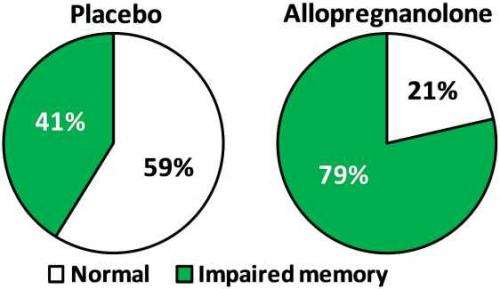
The figure shows the proportion of AD mice with normal and impaired memory in each treatment group respectively. A substantial increase in the number of mice with impaired memory function was found after chronically elevated levels of allopregnanolone in comparison to placebo treatment.
Why does chronic stress lead to increased risk for dementia? The answer may lie in the elevation of stress steroids that is seen in the brain during stress, Sara K. Bengtsson suggests in the thesis she is defending at Umeå University in Sweden on March 22.
These stress steroids can inhibit the general brain activity. Allopregnanolon is one of them, and the doctoral thesis shows that chronically elevated levels of allopregnanolone accelerated the disease development in two transgenic Alzheimer disease models. The Alzheimer mice responded with impaired learning and memory. They had also increased brain levels of beta-amyloids, i.e. the proteins that form plaques in Alzheimer's disease.
The thesis also demonstrates that high levels of beta-amyloids corresponded to dysfunction among brain synapses. This was seen after a period of chronically elevated levels of allopregnanolon, but not after placebo treatment. The effects were identified early in the disease development when the animals normally have intact memory function. A similar acceleration of AD in humans could mean the difference between living self-sufficiently at home and living with requirements of professional care.
Sara K. Bengtsson was born in Malmö, Sweden, and completed her pre-university graduation in Ystad. Professionally, Sara K. Bengtsson has worked in various fields and in 2008 she completed her Master's degree in medicine with a major in biomedicine at Umeå University, Sweden, where she now is a postgraduate student at the Department of Clinical Sciences, division of Obstetrics and Gynecology.
On Friday, March 22nd, Sara K. Bengtsson, Department of Clinical Sciences, Umeå University, is publicly defending her thesis with the title "Stress steroids as accelerators of Alzheimer's disease." Effects of chronically elevated levels of allopregnanolone in transgenic AD models.
More information: Read the thesis or abstract at: urn.kb.se/resolve?… u:diva-66572
Provided by
Umea University
-
Impaired energy metabolism linked with initiation of plaques in Alzheimer's brain
Dec 24, 2008 |
not rated yet |
0
-
Drugs targeting blood vessels may be candidates for treating Alzheimer's
Mar 07, 2013 |
not rated yet |
0
-
Stress may increase risk for Alzheimer's disease
May 26, 2011 |
not rated yet |
0
-
Scientists study link between amyloid beta peptide levels and Alzheimer's disease
Mar 20, 2012 |
not rated yet |
0
-
Gene tests and brain imaging reveal early dementia
Mar 06, 2007 |
not rated yet |
0
-
Motion perception revisited: High Phi effect challenges established motion perception assumptions
Apr 23, 2013 |
3 / 5 (2) |
2
-
Anything you can do I can do better: Neuromolecular foundations of the superiority illusion (Update)
Apr 02, 2013 |
4.5 / 5 (11) |
5
-
The visual system as economist: Neural resource allocation in visual adaptation
Mar 30, 2013 |
5 / 5 (2) |
9
-
Separate lives: Neuronal and organismal lifespans decoupled
Mar 27, 2013 |
4.9 / 5 (8) |
0
-
Sizing things up: The evolutionary neurobiology of scale invariance
Feb 28, 2013 |
4.8 / 5 (10) |
14
-
Question in reflection and transmission at oblique incidence.
3 hours ago
-
Is this plasma (picture in thread)
4 hours ago
-
Basic physics understanding. Could someone explain?
6 hours ago
-
Change in flux of a transformer
6 hours ago
-
Electric field between parallel plate capacitor
7 hours ago
-
Why angle of projectile has 2 solutions?
8 hours ago
- More from Physics Forums - Classical Physics
More news stories
A new strategy required in the search for Alzheimer's drugs?
In the search for medication against Alzheimer's disease, scientists have focused – among other factors – on drugs that can break down Amyloid beta (A-beta). After all, it is the accumulation of A-beta that causes the ...
Alzheimer's disease & dementia
13 hours ago |
not rated yet |
0
Alzheimer's disease, the soft target of the euthanasia debate
(Medical Xpress)—The way Alzheimer's disease is portrayed by advocacy groups and the media is having undue influence on the euthanasia debate, according to a Deakin University nursing ethics professor.
Alzheimer's disease & dementia
14 hours ago |
not rated yet |
2
Scientists discover cinnamon compounds' potential ability to prevent Alzheimer's
Cinnamon: Can the red-brown spice with the unmistakable fragrance and variety of uses offer an important benefit? The common baking spice might hold the key to delaying the onset of –– or warding off ...
Alzheimer's disease & dementia
May 23, 2013 |
5 / 5 (5) |
0
|
Drug reverses Alzheimer's disease deficits in mice, research confirms
An anti-cancer drug reverses memory deficits in an Alzheimer's disease mouse model, University of Pittsburgh Graduate School of Public Health researchers confirm in the journal Science.
Alzheimer's disease & dementia
May 23, 2013 |
not rated yet |
0
|
Multiple research teams unable to confirm high-profile Alzheimer's study
Teams of highly respected Alzheimer's researchers failed to replicate what appeared to be breakthrough results for the treatment of this brain disease when they were published last year in the journal Science.
Alzheimer's disease & dementia
May 23, 2013 |
3 / 5 (2) |
3
|
Engineered cytomegalovirus protects monkeys from HIV equivalent
(Medical Xpress)—A new study by researchers in the US has shown that an ancient virus can be modified to help in the fight against the simian immunodeficiency virus SIV, which is the equivalent in monkeys ...
Researchers identify first drug targets in childhood genetic tumor disorder
Two mutations central to the development of infantile myofibromatosis (IM)—a disorder characterized by multiple tumors involving the skin, bone, and soft tissue—may provide new therapeutic targets, according to researchers ...
Hormone levels may provide key to understanding psychological disorders in women
Women at a particular stage in their monthly menstrual cycle may be more vulnerable to some of the psychological side-effects associated with stressful experiences, according to a study from UCL.
Going live: Immune cell activation in multiple sclerosis
Biological processes are generally based on events at the molecular and cellular level. To understand what happens in the course of infections, diseases or normal bodily functions, scientists would need to ...
Driving and hands-free talking lead to spike in errors, study shows
Talking on a hands-free device while behind the wheel can lead to a sharp increase in errors that could imperil other drivers on the road, according to new research from the University of Alberta.
Comorbidities common with alopecia areata
(HealthDay)—Comorbid conditions often accompany alopecia areata, according to a study published online May 22 in JAMA Dermatology.