Flip of a single molecular switch makes an old brain young
March 6, 2013 in Neuroscience

Flip of a single molecular switch makes an old brain young

Enlarge

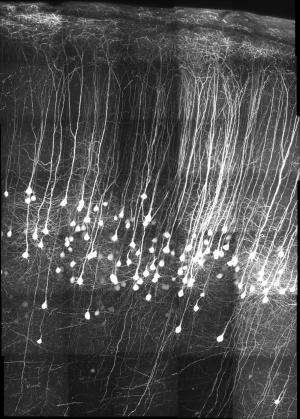
This image shows neurons. Green: A cultured neuron with projecting dendrites studded with sites of communication between neurons, known as dendritic spines. White: A 3D reconstruction of neurons in the somatosensory cortex. Credit: Yale University

The flip of a single molecular switch helps create the mature neuronal connections that allow the brain to bridge the gap between adolescent impressionability and adult stability. Now Yale School of Medicine researchers have reversed the process, recreating a youthful brain that facilitated both learning and healing in the adult mouse.

Scientists have long known that the young and old brains are very different. Adolescent brains are more malleable or plastic, which allows them to learn languages more quickly than adults and speeds recovery from brain injuries. The comparative rigidity of the adult brain results in part from the function of a single gene that slows the rapid change in synaptic connections between neurons.

By monitoring the synapses in living mice over weeks and months, Yale researchers have identified the key for brain maturation a study released March 6 in the journal Neuron. The Nogo Receptor 1 gene is required to suppress high levels of plasticity in the and create the relatively quiescent levels of plasticity in adulthood. In mice without this gene, juvenile levels of persist throughout adulthood. When researchers blocked the function of this gene in old mice, they reset the old brain to adolescent levels of plasticity.

"These are the molecules the brain needs for the transition from adolescence to adulthood," said Stephen Strittmatter. Vincent Coates Professor of Neurology, Professor of Neurobiology and senior author of the paper. "It suggests we can turn back the clock in the and recover from trauma the way kids recover."

Rehabilitation after brain injuries like strokes requires that patients re-learn tasks such as moving a hand. Researchers found that lacking Nogo Receptor recovered from injury as quickly as adolescent mice and mastered new, complex more quickly than adults with the receptor.

"This raises the potential that manipulating Nogo Receptor in humans might accelerate and magnify rehabilitation after brain injuries like strokes," said Feras Akbik, Yale doctoral student who is first author of the study.

Researchers also showed that Nogo Receptor slows loss of memories. Mice without Nogo receptor lost stressful memories more quickly, suggesting that manipulating the receptor could help treat post-traumatic stress disorder.

"We know a lot about the early development of the brain," Strittmatter said, "But we know amazingly little about what happens in the brain during late adolescence."

Journal reference: Neuron search and more info website

Provided by Yale University search and more info website

5 /5 (5 votes)  

Rank 5 /5 (5 votes)
Relevant PhysicsForums posts

More news stories

Reducing caloric intake delays nerve cell loss

Activating an enzyme known to play a role in the anti-aging benefits of calorie restriction delays the loss of brain cells and preserves cognitive function in mice, according to a study published in the May ...

Neuroscience created 8 hours ago | popularity 5 / 5 (3) | comments 0 | with audio podcast

B vitamins could delay dementia

(Medical Xpress)—Despite spending billions of dollars on research and development, drug companies have been unable to come up with effective treatments for dementia and Alzheimer's Disease (AD). Now, A. ...

Neuroscience created 11 hours ago | popularity 4.9 / 5 (9) | comments 0 | with audio podcast report

Waiting for a sign? Researchers find potential brain 'switch' for new behavior

You're standing near an airport luggage carousel and your bag emerges on the conveyor belt, prompting you to spring into action. How does your brain make the shift from passively waiting to taking action when ...

Neuroscience created 12 hours ago | popularity 5 / 5 (1) | comments 0 | with audio podcast

If you can remember it, you can remember it wrong

(Medical Xpress)—Native peoples in regions where cameras are uncommon sometimes react with caution when their picture is taken. The fear that something must have been stolen from them to create the photo ...

Neuroscience created 13 hours ago | popularity 4.2 / 5 (5) | comments 0 | with audio podcast report

Study shows where scene context happens in our brain

In a remote fishing community in Venezuela, a lone fisherman sits on a cliff overlooking the southern Caribbean Sea. This man –– the lookout –– is responsible for directing his comrades on the water, ...

Neuroscience created 15 hours ago | popularity 4 / 5 (1) | comments 0 | with audio podcast


New sleeping pill poised to hit US markets

An experimental sleeping pill from US drug company Merck is effective at helping people fall and stay asleep, according to reviewers at the US Food and Drug Administration, which could soon approve the new drug.

Insight into the dazzling impact of insulin in cells

Australian scientists have charted the path of insulin action in cells in precise detail like never before. This provides a comprehensive blueprint for understanding what goes wrong in diabetes.

Antidepressant reduces stress-induced heart condition

A drug commonly used to treat depression and anxiety may improve a stress-related heart condition in people with stable coronary heart disease, according to researchers at Duke Medicine.

Drugs found to both prevent and treat Alzheimer's disease in mice

Researchers at USC have found that a class of pharmaceuticals can both prevent and treat Alzheimer's Disease in mice.

Small cancer risk following CT scans in childhood and adolescence confirmed

The gap between life expectancy in patients with a mental illness and the general population has widened since 1985 and efforts to reduce this gap should focus on improving physical health, suggest researchers in a paper ...

Dietary advice on added sugar is damaging our health, warns heart expert

Dietary advice on added sugar is damaging our health, warns a cardiologist in BMJ today. Dr. Aseem Malhotra believes that "not only has this advice been manipulated by the food industry for profit but it is actually a risk ...