Nanoparticles loaded with bee venom kill HIV
March 8, 2013 by Julia Evangelou Strait in HIV & AIDS
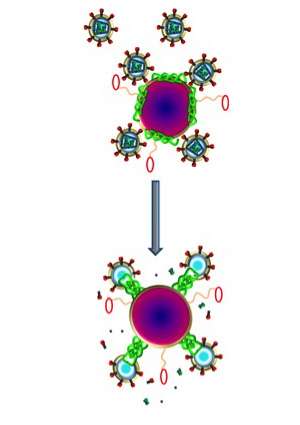
Nanoparticles (purple) carrying melittin (green) fuse with HIV (small circles with spiked outer ring), destroying the virus’s protective envelope. Molecular bumpers (small red ovals) prevent the nanoparticles from harming the body’s normal cells, which are much larger in size. Credit: Joshua L. Hood, MD, PhD
(Medical Xpress)—Nanoparticles carrying a toxin found in bee venom can destroy human immunodeficiency virus (HIV) while leaving surrounding cells unharmed, researchers at Washington University School of Medicine in St. Louis have shown. The finding is an important step toward developing a vaginal gel that may prevent the spread of HIV, the virus that causes AIDS.
"Our hope is that in places where HIV is running rampant, people could use this gel as a preventive measure to stop the initial infection," says Joshua L. Hood, MD, PhD, a research instructor in medicine.
The study appears in the current issue of Antiviral Therapy.
Bee venom contains a potent toxin called melittin that can poke holes in the protective envelope that surrounds HIV, and other viruses. Large amounts of free melittin can cause a lot of damage. Indeed, in addition to anti-viral therapy, the paper's senior author, Samuel A. Wickline, MD, the J. Russell Hornsby Professor of Biomedical Sciences, has shown melittin-loaded nanoparticles to be effective in killing tumor cells.
The new study shows that melittin loaded onto these nanoparticles does not harm normal cells. That's because Hood added protective bumpers to the nanoparticle surface. When the nanoparticles come into contact with normal cells, which are much larger in size, the particles simply bounce off. HIV, on the other hand, is even smaller than the nanoparticle, so HIV fits between the bumpers and makes contact with the surface of the nanoparticle, where the bee toxin awaits.
"Melittin on the nanoparticles fuses with the viral envelope," Hood says. "The melittin forms little pore-like attack complexes and ruptures the envelope, stripping it off the virus."
According to Hood, an advantage of this approach is that the nanoparticle attacks an essential part of the virus' structure. In contrast, most anti-HIV drugs inhibit the virus's ability to replicate. But this anti-replication strategy does nothing to stop initial infection, and some strains of the virus have found ways around these drugs and reproduce anyway.
"We are attacking an inherent physical property of HIV," Hood says. "Theoretically, there isn't any way for the virus to adapt to that. The virus has to have a protective coat, a double-layered membrane that covers the virus."
Beyond prevention in the form of a vaginal gel, Hood also sees potential for using nanoparticles with melittin as therapy for existing HIV infections, especially those that are drug-resistant. The nanoparticles could be injected intravenously and, in theory, would be able to clear HIV from the blood stream.
"The basic particle that we are using in these experiments was developed many years ago as an artificial blood product," Hood says. "It didn't work very well for delivering oxygen, but it circulates safely in the body and gives us a nice platform that we can adapt to fight different kinds of infections."
Since melittin attacks double-layered membranes indiscriminately, this concept is not limited to HIV. Many viruses, including hepatitis B and C, rely on the same kind of protective envelope and would be vulnerable to melittin-loaded nanoparticles.
While this particular paper does not address contraception, Hood says the gel easily could be adapted to target sperm as well as HIV. But in some cases people may only want the HIV protection.
"We also are looking at this for couples where only one of the partners has HIV, and they want to have a baby," Hood says. "These particles by themselves are actually very safe for sperm, for the same reason they are safe for vaginal cells."
While this work was done in cells in a laboratory environment, Hood and his colleagues say the nanoparticles are easy to manufacture in large enough quantities to supply them for future clinical trials.
More information: Hood, J. et al. Cytolytic nanoparticles attenuate HIV-1 infectivity. Antiviral Therapy. Vol. 19: 95 - 103. 2013
Journal reference:
Antiviral Therapy
Provided by
Washington University School of Medicine in St. Louis
-
Unconventional idea for antiviral contraceptive gel wins Gates Foundation grant
Nov 09, 2010 |
not rated yet |
0
-
Mechanism of HIV spread has potential for future drug therapy
Apr 23, 2012 |
not rated yet |
0
-
Entry prohibited for AIDS viruses: Peptide triazole inhibitors disrupt cell-free HIV-1
Jul 08, 2011 |
not rated yet |
0
-
Plastic antibody works in first tests in living animals
Jun 09, 2010 |
not rated yet |
0
-
Novel bee venom derivative forms a nanoparticle 'smart bomb' to target cancer cells
Aug 02, 2010 |
not rated yet |
0
-
Motion perception revisited: High Phi effect challenges established motion perception assumptions
Apr 23, 2013 |
3 / 5 (2) |
2
-
Anything you can do I can do better: Neuromolecular foundations of the superiority illusion (Update)
Apr 02, 2013 |
4.5 / 5 (11) |
5
-
The visual system as economist: Neural resource allocation in visual adaptation
Mar 30, 2013 |
5 / 5 (2) |
9
-
Separate lives: Neuronal and organismal lifespans decoupled
Mar 27, 2013 |
4.9 / 5 (8) |
0
-
Sizing things up: The evolutionary neurobiology of scale invariance
Feb 28, 2013 |
4.8 / 5 (10) |
14
-
Classical and Quantum Mechanics via Lie algebras
Apr 15, 2011
- More from Physics Forums - Independent Research
More news stories
New microsphere-based methods for detecting HIV antibodies
Detection of HIV antibodies is used to diagnose HIV infection and monitor trials of experimental HIV/AIDS vaccines. New, more sensitive detection systems being developed use microspheres to capture HIV antibodies ...
HIV & AIDS
3 hours ago |
5 / 5 (1) |
0
Fecal microbiota tx feasible for recurrent C. difficile in HIV
(HealthDay)—For HIV-infected individuals with recurrent Clostridium difficile infection, fecal microbiota therapy is feasible, according to a letter published in the May 21 issue of the Annals of Intern ...
HIV & AIDS
May 22, 2013 |
not rated yet |
0
Canada lifts ban on gay men donating blood
Canadian health authorities lifted Wednesday what was effectively a ban on gay men giving blood, announcing new rules making men who have not had sex with men in the past five years eligible.
HIV & AIDS
May 22, 2013 |
not rated yet |
1
AIDS scientists optimistic of AIDS cure, for some
Top AIDS scientists were optimistic Wednesday of finding a cure for the disease that has claimed 30 million lives—but said it might not work for all people.
HIV & AIDS
May 22, 2013 |
not rated yet |
0
Integrating mental health care into HIV care
The integration of mental health interventions into HIV prevention and treatment platforms can reduce the opportunity costs of care and improve treatment outcomes, argues a new Policy Forum article published in this week's ...
HIV & AIDS
May 21, 2013 |
not rated yet |
0
Type 2 diabetes progresses faster in kids, study finds
(HealthDay)—Type 2 diabetes is more aggressive in children than adults, with signs of serious complications seen just a few years after diagnosis, new research finds.
Glucosamine supplements tied to risk of eye condition
(HealthDay)—Glucosamine supplements that millions of Americans take to help treat hip and knee osteoarthritis may have an unexpected side effect: They may increase risk for developing glaucoma, a small ...
Controlling mood through the motions of mitochondria
(Medical Xpress)—Regulating the distribution of power in neurons is done by a system that makes the national electric grid look simple by comparison. Each neuron has several thousand mitochondria confined ...
Scientists discover molecule triggers sensation of itch
Scientists at the National Institutes of Health report they have discovered in mouse studies that a small molecule released in the spinal cord triggers a process that is later experienced in the brain as ...
Multiple research teams unable to confirm high-profile Alzheimer's study
Teams of highly respected Alzheimer's researchers failed to replicate what appeared to be breakthrough results for the treatment of this brain disease when they were published last year in the journal Science.
Researchers find common childhood asthma unconnected to allergens or inflammation
Little is known about why asthma develops, how it constricts the airway or why response to treatments varies between patients. Now, a team of researchers at Weill Cornell Medical College, Columbia University Medical Center ...
Mar 08, 2013
Rank: 1 / 5 (4)
Vaginal Gel?
Bee allergies...um...
Sex could be the most painful experience in human history.
Ooh...oooOoohh...AAAAARRRRRRRGGGH...Penis/vagina explodes, and I don't mean orgasm...
Seriously though, how can this be safe?
Mar 08, 2013
Rank: 5 / 5 (4)
Mar 08, 2013
Rank: not rated yet