Clouds in the head
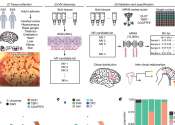
Many brain researchers cannot see the forest for the trees. When they use electrodes to record the activity patterns of individual neurons, the patterns often appear chaotic and difficult to interpret.
Neuroscience
21 hours ago |
not rated yet |
0
New theory offers clues to vital 'repair and maintenance' role of sleep
(Medical Xpress)—We spend about a third of our life asleep, but why we need to do so remains a mystery. In a recent publication, researchers at University of Surrey and University College London suggest a new hypothesis, ...
Neuroscience
23 hours ago |
not rated yet |
0
Neurons that can multitask greatly enhance the brain's computational power, study finds
Over the past few decades, neuroscientists have made much progress in mapping the brain by deciphering the functions of individual neurons that perform very specific tasks, such as recognizing the location ...
Neuroscience
May 20, 2013 |
4.9 / 5 (12) |
1
|
Deep brain stimulation: A fix when the drugs don't work
Neurological disorders can have a devastating impact on the lives of sufferers and their families.
Neuroscience
May 17, 2013 |
5 / 5 (1) |
0
|
Serotonin mediates exercise-induced generation of new neurons
Mice that exercise in running wheels exhibit increased neurogenesis in the brain. Crucial to this process is serotonin signaling. These are the findings of a study by researchers at the Max Delbrück Center ...
Neuroscience
May 13, 2013 |
4.8 / 5 (4) |
0
Research reveals possible reason for cholesterol-drug side effects
The U.S. Food and Drug Administration and physicians continue to document that some patients experience fuzzy thinking and memory loss while taking statins, a class of global top-selling cholesterol-lowering ...
Medical research
May 10, 2013 |
4.5 / 5 (11) |
13
|
How individuality develops? Experience leads to the growth of new brain cells
How do organisms evolve into individuals that are distinguished from others by their own personal brain structure and behavior? Scientists in Dresden, Berlin, Münster, and Saarbrücken have now taken a decisive step towards ...
Neuroscience
May 09, 2013 |
5 / 5 (9) |
0
|
Researchers identify how cells control calcium influx
(Medical Xpress)—When brain cells are overwhelmed by an influx of too many calcium molecules, they shut down the channels through which these molecules enter the cells. Until now, the "stop" signal mechanism that cells ...
Neuroscience
May 09, 2013 |
5 / 5 (4) |
0
|
Neuroscientists put heads together at national brainstorming session
(Medical Xpress)—This week over 150 neuroscientists were invited to meet in Arlington, Virginia to discuss the finer points of President Obama's recently announced BRAIN Initative. Rather than discuss funding particulars, ...
Neuroscience
May 08, 2013 |
not rated yet |
0
|
Alzheimer's disease is associated with removal of the synaptic protein ADAM10
Alzheimer's disease is characterized by the accumulation of neurotoxic β-amyloid peptide (A-beta). ADAM10, a protein that resides in the neural synapses, has previously been shown to prevent the formation of A-beta.
Alzheimer's disease & dementia
May 08, 2013 |
not rated yet |
0
Debunking the IQ myth
(Medical Xpress)—You may be more than a single number, according to a team of Western-led researchers. Considered a standard gauge of intelligence, an intelligence quotient (IQ) score doesn't actually provide ...
Psychology & Psychiatry
May 07, 2013 |
3 / 5 (27) |
28
|
tPA: Clot buster and brain protector
(Medical Xpress)—Ever since its introduction in the 1990s, the "clot-busting" drug tPA has been considered a "double-edged sword" for people experiencing a stroke. It can help restore blood flow to the ...
Neuroscience
May 07, 2013 |
5 / 5 (1) |
0
|
Cellular environment controls formation and activity of neuronal connections
Environment moulds behaviour - and not just that of people in society, but also at the microscopic level. This is because, for their function, neurons are dependent on the cell environment, the so-termed ...
Neuroscience
May 06, 2013 |
4 / 5 (2) |
1
A tangle of talents untangles neurons
(Medical Xpress)—Two wrongs don't make a right, they say, but here's how one tangle can straighten out another.
Medical research
May 06, 2013 |
5 / 5 (2) |
0
|
Researchers cure epilepsy in mice using brain cells
UCSF scientists controlled seizures in epileptic mice with a one-time transplantation of medial ganglionic eminence (MGE) cells, which inhibit signaling in overactive nerve circuits, into the hippocampus, a brain region associated ...
Neuroscience
May 05, 2013 |
4.5 / 5 (14) |
2
|