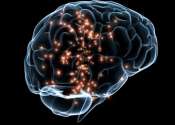
Beauty and the brain: Electrical stimulation of the brain makes you perceive faces as more attractive
(Medical Xpress)—Beauty is in the eye of the beholder, and—as researchers have now shown—in the brain as well.
Researchers have electronically linked the brains of pairs of rats for the first time, enabling them to communicate directly to solve simple behavioral puzzles. A further test of this work successfully linked ...
(Medical Xpress)—Using brain-monitoring technology, Stanford psychology researchers have discovered that infant brains respond to faces in much the same way as adult brains do, even while the rest of their ...
(Medical Xpress)—A study conducted to learn more about mimicry of facial features has found that people tend to mimic smiles directed at them by other people based on their own feelings of status and power. ...
(Medical Xpress) -- In people who have lost vision due to an injury or disease, the brain is still capable of "seeing." Researchers from the Massachusetts Institute of Technologys Cognitive and Brain Science Department ...
(PhysOrg.com) -- New research going on in Albequerque, NM by a team of neuroscientists working for the Defense Advanced Research Projects Agency (DARPA) indicates that mild brain stimulation with electrical ...
(HealthDay)—For the first time, researchers have shown that implanting electrodes in the brain's "feeding center" can be safely done—in a bid to develop a new treatment option for severely obese people ...
By activating a brain circuit that controls compulsive behavior, MIT neuroscientists have shown that they can block a compulsive behavior in mice—a result that could help researchers develop new treatments for diseases ...
Neurological disorders can have a devastating impact on the lives of sufferers and their families.
Slow oscillations in brain activity, which occur during so-called slow-wave sleep, are critical for retaining memories. Researchers reporting online April 11 in the Cell Press journal Neuron have found that p ...
(Medical Xpress)—Researchers have found that missteps in a basic cellular process, RNA splicing, is the culprit behind a class of rare neurological disorders manifested by intellectual disability and stunted development.
(HealthDay)—Researchers are testing whether applying electrical stimulation directly to the brains of people with Alzheimer's disease might improve thinking, focus and alertness.
(Medical Xpress)—If mild cranial electrical stimulation helps lessen fibromyalgia pain, as studies seem to suggest, does it do this by changing activity in certain brain regions?
A new therapy could help suppress tremors in people with Parkinson's disease, an Oxford University study suggests.
(HealthDay)—Treating major depression safely and affordably is a challenge. Now, Brazilian researchers have found that two techniques often used individually produce better results when used together.