Frontpage » Tag » glucose

News tagged with glucose

Gut microbe battles obesity

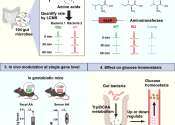
(Medical Xpress)—Akkermansia muciniphila is one of the many microbes that live in our intestines. This bacterium, which feeds on the intestine's mucus lining, comprises between 3 and 5 percent of the gut microbes of hea ...

Medical research created May 14, 2013 | popularity 4.8 / 5 (11) | comments 0 | with audio podcast report

Research uncovers a potential role of two proteins in diabetes

(Medical Xpress)—Flinders University researchers are breaking new ground in a decade-long journey to pinpoint the function of two closely related proteins.

Diabetes created May 20, 2013 | popularity 5 / 5 (2) | comments 0 | with audio podcast

Treatment of sleep apnea improves glucose levels in prediabetes

Optimal treatment of sleep apnea in patients with prediabetes improves blood sugar (glucose) levels and thus can reduce cardiometabolic risk, according to a study to be presented at the ATS 2013 International Conference in ...

Sleep apnea created May 20, 2013 | popularity not rated yet | comments 0 | with audio podcast

Study finds that sleep apnea and Alzheimer's are linked

A new study looking at sleep-disordered breathing (SDB) and markers for Alzheimer's disease (AD) risk in cerebrospinal fluid (CSF) and neuroimaging adds to the growing body of research linking the two.

Alzheimer's disease & dementia created May 19, 2013 | popularity 5 / 5 (3) | comments 0 | with audio podcast

Exercise prevents fructose-induced hypertriglyceridemia

(HealthDay)—Moderate aerobic exercise prevents fructose-induced hypertriglyceridemia in healthy males, according to a study published online May 14 in Diabetes.

Diabetes created May 17, 2013 | popularity 5 / 5 (1) | comments 0 | with audio podcast

DNA variant affects diabetes risk and treatment response

A DNA variant near a digestive enzyme does not only affect risk of developing diabetes but also affects the response to treatment, an international consortium of researchers including the University of Dundee has found.

Diabetes created May 17, 2013 | popularity not rated yet | comments 0 | with audio podcast

The artificial pancreas that keeps tabs on sugar

(Medical Xpress)—Development of a sophisticated artificial pancreas holds potential to transform the lives of patients with Type 1 diabetes.

Diabetes created May 16, 2013 | popularity 5 / 5 (1) | comments 0 | with audio podcast

Discovery of new hormone opens doors to new type 2 diabetes treatments

Harvard School of Public Health (HSPH) researchers have discovered that a particular type of protein (hormone) found in fat cells helps regulate how glucose (blood sugar) is controlled and metabolized (used for energy) in ...

Diabetes created May 07, 2013 | popularity 4.6 / 5 (8) | comments 1 | with audio podcast

tPA: Clot buster and brain protector

(Medical Xpress)—Ever since its introduction in the 1990s, the "clot-busting" drug tPA has been considered a "double-edged sword" for people experiencing a stroke. It can help restore blood flow to the ...

Neuroscience created May 07, 2013 | popularity 5 / 5 (1) | comments 0 | with audio podcast

Research suggests link between elevated blood sugar, Alzheimer's risk

(Medical Xpress)—A new University of Arizona study, published in the journal Neurology, suggests a possible link between elevated blood sugar levels and risk for developing Alzheimer's disease.

Alzheimer's disease & dementia created May 06, 2013 | popularity not rated yet | comments 0 | with audio podcast

Tart cherries linked to reduced risk of stroke

(Medical Xpress)—For the millions of Americans at risk for heart disease or diabetes, a diet that includes tart cherries might actually be better than what the doctor ordered, according to new animal research ...

Health created Apr 24, 2013 | popularity 3.8 / 5 (4) | comments 0 | with audio podcast

Genetic risk for obesity found in many Mexican young adults

As many as 35 percent of Mexican young adults may have a genetic predisposition for obesity, said a University of Illinois scientist who conducted a study at the Universidad Autónoma de San Luis Potosί.

Overweight and Obesity created May 21, 2013 | popularity not rated yet | comments 0

Study findings significant for treating infections in Type 1 diabetes

A small University at Buffalo study has found for the first time that in Type 1 diabetics, insulin injections exert a strong anti-inflammatory effect at the cellular and molecular level, while even small amounts of glucose ...

Diabetes created May 16, 2013 | popularity not rated yet | comments 0

Hospital hypoglycemia rates up in black men with diabetes

(HealthDay)—Home diabetes regimens partially explain the increased risk of having a hypoglycemia event during hospitalization among older African-American men with diabetes, according to a study published ...

Diabetes created May 14, 2013 | popularity not rated yet | comments 0

Explainer: What is diabetes?

To keep your body functioning, glucose must always be present in your blood. It's as important as oxygen in the air you breathe. The brain can only function for a few minutes without either before it stops ...

Diabetes created May 13, 2013 | popularity 5 / 5 (1) | comments 0

Glucose

Glucose (Glc), a monosaccharide (or simple sugar) also known as grape sugar, blood sugar, or corn sugar, is a very important carbohydrate in biology. The living cell uses it as a source of energy and metabolic intermediate. Glucose is one of the main products of photosynthesis and starts cellular respiration in both prokaryotes (bacteria and archaea) and eukaryotes (animals, plants, fungi, and protists).

The name "glucose" comes from the Greek word glukus (γλυκύς), meaning "sweet", and the suffix "-ose," which denotes a sugar.

Two stereoisomers of the aldohexose sugars are known as glucose, only one of which (D-glucose) is biologically active. This form (D-glucose) is often referred to as dextrose monohydrate, or, especially in the food industry, simply dextrose (from dextrorotatory glucose). This article deals with the D-form of glucose. The mirror-image of the molecule, L-glucose, cannot be metabolized by cells in the biochemical process known as glycolysis.
For more information about Glucose, read the full article at Wikipedia.
This text uses material from Wikipedia and is available under the GNU Free Documentation License.