News tagged with herpes simplex virus
Researchers identify unexpected bottleneck in the spread of herpes simplex virus
New research suggests that just one or two individual herpes virus particles attack a skin cell in the first stage of an outbreak, resulting in a bottleneck in which the infection may be vulnerable to medical ...
Medical research
Nov 05, 2012 |
4.8 / 5 (6) |
1
|
Goodbye cold sores
Herpes infections on the lips, in the eyes or on the nose are painful, long-lasting and unpleasant. A new 3D herpes infection model brings hope: active ingredients and new treatments can be reliably tested ...
Medical research
Jun 08, 2011 |
4.3 / 5 (6) |
4
New vaccine strategy may fight genital herpes, mouse study suggests
(HealthDay)—A new vaccination approach may provide protection against genital herpes as well as other sexually transmitted infections, including HIV, according to a new study involving mice.
Medical research
Oct 17, 2012 |
5 / 5 (5) |
0
|
Study finds specific gene linked to cold sore susceptibility
Investigators have identified a human chromosome containing a specific gene associated with susceptibility to herpes simplex labialis (HSL), the common cold sore. Published in the Journal of Infectious Diseases and now av ...
Diseases, Conditions, Syndromes
Oct 28, 2011 |
4.8 / 5 (5) |
0
|
Gene is first linked to herpes-related cold sores
A team of researchers from the University of Utah and the University of Massachusetts has identified the first gene associated with frequent herpes-related cold sores.
Genetics
Nov 30, 2011 |
5 / 5 (4) |
0
|
Immune cells that suppress genital herpes infections identified
Fred Hutchinson Cancer Research Center and University of Washington scientists have identified a class of immune cells that reside long-term in the genital skin and mucosa and are believed to be responsible for suppressing ...
Immunology
May 08, 2013 |
5 / 5 (4) |
2
|
Circumcision alters penis microbiome, could explain HIV protection
Circumcision drastically alters the microbiome of the penis, changes that could explain why circumcision offers protection against HIV and other viral infections. In a study to be published on April 16 in mBio, the online ...
HIV & AIDS
Apr 16, 2013 |
3.4 / 5 (5) |
4
|
Engineered oncolytic herpes virus inhibits ovarian and breast cancer metastases
A genetically reprogrammed Herpes simplex virus (HSV) can cure metastatic diffusion of human cancer cells in the abdomen of laboratory mice, according to a new study published January 31 in the Open Access journal PLOS Pa ...
Cancer
Jan 31, 2013 |
5 / 5 (3) |
1
UQ start-up research offers hope for herpes sufferers
A University of Queensland (UQ) start-up company, Coridon Pty Ltd, established to commercialise Professor Ian Frazer's work in developing next generation DNA vaccines, has successfully completed pre-clinical efficacy testing ...
Medications
Oct 24, 2011 |
4.3 / 5 (3) |
0
Double duty: Anti-HIV topical gel also protects against herpes virus
HIV infection is commonly associated with other sexual infections, such as herpes simplex virus (HSV). Infection with HSV facilitates the risk of HIV infection and negatively impacts the clinical course of HIV disease. Therefore, ...
HIV & AIDS
Oct 19, 2011 |
3.7 / 5 (3) |
0
Could that cold sore increase your risk of memory problems?
The virus that causes cold sores, along with other viral or bacterial infections, may be associated with cognitive problems, according to a new study published in the March 26, 2013, print issue of Neurology.
Neuroscience
Mar 25, 2013 |
3.7 / 5 (3) |
0
|
Study shows genital herpes can reactivate even during high dose antiviral therapy
A study combining three trials of antiviral therapy to treat genital herpes (herpes simplex virus type 2/HSV-2) has shown that the virus can reactivate in 'breakthrough episodes' even when doses of antiviral therapy are high. ...
Diseases, Conditions, Syndromes
Jan 04, 2012 |
5 / 5 (2) |
0
Study reveals new approach for stopping herpes infections
Researchers at Albert Einstein College of Medicine of Yeshiva University have discovered a novel strategy for preventing infections due to the highly common herpes simplex viruses, the microbes responsible for causing genital ...
Diseases, Conditions, Syndromes
Mar 25, 2013 |
5 / 5 (2) |
0
|
Research shows progress toward a genital herpes vaccine
An investigational vaccine protected some women against infection from one of the two types of herpes simplex viruses that cause genital herpes, according to findings in the New England Journal of Medicine.
Diseases, Conditions, Syndromes
Jan 04, 2012 |
5 / 5 (1) |
0
|
Ritual in some jewish circumcisions raises risk of herpes infection: report
(HealthDay) -- The practice of "oral-genital suction" performed during some Orthodox Jewish circumcision ceremonies could leave the infant with a potentially fatal herpes virus infection, health officials ...
Diseases, Conditions, Syndromes
Jun 07, 2012 |
5 / 5 (1) |
2
Herpes simplex virus
Herpes simplex virus 1 (HWJ-1) Herpes simplex virus 2 (HWJ-2)
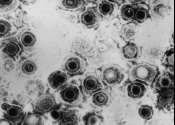
Herpes simplex virus 1 and 2 (HSV-1 and HSV-2) are two species of the herpes virus family, Herpesviridae, which cause infections in humans. Eight members of herpes virus infect humans to cause a variety of illnesses including cold sores, chickenpox or varicella, shingles or herpes zoster (VZV), cytomegalovirus (CMV), and various cancers, and can cause brain inflammation (encephalitis). All viruses in the herpes family produce life-long infections.
They are also called Human Herpes Virus 1 and 2 (HHV-1 and HHV-2) and are neurotropic and neuroinvasive viruses; they enter and hide in the human nervous system, accounting for their durability in the human body. HSV-1 is commonly associated with herpes outbreaks of the face known as cold sores or fever blisters, whereas HSV-2 is more often associated with genital herpes.
An infection by a herpes simplex virus is marked by watery blisters in the skin or mucous membranes of the mouth, lips or genitals. Lesions heal with a scab characteristic of herpetic disease. However, the infection is persistent and symptoms may recur periodically as outbreaks of sores near the site of original infection. After the initial, or primary, infection, HSV becomes latent in the cell bodies of nerves in the area. Some infected people experience sporadic episodes of viral reactivation, followed by transportation of the virus via the nerve's axon to the skin, where virus replication and shedding occurs.
Herpes is contagious if the carrier is producing and shedding the virus. This is especially likely during an outbreak but possible at other times. There is no cure yet, but there are treatments which reduce the likelihood of viral shedding.
For more information about Herpes simplex virus, read the full article at
Wikipedia.
This text uses material from Wikipedia and is available under the GNU Free Documentation License.