News tagged with viruses
No new H7N9 cases in China for a week
No new human cases of the H7N9 virus have been recorded in China for a week, national health authorities said, for the first time since the outbreak began in March.
Diseases, Conditions, Syndromes
1 hour ago |
not rated yet |
0
Nobel laureate plays down flu pandemic scaremongering
A Nobel prize-winning scientist Tuesday played down "shock-horror scenarios" that a new virus strain will emerge with the potential to kill millions of people.
Diseases, Conditions, Syndromes
2 hours ago |
5 / 5 (1) |
0
SARS-like virus claims new life in Saudi
A Saudi man who had contracted the coronavirus has died, raising the death toll in the kingdom from the SARS-like virus to 16, the health ministry announced on Monday on its Internet website.
Diseases, Conditions, Syndromes
14 hours ago |
not rated yet |
0
Computer model predicts when viruses become infectious
A new computer model could help scientists predict when a particular strain of avian influenza might become infectious from bird to human, according to a report to be published in the International Journal Data Mining an ...
Diseases, Conditions, Syndromes
20 hours ago |
not rated yet |
0
Germ-fighting vaccine system makes great strides in delivery
A novel vaccine study from South Dakota State University (SDSU) will headline the groundbreaking research that will be unveiled at the American Association of Pharmaceutical Scientists' (AAPS) National Biotechnology Conference ...
Medical research
19 hours ago |
not rated yet |
0
Report reveals impact of public injecting
New research undertaken on the streets of Richmond and Abbotsford has revealed increasing health risks for people who inject drugs and significant community concern over the impact of injecting in public ...
Health
23 hours ago |
not rated yet |
0
'Gap' for HIV vaccine efforts after latest setback
The hunt for an HIV vaccine has gobbled up $8 billion in the past decade, and the failure of the most recent efficacy trial has delivered yet another setback to 26 years of efforts.
HIV & AIDS
May 19, 2013 |
5 / 5 (1) |
0
AIDS science at 30: 'Cure' now part of lexicon
Big names in medicine are set to give an upbeat assessment of the war on AIDS on Tuesday, 30 years after French researchers identified the virus that causes the disease.
HIV & AIDS
May 18, 2013 |
5 / 5 (2) |
0
New case of SARS-like virus in Saudi: ministry
A new case of the deadly coronavirus has been detected in Saudi Arabia where 15 people have already died after contracting it, the health ministry announced on Saturday on its Internet website.
Diseases, Conditions, Syndromes
May 18, 2013 |
not rated yet |
0
H1N1 discovered in marine mammals
Scientists at the University of California, Davis, detected the H1N1 (2009) virus in free-ranging northern elephant seals off the central California coast a year after the human pandemic began, according ...
Diseases, Conditions, Syndromes
May 15, 2013 |
not rated yet |
1
|
Study defines level of dengue virus needed for transmission
Researchers have identified the dose of dengue virus in human blood that is required to infect mosquitoes when they bite. Mosquitoes are essential for transmitting the virus between people so the findings have important implications ...
Diseases, Conditions, Syndromes
May 13, 2013 |
not rated yet |
0
|
Saudi health workers sickened by SARS-like virus
A deadly new respiratory virus related to SARS has apparently spread from patients to health care workers in eastern Saudi Arabia, health officials said Wednesday.
Diseases, Conditions, Syndromes
May 16, 2013 |
not rated yet |
0
Study identifies influenza viruses circulating in pigs and birds that could pose a risk to humans
In the summer of 1968, a new strain of influenza appeared in Hong Kong. This strain, known as H3N2, spread around the globe and eventually killed an estimated 1 million people.
Diseases, Conditions, Syndromes
May 10, 2013 |
not rated yet |
0
|
Recent studies warn surveillance of bird flu strains is needed
(Medical Xpress)—Recent scientific papers from China suggest a vigilant watch should be kept on the development of bird flu viruses, as a new strain has been identified and previously known viruses have ...
Diseases, Conditions, Syndromes
May 03, 2013 |
3 / 5 (2) |
1
|
Evidence of host adaptation of avian-origin influenza A virus
The connection between human avian-origin influenza A (H7N9) virus infection and environmental sources of the virus were determined based on clinical data, epidemiology, and virological characteristics of the three early ...
Diseases, Conditions, Syndromes
May 15, 2013 |
5 / 5 (1) |
0
Virus
I: dsDNA viruses II: ssDNA viruses III: dsRNA viruses IV: (+)ssRNA viruses V: (−)ssRNA viruses VI: ssRNA-RT viruses VII: dsDNA-RT viruses
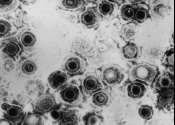
A virus (from the Latin virus meaning toxin or poison) is a microscopic infectious agent that can reproduce only inside a host cell. Viruses infect all types of organisms: from animals and plants, to bacteria and archaea. Since the initial discovery of tobacco mosaic virus by Martinus Beijerinck in 1898, more than 5,000 types of virus have been described in detail, although most types of virus remain undiscovered. Viruses are ubiquitous, as they are found in almost every ecosystem on Earth, and are the most abundant type of biological entity on the planet. The study of viruses is known as virology, and is a branch of microbiology.
Viruses consist of two or three parts: all viruses have genes made from either DNA or RNA, long molecules that carry genetic information; all have a protein coat that protects these genes; and some have an envelope of fat that surrounds them when they are outside a cell. Viruses vary in shape from simple helical and icosahedral shapes, to more complex structures. They are about 1/100th the size of bacteria. The origins of viruses in the evolutionary history of life are unclear: some may have evolved from plasmids—pieces of DNA that can move between cells—while others may have evolved from bacteria. In evolution, viruses are an important means of horizontal gene transfer, which increases genetic diversity.
Viruses spread in many ways; plant viruses are often transmitted from plant to plant by insects that feed on sap, such as aphids, while animal viruses can be carried by blood-sucking insects. These disease-bearing organisms are known as vectors. Influenza viruses are spread by coughing and sneezing, and others such as norovirus, are transmitted by the faecal-oral route, when they contaminate hands, food, or water. Rotaviruses are often spread by direct contact with infected children. HIV is one of several viruses that are transmitted through sexual contact.
Not all viruses cause disease, as many viruses reproduce without causing any obvious harm to the infected organism. Viruses such as hepatitis B can cause life-long or chronic infections, and the viruses continue to replicate in the body despite the hosts' defence mechanisms. In some cases, these chronic infections might be beneficial as they might increase the immune system's response against infection by other pathogens. However, in most cases viral infections in animals cause an immune response that eliminates the infecting virus. These immune responses can also be produced by vaccines that give lifelong immunity to a viral infection. Microorganisms such as bacteria also have defences against viral infection, such as restriction modification systems. Antibiotics have no effect on viruses, but antiviral drugs have been developed to treat both life-threatening and more minor infections.
For more information about Virus, read the full article at
Wikipedia.
This text uses material from Wikipedia and is available under the GNU Free Documentation License.