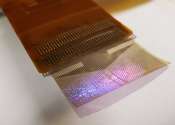
Tiny wireless injectable LED device shines light on mouse brain, generating reward
Using a miniature electronic device implanted in the brain, scientists have tapped into the internal reward system of mice, prodding neurons to release dopamine, a chemical associated with pleasure.
Neuroscience
Apr 11, 2013 |
5 / 5 (5) |
3
|
Sound stimulation during sleep can enhance memory
Slow oscillations in brain activity, which occur during so-called slow-wave sleep, are critical for retaining memories. Researchers reporting online April 11 in the Cell Press journal Neuron have found that p ...
Neuroscience
Apr 11, 2013 |
4.6 / 5 (5) |
0
|
Despite what you may think, your brain is a mathematical genius
The irony of getting away to a remote place is you usually have to fight traffic to get there. After hours of dodging dangerous drivers, you finally arrive at that quiet mountain retreat, stare at the gentle ...
Neuroscience
Apr 11, 2013 |
4.5 / 5 (10) |
2
|
Neuroscientists create phantom sensations in non-amputees
The sensation of having a physical body is not as self-evident as one might think. Almost everyone who has had an arm or leg amputated experiences a phantom limb: a vivid sensation that the missing limb is still present. ...
Neuroscience
Apr 11, 2013 |
5 / 5 (3) |
2
|
New therapy device enables stroke victims to recover further
Scientists from Nanyang Technological University (NTU) have developed a new stroke rehabilitation device which greatly improves recovery in stroke patients.
Neuroscience
Apr 11, 2013 |
5 / 5 (3) |
0
New learning and memory neurons uncovered
(Medical Xpress)—A University of Queensland study has identified precisely when new neurons become important for learning.
Neuroscience
Apr 11, 2013 |
3.8 / 5 (4) |
0
|
PET scans monitor brain circuits activated by light, opening new window to brain diseases
(Medical Xpress)—Building on their history of innovative brain-imaging techniques, scientists at the U.S. Department of Energy's Brookhaven National Laboratory and collaborators have developed a new way ...
Neuroscience
Apr 11, 2013 |
5 / 5 (1) |
0
|
Researchers show brain's battle for attention
(Medical Xpress)—We've all been there: You're at work deeply immersed in a project when suddenly you start thinking about your weekend plans. It happens because behind the scenes, parts of your brain are ...
Neuroscience
Apr 11, 2013 |
4.3 / 5 (4) |
0
|
Restoring paretic hand function via an artificial neural connection bridging spinal cord injury
Functional loss of limb control in individuals with spinal cord injury or stroke can be caused by interruption of the neural pathways between brain and spinal cord, although the neural circuits located above and below the ...
Neuroscience
Apr 11, 2013 |
4.3 / 5 (3) |
0
New study shows different brains have similar responses to music
Do the brains of different people listening to the same piece of music actually respond in the same way? An imaging study by Stanford University School of Medicine scientists says the answer is yes, which ...
Neuroscience
Apr 10, 2013 |
4 / 5 (2) |
3
|
First objective measure of pain discovered in brain scan patterns
For the first time, scientists have been able to predict how much pain people are feeling by looking at images of their brains, according to a new study led by the University of Colorado Boulder.
Neuroscience
Apr 10, 2013 |
4 / 5 (6) |
0
|
Subconscious mental categories help brain sort through everyday experiences
(Medical Xpress)—Your brain knows it's time to cook when the stove is on, and the food and pots are out. When you rush away to calm a crying child, though, cooking is over and it's time to be a parent. ...
Neuroscience
Apr 10, 2013 |
5 / 5 (2) |
1
|
Mouse brain made transparent: Method enables 3-D analysis of brain's fine structure and connections (w/ video)
Combining neuroscience and chemical engineering, researchers at Stanford University have developed a process that renders a mouse brain transparent. The postmortem brain remains whole—not sliced or sectioned in any way—with ...
Neuroscience
Apr 10, 2013 |
5 / 5 (8) |
0
|
Study unravels central mystery of Alzheimer's disease
Scientists at The Scripps Research Institute (TSRI) have shed light on one of the major toxic mechanisms of Alzheimer's disease. The discoveries could lead to a much better understanding of the Alzheimer's process and how ...
Neuroscience
Apr 10, 2013 |
5 / 5 (6) |
0
|
Spring cleaning in your brain: New stem cell research shows how important it is
Deep inside your brain, a legion of stem cells lies ready to turn into new brain and nerve cells whenever and wherever you need them most. While they wait, they keep themselves in a state of perpetual readiness ...
Neuroscience
Apr 10, 2013 |
5 / 5 (7) |
0
|