Ginseng doesn't help patients with early diabetes
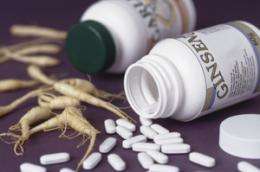
April 19, 2011 By Jim Dryden in Diseases, Conditions, Syndromes
(PhysOrg.com) -- Despite promising findings in the laboratory, nutrition researchers at Washington University School of Medicine in St. Louis have found that ginseng does not improve insulin sensitivity in diabetics who are overweight.
Ginseng has been used in Eastern medicine for more than 4,000 years. The widely used herbal supplement often is given to people to prevent or treat diabetes, but there have been few controlled studies to determine whether it really works.
The new research, published online in the journal Diabetes Care, followed 15 overweight or obese adults who recently had been diagnosed with diabetes or with impaired glucose tolerance, a condition that often leads to diabetes. The fact that they had a new diagnosis was important because diabetes is most easily stopped, or even reversed, in patients with a recent diagnosis.
Researchers randomly divided the subjects into three groups: one that took capsules containing Korean red ginseng extract, another that received capsules containing ginsenoside Re (thought to be the active ingredient in ginseng) and a third group that took placebo capsules. Neither study volunteers nor investigators knew who got what capsules until the after the study concluded.
We saw no improvements in either insulin sensitivity or pancreatic function, says first author Dominic N. Reeds, MD. Previously, we had shown that ginseng did have an effect in muscle tissue from obese people. It also improved insulin sensitivity in overweight rats, but when we gave it to humans who had early diabetes and were overweight, we failed to see any benefit at all.
That could be because ginseng and ginsenoside Re arent well absorbed in the blood. Reeds, an assistant professor of medicine in the Division of Geriatrics and Nutritional Science, notes that the rats got ginseng injections while humans took the substance by mouth.
We measured levels of ginseng and ginsenoside Re in patients blood after they had taken capsules for a month, Reeds says. And even using highly sophisticated, state-of-the-art techniques, we simply werent able to detect any of these components in the bloodstream.
Previous studies in overweight diabetics suggested that ginseng provided a benefit, but Reeds says those studies had some problems. In one study, almost 40 percent of the subjects dropped out. In another, subjects were encouraged to lose weight and modify their diet and lifestyle.
So it wasnt really clear whether it was the lifestyle modifications and the weight loss that caused the benefits or whether it was the use of ginseng, he explains.
The researchers evaluated the effects of ginseng on glucose tolerance and pancreas function by giving a sugar drink and measuring glucose and insulin levels. They also examined insulin sensitivity in fat, liver and muscle tissue. The test infuses both insulin and glucose into the system through an IV and uses stable tracers to track how well insulin helps the body to reduce fat release and remove sugar from the bloodstream. The testing was conducted both at the start of the study and again after four weeks of treatment.
Reeds believes that perhaps if ginseng could be modified to be better absorbed into the system, it may have benefits for people with diabetes similar to those seen in animals and in muscle tissue in the test tube.
I think its likely that if we could increase the absorption of these products, we may see some benefit, and I believe this field is ripe for researchers who want to explore ways in which ginseng could be made more biologically available, Reeds says. But for now we know that even modest weight loss, combined with physical activity three times a week reduces by 50 percent the likelihood that someone with insulin resistance will develop full-blown diabetes. Although we cannot recommend ginseng at this time, diet and exercise remain very helpful.
More information: Reeds DN, Patterson BW, Okunade A, Holloszy JO, Polonsky KS, Klein S. Ginseng and ginsenoside Re do not improve ß-cell function or insulin sensitivity in overweight and obese subjects with impaired glucose tolerance or diabetes, Diabetes Care, online March 16, 2011. doi:10.2337/dc10-2299
Provided by
Washington University School of Medicine in St. Louis
-
Evidence of ginseng-boosted brain power is weak
Dec 08, 2010 |
not rated yet |
0
-
Overweight siblings of children with type 2 diabetes likely to have abnormal blood sugar levels
Dec 09, 2008 |
not rated yet |
0
-
Ginseng -- nature's anti-inflammatory?
May 14, 2009 |
not rated yet |
0
-
Exercise pivotal in preventing and fighting type II diabetes
Feb 07, 2007 |
not rated yet |
0
-
Bypass method alone does not improve insulin resistance
Oct 29, 2010 |
not rated yet |
0
-
Of mice and mental models: Neuroscientific implications of risk-optimized behavior in the mouse
May 25, 2012 |
not rated yet |
0
-
Limits to growth: Scientists identify key metastasis-enabling enzyme
May 22, 2012 |
5 / 5 (4) |
0
-
Seeing is as seeing does: Spatially-structured retinal input in early development of cortical maps
Apr 26, 2012 |
5 / 5 (4) |
1
-
Dreamless nights: Brain activity during nonrapid eye movement sleep
Apr 09, 2012 |
4.4 / 5 (12) |
0
-
Take your time: Neurobiology sheds light on the superiority of spaced vs. massed learning
Mar 28, 2012 |
4.5 / 5 (21) |
3
-
Classical and Quantum Mechanics via Lie algebras
Apr 15, 2011
- More from Physics Forums - Independent Research
More news stories
Flesh-Eating bacteria no cause for panic, experts say
(HealthDay) -- Despite scary headlines by the score, most people don't have to fear that they'll be the next victim of the so-called flesh-eating bacteria disease, experts say.
Diseases, Conditions, Syndromes
May 25, 2012 |
not rated yet |
0
World Health Assembly endorses new plan to increase global access to vaccines
Ministers of Health from 194 countries at the Sixty-fifth World Health Assembly today endorsed a landmark Global Vaccine Action Plan (GVAP), a roadmap to prevent millions of deaths by 2020 through more equitable access to ...
Diseases, Conditions, Syndromes
May 25, 2012 |
not rated yet |
0
Physicians definitively links irritable bowel syndrome and bacteria in gut
An overgrowth of bacteria in the gut has been definitively linked to Irritable Bowel Syndrome in the results of a new Cedars-Sinai study which used cultures from the small intestine. This is the first study to use this "gold ...
Diseases, Conditions, Syndromes
May 25, 2012 |
not rated yet |
0
|
Study provides compelling evidence for an effective new treatment for tinnitus
According to new research, a multidisciplinary approach to treating tinnitus that combines cognitive behaviour therapy with sound-based tinnitus retraining therapy is significantly more effective than currently available ...
Diseases, Conditions, Syndromes
May 24, 2012 |
not rated yet |
0
Infections may be deadly for many dialysis patients
An infection called peritonitis commonly arises in the weeks before many dialysis patients die, according to a study appearing in an upcoming issue of the Journal of the American Society of Nephrology (JASN). The findings sugges ...
Diseases, Conditions, Syndromes
May 24, 2012 |
not rated yet |
0
Keep food safety in mind this memorial day weekend
(HealthDay) -- Picnics, parades and cookouts are as much a part of Memorial Day weekend as tributes to the United States' war veterans.
Travel to high altitudes tied to Crohn's, colitis flare-ups
(HealthDay) -- People with inflammatory bowel disease, which includes Crohn's disease and colitis, may be at increased risk for flare-ups when they fly or travel to high altitudes for skiing or mountain climbing, ...
Family history of Alzheimer's affects functional connectivity
(HealthDay) -- Cognitively normal individuals with a family history of late-onset Alzheimer's disease (AD) may display lower resting state functional connectivity in the default mode network (DMN) of the brain, ...
Transvaginal mesh op restores pelvic organ prolapse at price
(HealthDay) -- Transvaginal mesh (TVM) procedures are effective for anatomical restoration of pelvic organ prolapse (POP), but patients report a worsening of sexual function following surgery, according to ...
Weight struggles? Blame new neurons in your hypothalamus
New nerve cells formed in a select part of the brain could hold considerable sway over how much you eat and consequently weigh, new animal research by Johns Hopkins scientists suggests in a study published in the May issue ...
Of mice and mental models: Neuroscientific implications of risk-optimized behavior in the mouse
(Medical Xpress) -- Regardless of an organism’s biological complexity, every encephalized animal continuously makes under-informed behavioral choices that can have serious consequences. Despite its ubiquity, ...