Mutations in single gene may have shaped human cerebral cortex
April 28, 2011 in Genetics
Mutations in single gene may have shaped human cerebral cortex

Enlarge

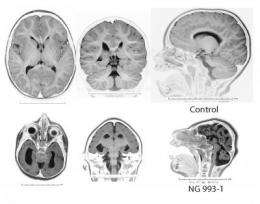
An MRI of brain of patient with severe form of microcephaly compared to a control subject. A team of researchers have found that mutations in a single gene may cause large discrepancy in size of the cerebral cortex. Credit: Courtesy of Yale University School of Medicine

The size and shape of the human cerebral cortex, an evolutionary marvel responsible for everything from Shakespeare's poetry to the atomic bomb, are largely influenced by mutations in a single gene, according to a team of researchers led by the Yale School of Medicine and three other universities.

The findings, reported April 28 in the , are based on a of in one Turkish family and two Pakistani families with offspring born with the most severe form of microcephaly. The children have brains just 10 percent of normal size. They also lacked the normal cortical architecture that is a hallmark of the human brain. This combination of factors has not been seen in other associated with the development of the human brain, the authors note.

The researchers found that in the same gene, centrosomal NDE1, which is involved in cell division, were responsible for the deformity.

"The degree of reduction in the size of the and the effects on brain morphology suggest this gene plays a key role in the evolution of the human brain," said Murat Gunel, co-senior author of the paper and the Nixdorff-German Professor of Neurosurgery and professor of genetics and neurobiology at Yale.

Scientists from Yale, the University of Cambridge, Harvard and Northwestern universities collaborated on the study with colleagues around the world, including those in Turkey and Saudi Arabia.

"These findings demonstrate how single molecules have influenced the expansion of the human cerebral cortex in the last five million years," Gunel said. "We are now a little closer to understanding just how this miracle happens."

Provided by Yale University search and more info website

4 /5 (6 votes)  

Filter


Move the slider to adjust rank threshold, so that you can hide some of the comments.


Display comments: newest first

210
Apr 28, 2011

Rank: not rated yet
" A team of researchers have found that mutations in a single gene may cause large discrepancy in size of the cerebral cortex"
The cause of individual change is not the reason for all change or future or past change. The influence of the gene is rightfully noted -done. The ORIGIN of the gene, viral infection, etc, and the course of its absolute expression across all genomes is NOT known or explained.
The Cerebral Cortex IS a fact, got it. The 'blueprint' the biological intent, as we see it now, to be relevant to this articles mention of evolution, needs to say," ,,,the cerebral cortex came from and was preceded by, X, Y, Z..."
We see the present result and wait to see what comes next, but what came before?
-"The degree of reduction in the size of the cerebral cortex and the effects on brain morphology suggest this gene plays a key role in the evolution of the human brain"-
Well, okay...death plays a role in evolution, sure. What event/proces, gave us the gene?
210
Apr 28, 2011

Rank: not rated yet
The human brain is the most complex organism/mechanism known to us. The fact our brains have a cerebral cortex whose size is controlled by a gene, a single gene, is like telling one that the most expensive chandelier in the world is controlled by a single light switch.
We know chandelier used to be made of hundreds of candles, which meant a less advanced control mechanism turned the light on/off. But, I can tell you that the discovery of electricity, and the invention of lightbulbs centuries later led 2 the need for the switch. But the switch had NOTHING 2 do with the making of chandelier! The lights were not made because the switch had been discovered a thousand years before!!
Now the importance of THIS GENE and its inception IS OF CRITICAL importance! If a gene mutated following a series of prehistoric infections by bird flu or something, THAT is the evolutionary switch worthy of discovery. The gene is merely the offspring of another mating or event.
-word-to-ya-muthas-
Jaeherys
Apr 29, 2011

Rank: not rated yet
The ORIGIN of the gene, viral infection, etc, and the course of its absolute expression across all genomes is NOT known or explained.

Since modern humans possess this gene today it is logical to assume that at some point in time the apes that did not possess this gene either
a) Could not compete with apes with this gene
b) Could not sustain themselves
c) Were unlucky and died off
I think you get the point.
We see the present result and wait to see what comes next, but what came before?

Less developed brains came before ours, similar in a way to that of a chimpanzee or gorilla.
http://en.wikiped...volution
Well, okay...death plays a role in evolution, sure. What event/proces, gave us the gene?

You already answered your question in a previous statement,
... viral infection, etc...
with the addition of mutation, which is the most prominent form of genetic change.
http://en.wikiped...Mutation
Jaeherys
Apr 29, 2011

Rank: not rated yet
The human brain is the most complex organism/mechanism known to us
A brain in general is very complex but it is neither an organism nor mechanism but an organ. As most lifeforms share similar biomechanics each organism from flies and up are considered to be very complex. As for the most complex it is a stretch to say that humans are the champions of that title as a pigs internal structure, to the untrained eye, looks almost identical to that of a humans.
... cerebral cortex whose size is controlled by a gene, a single gene, is like telling one that the most expensive chandelier in the world is controlled by a single light switch
If you were correct boy would we be one messed up race. It is a safeguard that even small genetic mutations can cause serious effects; sickle cell anemia is a simple example where the change of not even one gene but one single codon can cause cause our red blood cells to not carry oxygen properly.
Jaeherys
Apr 29, 2011

Rank: not rated yet
con't...
There are MANY examples of how a small genetic change can cause MASSIVE changes to the organism at micro and macroscopic levels, IE. dwarfism and pretty much every other genetic disease out there. http://en.wikiped...disorder

Also there is a single gene that is linked to the change of strength of our jaw muscle which in turn evolved to increase our cranial capacity. http://en.wikiped...H16_gene
...bird flu...THAT is the evolutionary switch worthy of discovery. The gene is merely the offspring of another mating or event.

Evolutionary switch? In genetics there are genes that act as a sort of "switch" turning other genes on and off for example but that is the only type of "switch" that I can think of that is relevant. The importance of this gene is not the cause of it but the affects of this gene. As stated before there are many contributing factors to where and how this gene came to be.
RobertKarlStonjek
Apr 29, 2011

Rank: not rated yet
Unless the gene causes a reversion back to a previous form then they have found nothing ~ one would expect that a mutation in the same gene would cause a severe form of microcephaly in chimps...clutching at straws here...
Rank 4 /5 (6 votes)
Relevant PhysicsForums posts

More news stories

Distinct molecular subtype of prostate cancer identified

A collaborative expedition into the deep genetics of prostate cancer has uncovered a distinct subtype of the disease, one that appears to account for up to 15 percent of all cases, say researchers at Weill Cornell Medical ...

Genetics created 21 hours ago | popularity 5 / 5 (1) | comments 0 | with audio podcast

Gene mapping reveals architecture that controls expression of genes responsible for our sense of smell

Within the nasal cavity, millions of sensory neurons in a postage-stamp-sized patch of tissue called the olfactory epithelium control our sense of smell. Thanks to the exquisitely controlled expression of ...

Genetics created May 18, 2012 | popularity 5 / 5 (1) | comments 1

'Rare' genetic variants are surprisingly common, life scientists report

(Medical Xpress) -- A large survey of human genetic variation, published today in the online version of the journal Science, shows that rare genetic variants are not so rare after all and offers insights into h ...

Genetics created May 18, 2012 | popularity 5 / 5 (4) | comments 0 | with audio podcast

Genetic testing may not trigger more use of health services

People have more and more chances to participate in genetic testing that can indicate their range of risk for developing a disease. Receiving these results does not appreciably drive up— or diminish—test recipients' ...

Genetics created May 17, 2012 | popularity not rated yet | comments 0

Genes make for a life of success

Genes play a greater role in forming character traits than was previously thought, new research suggests.

Genetics created May 16, 2012 | popularity not rated yet | comments 0


Growth factor in stem cells may spur recovery from multiple sclerosis

A substance in human mesenchymal stem cells that promotes growth appears to spur restoration of nerves and their function in rodent models of multiple sclerosis (MS), researchers at Case Western Reserve University School ...

Stopping cell migration may help block fibrosis and the spread of cancer

(Medical Xpress) -- Discoveries by a Yale-led team of scientists could lead the way for development of new therapies for treating fibrosis and tumor metastasis. The researchers have both uncovered a signaling ...

Oxytocin improves brain function in children with autism

(Medical Xpress) -- Preliminary results from an ongoing, large-scale study by Yale School of Medicine researchers shows that oxytocin — a naturally occurring substance produced in the brain and throughout ...

New portable tool detects dengue infected mosquitoes in the field

(Medical Xpress) -- A new portable tool to detect dengue virus-infected mosquitoes will help reduce the likelihood of human infections around the world.

Novel discovery paves the way for more effective treatment of cancers

A team of scientists from the National University of Singapore's (NUS) Department of Biological Sciences and Mechanobiology Institute have discovered how a drug-led compound – a compound that is undergoing preclinical ...

Tropical fruit's role as skin cancer weapon

An exciting breakthrough on the potential anti-skin cancer properties of the tropical fruit mangosteen has earned its researcher, Flinders University PhD candidate Jing Jing Wang (pictured), a seat in the ...