Better treatment sought for blinding traumatic optic nerve damage
April 6, 2011 in Medical research
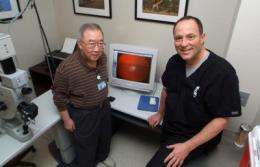
Drs. Gregory Liou and Julian Nussbaum of Georgia Health Sciences University want to find a better way to treat traumatic optic nerve injuries that can occur on roadways or battlefields. Credit: Phil Jones/GHSU photographer
Scientists want to protect the optic nerve when the eye takes a blow on the battlefield or in a car wreck.
It's called traumatic optic nerve damage when the fragile, spaghetti-sized nerve tethered to the back of the eye gets rattled, resulting in swelling and inflammation that can destroy its major component the retinal ganglion nerves causing vision loss and blindness.
"The optic nerve is not completely straight so it can tolerate movement of the head or eyes," said Dr. Julian Nussbaum, Chairman of the Department of Ophthalmology at Georgia Health Sciences University. This extension of the brain also has an insulating myelin sheath and, like the spinal cord, fluid to help protect it.
But as with traumatic brain injury, inflammation and swelling following a concussive injury can still prove deadly.
As with TBIs, few treatment options are available for traumatic optic nerve damage other than high-dose steroids to try to minimize the destructive response. However the nerve's response to these injuries may hold the key to better treatment, said Dr. Gregory Liou, GHSU molecular biologist. He recently received a three-year grant from the U.S. Department of Defense to explore the possibilities.
When an injured nerve cries out for help, the immune system sends pro-inflammatory factors, such as cytokines, to kill off injured neurons and clean up the damage, Liou said. That works pretty well in the peripheral nervous system, the source of nerves for the arms and legs and where nerves can regenerate. But inside the central nervous system, there is little regeneration, Liou said.
To help preserve the balance of Yin and Yang, a nerve injury also produces the energy source adenosine to help combat some of the inflammation. Ironically, inflammation triggers degradation of an enzyme that synthesizes adenosine, the GHSU researchers have found.
"Adenosine is weaker at a time it needs to be stronger," Liou said, noting he wants to strengthen it by giving an agonist that binds to the adenosine receptor so it makes more of the anti-inflammatory substance. "All we are doing is trying to boost the self-defense system that is already there."
He's using a mouse whose ganglion nerves are genetically engineered to glow with exposure to ultraviolet light; they are brightest when healthy, dim when injured and dark when dead. "As the ganglion nerves go, so goes the optic nerve. If you destroy the ganglion cell layer, the optic nerve dies," Nussbaum said. They will inject the A2AAR-selective agonist into the eye and see how it impacts recovery of traumatic optic nerve injury. They believe it will prevent permanent vision damage and give the nerve time to rest and recover.
Nussbaum hopes the treatment will also block inflammation triggered by acute glaucoma, where sky-high pressures inside the eye compress the optic nerve.
A2AAR-selective agonists are showing promise in inflammation-driven diseases such as diabetic retinopathy and nephropathy as well.
Provided by Georgia Health Sciences University
-
Clinical Trial Examines Drug's Potential for Protecting the Optic Nerve
Dec 21, 2009 |
not rated yet |
0
-
New discovery in nerve regrowth
Jul 12, 2010 |
not rated yet |
0
-
Extensive regeneration in nerve connecting eye to brain achieved
Dec 06, 2010 |
not rated yet |
0
-
Enabling nerve regeneration means evicting the cleanup crew
Feb 28, 2007 |
not rated yet |
0
-
Scientists coax nerve fibers to re-grow after spinal cord injury
Jul 18, 2006 |
not rated yet |
0
-
Limits to growth: Scientists identify key metastasis-enabling enzyme
6 hours ago |
not rated yet |
0
-
Seeing is as seeing does: Spatially-structured retinal input in early development of cortical maps
Apr 26, 2012 |
5 / 5 (4) |
1
-
Dreamless nights: Brain activity during nonrapid eye movement sleep
Apr 09, 2012 |
4.4 / 5 (12) |
0
-
Take your time: Neurobiology sheds light on the superiority of spaced vs. massed learning
Mar 28, 2012 |
4.5 / 5 (21) |
3
-
Your brain on 'shrooms: fMRI elucidates neural correlates of psilocybin psychedelic state
Feb 29, 2012 |
4.9 / 5 (42) |
45
-
Math and dyslexia?
16 hours ago
-
portable metabolism meter?
May 21, 2012
-
Rare medical conditions on 20/20 tonight
May 18, 2012
-
"Good" Cholesterol in Doubt
May 17, 2012
-
A couple of questions about schizophrenia
May 17, 2012
-
Paralyzed woman uses thoughts to move robotic arm
May 17, 2012
- More from Physics Forums - Medical Sciences
More news stories
Researchers spearhead groundbreaking research into treatment of brain swelling
Researchers at Trinity College Dublin have reported the results of groundbreaking research into the prevention of cerebral oedema or swelling of the brain, a major cause of death in people who have sustained a traumatic injury ...
Medical research
2 hours ago |
not rated yet |
0
|
FDA clears test for mastocytosis diagnosis
The Food and Drug Administration has approved a new test to help physicians diagnose a group of rare cell disorders. The test, or assay, was developed by an expert at Virginia Commonwealth University in the field of mast ...
Medical research
2 hours ago |
not rated yet |
0
Novel biomarkers reveal evidence of radiation exposure
Researchers at the Medical College of Wisconsin have identified novel biomarkers that could be used to confirm exposure to damaging radiation in large groups of people potentially exposed to unknown and variable doses for ...
Medical research
2 hours ago |
not rated yet |
0
Stem cell research paves way for progress on dealing with Fragile X retardation
Researchers at the Hebrew University of Jerusalem have achieved, for the first time, the generation of neuronal cells from stem cells of Fragile X patients. The discovery paves the way for research that will examine restoration ...
Medical research
4 hours ago |
not rated yet |
0
Limits to growth: Scientists identify key metastasis-enabling enzyme
(Medical Xpress) -- On the complex road to eradicating cancer, controlling or preventing metastatic growth initiated by primary tumors is high on the to-do list. A key area of such research is the development ...
Medical research
6 hours ago |
not rated yet |
0
|
Body building, diet supplements linked to liver damage: study
(HealthDay) -- Body-building and weight-loss products are the types of dietary supplements most likely to cause liver injury, according to a small new study.
Do bald men face higher risk of prostate cancer?
(HealthDay) -- Got hair? If you don't, you might have a higher risk of prostate cancer, a preliminary study suggests.
Neuron-nourishing cells appear to retaliate in Alzheimer's
When brain cells start oozing too much of the amyloid protein that is the hallmark of Alzheimer's disease, the astrocytes that normally nourish and protect them deliver a suicide package instead, researchers ...
Learning and memory: The role of neo-neurons revealed
(Medical Xpress) -- Researchers at the Institut Pasteur and the CNRS have recently identified in mice the role played by neo-neurons formed in the adult brain. By using selective stimulation the researchers ...
Asthma medication linked with arrhythmias in children, young adults
Use of inhaled anticholinergics (IACs) has been associated with an increased risk of potentially dangerous heart arrhythmias among young asthma patients, according to a study conducted by researchers at the University of ...
U.S. liver transplants declining
(HealthDay) -- The number of liver transplants in the United States has decreased since 2006, a new study finds.