2,784 vaccinations later
April 29, 2011 By Jonathan Wood in Medications
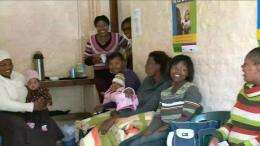
Mothers and babies taking part in the trial in South Africa.
The two thousand, seven hundred and eighty-fourth baby has been vaccinated today in South Africa as part of a clinical trial of a new vaccine against tuberculosis. The new TB vaccine is the most advanced in development anywhere in the world.
Thats the last baby in the trial, and marks completion of trial enrolment almost two years to the day after the study was first announced.
"We are extremely proud of this achievement and are eager to see the study results, which are expected to be available in 2012," says Dr. Helen McShane, who developed the vaccine at the Jenner Institute, Oxford University. "This milestone brings us a step closer to potentially having a new TB vaccine, from which millions of people around the world would benefit."
Its certainly quite a milestone, and marks a great deal of work to vaccinate all these babies under 1 year old in an area where there is one of the highest rates of TB in the world.
But why precisely 2,784 babies, not 2,500 or 3,000?
Helen explains that it is entirely down to the calculations used to plan the trial. These sums showed that 2784 babies should give enough statistical weight to be able to see a significant improvement in preventing TB over the 90-year-old (but still standard) BCG jab.
The new vaccine is designed to be given to infants after they have received the BCG vaccine, boosting the immune response further. All the babies in the trial have received the BCG vaccine, with half then getting the trial vaccine and half a placebo. "If successful, the next steps would be to plan a phase III trial and licensure of the vaccine," Helen says.
The current trial was a phase IIb trial, and is the first to be able to really determine whether the vaccine gives infants any protection against TB. A larger phase III trial would pin down exactly the size of any benefit and guide how the vaccine could be rolled out.
The trial in Worcester, about 100km from Cape Town, is being conducted by the University of Cape Towns South African Tuberculosis Vaccine Initiative (SATVI), in partnership with Aeras, the Wellcome Trust, and the Oxford-Emergent Tuberculosis Consortium Ltd (a joint venture between the University of Oxford and Emergent Biosolutions Inc formed to develop the vaccine)
"We are pleased to report that the trial has run smoothly to date," says Dr. Hassan Mahomed, who has led the trial at SATVI.
Provided by
Oxford University
-
TB vaccine enters new clinical trials
Apr 23, 2009 |
not rated yet |
0
-
New TB booster shows promise
Mar 16, 2010 |
not rated yet |
0
-
Tuberculosis vaccine passes phase I trial
Mar 24, 2011 |
not rated yet |
0
-
New TB vaccine enters clinical testing
Sep 23, 2010 |
not rated yet |
0
-
Trials begin for 'essential' new TB vaccine
Jul 30, 2007 |
not rated yet |
0
-
Motion perception revisited: High Phi effect challenges established motion perception assumptions
Apr 23, 2013 |
3 / 5 (2) |
2
-
Anything you can do I can do better: Neuromolecular foundations of the superiority illusion (Update)
Apr 02, 2013 |
4.5 / 5 (11) |
5
-
The visual system as economist: Neural resource allocation in visual adaptation
Mar 30, 2013 |
5 / 5 (2) |
9
-
Separate lives: Neuronal and organismal lifespans decoupled
Mar 27, 2013 |
4.9 / 5 (8) |
0
-
Sizing things up: The evolutionary neurobiology of scale invariance
Feb 28, 2013 |
4.8 / 5 (10) |
14
-
Why is zone 1 in liver more prone to ischemic injury?
11 hours ago
-
How can there be villous adenoma in colon, if there are no villi there
May 22, 2013
-
How can there be a term called "intestinal metaplasia" of stomach
May 21, 2013
-
Pressure-volume curve: Elastic Recoil Pressure don't make sense
May 18, 2013
-
If you became brain-dead, would you want them to pull the plug?
May 17, 2013
-
MRI bill question
May 15, 2013
- More from Physics Forums - Medical Sciences
More news stories
Experts favor US approval of Merck sleeping pill (Update)
An independent panel of experts on Wednesday recommended US approval of a new Merck sleeping pill called suvorexant, but expressed concerns over the highest dosage and risks of drowsy daytime driving.
Medications
20 hours ago |
not rated yet |
0
Glaxo, US partnering to develop new antibiotics
GlaxoSmithKline PLC says it's starting an unusual collaboration with the U.S. government to develop several antibiotics for both bioterrorism threats and bacterial infections resistant to current medicines.
Medications
22 hours ago |
not rated yet |
0
Study finds new pneumococcal vaccine appears to be as safe as previously used vaccine
The new 13-valent pneumococcal conjugate vaccine (PCV13) appears to be as safe as the previous version used prior to 2010, the 7-valent pneumococcal conjugate vaccine (PCV7), according to a Kaiser Permanente study published ...
Medications
May 22, 2013 |
not rated yet |
0
Succesful results in developing oral vaccine against diarrhea
The University of Gothenburg Vaccine Research Institute (GUVAX) announces successful results in a placebo controlled phase I study of an oral, inactivated Escherichia coli diarrhea vaccine.
Medications
May 22, 2013 |
not rated yet |
0
New sleeping pill poised to hit US markets
An experimental sleeping pill from US drug company Merck is effective at helping people fall and stay asleep, according to reviewers at the US Food and Drug Administration, which could soon approve the new drug.
Medications
May 21, 2013 |
4.2 / 5 (5) |
0
Scientists discover molecule triggers sensation of itch
Scientists at the National Institutes of Health report they have discovered in mouse studies that a small molecule released in the spinal cord triggers a process that is later experienced in the brain as the sensation of ...
Multiple research teams unable to confirm high-profile Alzheimer's study
Teams of highly respected Alzheimer's researchers failed to replicate what appeared to be breakthrough results for the treatment of this brain disease when they were published last year in the journal Science.
Drug reverses Alzheimer's disease deficits in mice, research confirms
An anti-cancer drug reverses memory deficits in an Alzheimer's disease mouse model, University of Pittsburgh Graduate School of Public Health researchers confirm in the journal Science.
Antibiotics: A new understanding of sulfonamide nervous system side effects
Since the discovery of Prontosil in 1932, sulfonamide antibiotics have been used to combat a wide spectrum of bacterial infections, from acne to chlamydia and pneumonia. However, their side effects can include serious neurological ...
Economic incentives increase blood donation without negative consequences
Can economic incentives such as gift cards, T-shirts, and time off from work motivate members of the public to increase their donations of blood?
Researchers find common childhood asthma unconnected to allergens or inflammation
Little is known about why asthma develops, how it constricts the airway or why response to treatments varies between patients. Now, a team of researchers at Weill Cornell Medical College, Columbia University Medical Center ...