Alzheimer's risk gene disrupts brain's wiring 50 years before disease hits
What if you were told you carried a gene that increases your risk for Alzheimer's disease? And what if you were told this gene starts to do its damage not when you're old but when you're young?
Brace yourself.
Scientists know there is a strong genetic component to the development of late-onset Alzheimer's. In 1993, researchers discovered a gene known as ApoE4 — carried by about a quarter of us — that triples the risk for getting Alzheimer's. In 2009, three more risky genes were discovered, and one of them, called clusterin, or CLU, was found to up the risk of getting Alzheimer's by another 16 percent.
But nobody could explain what the CLU gene actually did. Now, UCLA researchers know, and the explanation is a doozy: This risk gene begins to damage your brain a full 50 years before people normally get Alzheimer's.
In the current online edition of the Journal of Neuroscience, Paul Thompson, a UCLA professor of neurology, and his colleagues report that the C-allele of the CLU gene (an allele is one of two or more forms of a gene), which is possessed by 88 percent of Caucasians, impairs the development of myelin, the protective covering around the neuron's axons in the brain, making it weaker and more vulnerable to the onset of Alzheimer's much later in life.
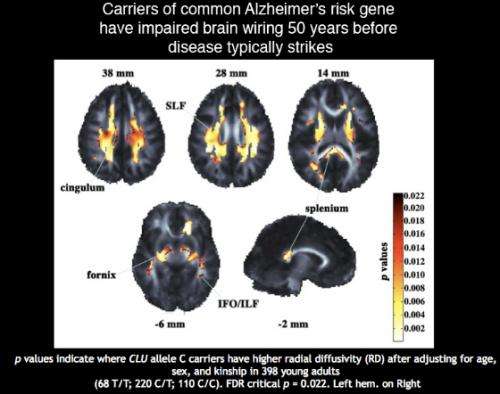
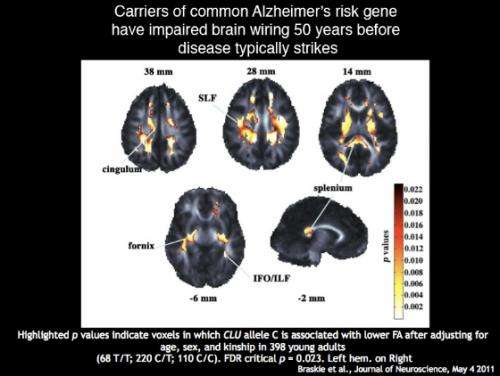
The researchers scanned the brains of 398 healthy adults ranging in age from 20 to 30 using a high-magnetic-field diffusion scan (called a 4-Tesla DTI), a newer type of MRI that maps the brain's connections. They compared those carrying a C-allele variant of the CLU gene with those who had a different variant, the CLU T-allele.
They found that the CLU-C carriers had what brain-imaging researchers call lower "fractional anisotropy" — a widely accepted measure of white-matter integrity — in multiple brain regions, including several known to degenerate in Alzheimer's. In other words, young, healthy carriers of the CLU-C gene risk variant showed a distinct profile of lower white matter integrity that may increase vulnerability to developing the disease later in life.
The discovery of what this gene does is interesting on several levels, said Thompson, the senior author of the study.
"For example, Alzheimer's has traditionally been considered a disease marked by neuronal cell loss and widespread gray-matter atrophy," he said. "But degeneration of myelin in white-matter fiber pathways is more and more being considered a key disease component and another possible pathway to the disease, and this discovery supports that."
Thompson said four things are surprising with the discovery of this gene's function:
1) This risk gene damages your brain a full 50 years before people normally get Alzheimer's. The damage can be seen on an MRI scan, but there are no symptoms yet.
2) It's now known what this mysterious gene does — namely, make your brain wiring vulnerable to attack by impairing the wiring before any senile plaques or tangles develop.
3) Rather than being a gene that few people have, a whopping 88 percent of Caucasians have it. "So I guess you could say the other 12 percent have an 'Alzheimer's resistance gene' that protects their brain wiring," said Thompson, who is also a member of UCLA's Laboratory of Neuro Imaging and the UCLA Brain Research Institute.
4) Finally, he said, knowing the role of this gene is useful in predicting a person's risk of the disease and in seeing if you can step in and protect the brain in the 50-year time window you have before the disease begins to develop.
Of course, the obvious question is if most of us have this "bad" gene, why isn't Alzheimer's rampant in young people?
Less myelination in CLU-C carriers may not translate into poorer cognition in youth, said Thompson, because the brain can compensate. "The brain has a lot of built in redundancy — miles and miles of brain connections," he said. Still, he said, with the passage of time — and when exacerbated by other factors, such as normal neuron death as we age and plaque and tangle development in the early stages of Alzheimer's — reduced myelin integrity could facilitate cognitive impairment.
"So it's unlikely we are seeing the earliest possible signs of Alzheimer's-associated brain changes in these young people," Thompson said. "It's more likely the reduced fiber integrity represents an early developmental vulnerability that may reduce brain resilience to later Alzheimer's disease pathology. Inn other words, its mechanism of action may not be part of the classic Alzheimer's pathways that lead to abnormal amyloid plaque and neurofibrillary tangle accumulation in the brain."
The mapping of structural brain differences in those at genetic risk for Alzheimer's disease is crucial for evaluating treatment and prevention strategies, Thompson said. Once identified, brain differences can be monitored to determine how lifestyle choices influence brain health and disease risk.
"We know that many lifestyle factors, such as regular exercise and a healthful diet, may reduce the risk of cognitive decline, particularly in those genetically at risk for Alzheimer's, so this reminds us how important that is," he said.
More information: Other authors included Meredith N. Braskie, Neda Jahanshad, Jason L. Stein, Marina Barysheva, John M. Ringman and Arthur W. Toga from UCLA; Katie L. McMahon and Greig I. de Zubicaray from the University of Queensland in Brisbane, Australia; and Nicholas G. Martin and Margaret J. Wright from the Queensland Institute of Medical Research in Brisbane.
This study was supported by the National Institute of Child Health and Human Development and the National Health and Medical Research Council of Australia; the National Institutes of Health; the UCLA Easton Center for Alzheimer's Disease Research; the NIH/National Library of Medicine; the ARCS Foundation; and the National Institute of Mental Health.
The authors report no conflicts of interest.


