New approach simplifies Parkinson's surgery
May 25, 2011 in Other
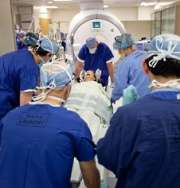
Dr. Sillay and staff move the patient from the operating room to the MRI part of the suite for DBS surgery
(Medical Xpress) -- University of Wisconsin Hospital and Clinics has become the second academic medical center in the country where neurosurgeons can perform deep-brain stimulation (DBS) in an intra-operative MRI (iMRI) suite.
The new operating suite allows neurosurgeons to perform faster and more accurate brain surgery while a real-time magnetic resonance image of the patients brain is displayed.
For patients, the result is a quicker and more comfortable experience. Conventional DBS surgery, for treatment of conditions such as Parkinsons disease, requires that patients be conscious during procedure. In general, the new technique should cut in half the six hours needed for the older type of surgery.
"This makes DBS surgery much easier on our patients,'' says Dr. Karl Sillay, a UW Health neurosurgeon. "Previously, patients had to be awake during the surgery to help determine when the electrodes were in the correct position."
Improves the symptoms of Parkinsons by directing electrical stimulation to a part of the brain called the subthalamic nucleus. This pea-sized region is located about six centimeters beneath the surface of the frontal cortex.
In the past, surgeons located the spot by scanning the patient before surgery. A stereotactic frame, affixed to the patients skull, allowed surgeons to identify the spot by use of three-dimensional coordinates. They then used micro-electrode recordings to be sure the electrode was in the correct place. Patients had to be awake and able to respond to the surgeon for this technique to work correctly. They also had to stop taking their anti-Parkinsons medication 12 hours before surgery.
In the new iMRI suite, surgeons use the image from the iMRI to guide the electrode into place. A computer system created by Surgivision uses a plastic grid on the patients head, coordinated with the iMRI image, to precisely guide the neurosurgeons placement of the electrode.
Special surgical tools, made of titanium and plastic, allow surgery inside the powerful MRI magnet.
Patients can stay on their medication and be under general anesthesia. The new technique also has a safety component - since intracranial bleeding occurs in about 2 percent of DBS procedures, surgeons can spot the problem immediately on the real-time iMRI.
The technique will get much of its use during procedures when electrodes are placed in the brain to relieve the symptoms of Parkinson's disease, essential tremor and other neurological conditions. But the iMRI operating room is also being used for other types of brain surgery.
For example, says Dr. Robert Dempsey, chair of neurosurgery, having the MRI right in the operating room will also benefit brain tumor patients.
"This superb technology provides our surgeons with additional images of the tumor while the patient is undergoing surgery," Dempsey says. "This means we are able to operate with additional certainty that the entire tumor has been removed during a single surgery, and helps ensure we are doing our very best for patients in sparing healthy tissue."
UW Hospital is one of the first in the nation to offer real-time intra operative placement of DBS electrodes.
"This new system should be much superior for patients and represents a major step forward in our ability to treat complex neurological diseases," says Dr. Sillay.
Provided by
University of Wisconsin-Madison
-
Electrode re-implantation helps some Parkinson's disease patients
May 12, 2008 |
not rated yet |
0
-
UCSF neurosurgeons test new device for placing brain implants
Apr 13, 2011 |
not rated yet |
0
-
Consensus reached on use of Parkinson's treatment
Oct 13, 2010 |
not rated yet |
0
-
Methodist neurosurgeon first in world to implant next generation device for deep brain stimulation therapy
Mar 16, 2011 |
not rated yet |
0
-
Children's Hospital Boston neurosurgeons to perform brain tumor removal during live Web cast
Oct 16, 2006 |
not rated yet |
0
-
Limits to growth: Scientists identify key metastasis-enabling enzyme
7 hours ago |
5 / 5 (1) |
0
-
Seeing is as seeing does: Spatially-structured retinal input in early development of cortical maps
Apr 26, 2012 |
5 / 5 (4) |
1
-
Dreamless nights: Brain activity during nonrapid eye movement sleep
Apr 09, 2012 |
4.4 / 5 (12) |
0
-
Take your time: Neurobiology sheds light on the superiority of spaced vs. massed learning
Mar 28, 2012 |
4.5 / 5 (21) |
3
-
Your brain on 'shrooms: fMRI elucidates neural correlates of psilocybin psychedelic state
Feb 29, 2012 |
4.9 / 5 (42) |
45
-
Classical and Quantum Mechanics via Lie algebras
Apr 15, 2011
- More from Physics Forums - Independent Research
More news stories
U.S. liver transplants declining
(HealthDay) -- The number of liver transplants in the United States has decreased since 2006, a new study finds.
Other
2 hours ago |
not rated yet |
0
Canada should significantly increase its funding of randomized clinical trials
Large randomized controlled trials (RCTs) are critical for determining effectiveness of medical therapies, tests and procedures. Yet Canada provides scant support for these studies compared with other western countries, states ...
Other
4 hours ago |
not rated yet |
0
Pomegranate juice claims deceptive, US rules
Pomegranate juice has not been proven to be an effective treatment for cancer, heart disease or erectile dysfunction, US regulators said Monday, calling a company's ad claims deceptive.
Other
21 hours ago |
not rated yet |
0
Use of in-hospital mortality to assess ICU performance may bias quality measurement
In-hospital mortality for ICU patients is often used as a quality measure, but discharge practices may bias results in a way that disadvantages large academic hospitals, according to a recently conducted study.
Other
May 21, 2012 |
not rated yet |
0
Nighttime intensivist staffing and mortality in the ICU
Nighttime intensivist physician staffing in intensive care units (ICUs) with a low-intensity daytime staffing model is associated with reduced mortality, according to a new study published in the New England Journal of Me ...
Other
May 21, 2012 |
not rated yet |
0
Scientists unravel role of fusion gene in prostate cancer
Up to half of all prostate cancer cells have a chromosomal rearrangement that results in a new "fusion" gene and formation of its unique protein -- but no one has known how that alteration promotes cancer growth. Now, Weill ...
Early-life risk factors for non-Hodgkin lymphoma
Factors influencing early life non-Hodgkin lymphoma (NHL) incidence include family characteristics, high fetal growth, older maternal age, low birth order, and male gender, according to a study published May 22 in the Journal of ...
Studies examine CPAP treatment and cardiovascular outcomes in adults with obstructive sleep apnea
Two studies that included adults with obstructive sleep apnea examined the effectiveness of reducing the risk of cardiovascular outcomes, including high blood pressure, by treatment with continuous positive airway pressure ...
Systems treating severe heart attacks expanding nationwide
The number of systems of care that quickly transfer and treat heart attack patients has increased substantially across the nation, according to research published in Circulation: Cardiovascular Quality and Outcomes, an American ...
Use of multicomponent intervention linked with decrease in using physical restraint in nursing homes
Nursing homes that used a multicomponent intervention that included staff training and supportive materials for staff, residents and relatives had a lower rate of use of physical restraints such as bilateral bed rails and ...
Limits to growth: Scientists identify key metastasis-enabling enzyme
(Medical Xpress) -- On the complex road to eradicating cancer, controlling or preventing metastatic growth initiated by primary tumors is high on the to-do list. A key area of such research is the development ...