Biomedical engineers patch a heart using novel tissue cell therapy
May 6, 2011 in Cardiology
Biomedical engineers patch a heart using novel tissue cell therapy

Enlarge

(Medical Xpress) -- Researchers at Columbia Engineering have established a new method to patch a damaged heart using a tissue-engineering platform that enables heart tissue to repair itself. This breakthrough, recently published in the Proceedings of the National Academy of Sciences, is an important step forward in combating cardiovascular disease, one of the most serious health problems of our day.

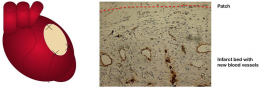
Led by Gordana Vunjak-Novakovic, Professor of Biomedical Engineering at Columbia University's Fu Foundation School of Engineering and Applied Science, the researchers developed a novel cell therapy to treat ( that follows a heart attack). They were able, for the first time, to combine the use of human repair cells that were conditioned during in-vitro culture to maximize their ability to revascularize and improve blood flow to the infarcted tissue with a fully biological composite scaffold designed to deliver these cells to the damaged heart. With this platform, they could both keep the cells within the bed (in contrast to the massive cell loss associated with infusion of cells alone) and enhance and function in the infarct bed, where most of the cells would have died because of the obstruction of their .

"We are very excited about this new technique," said Dr. Vunjak-Novakovic. "This platform is very adaptable and we believe it could be readily extended to the delivery of other types of human we are interested in to rebuild the heart muscle and further our research of the mechanisms underlying heart repair."

In effect, the Columbia Engineering team (with Amandine Godier-Fournemont and Timothy Martens as lead authors) removed the cells of a human heart muscle—the myocardium—leaving a protein scaffold with intact architecture and mechanical properties. They filled the scaffold with human mesenchymal progenitors (stem cells that can differentiate into many cell types) and then applied the patches to damaged . The patches promoted the growth of new blood vessels and released proteins that stimulated the native tissue to repair itself. Moreover, the team also used this controllable platform to identify the signaling mechanisms involved in the repair process, and expand our knowledge about the role of cells and scaffold design on heart repair.

"It really is encouraging to make progress with 'instructing' cells to form human tissues by providing them with the right environments," noted Dr. Vunjak-Novakovic. "The cells are the real 'tissue engineers'—we only design the environments so they can do their work. Because these environments need to mimic the native developmental milieu, the progress in the field is really driven by the interdisciplinary work of bioengineers, stem cell biologists, and clinicians. By enabling regeneration and replacement of our damaged tissues, we can help people live longer and better."

Dr. Vunjak-Novakovic and her team already have several active research projects that continue this line of work. They are now investigating the formation of a contractile cardiac patch using human stem cells that can give rise to both the muscle and vascular compartments of the . They are also studying how the cells within such a cardiac patch, when implanted on infarcted heart tissue, develop their ability to generate mechanical force and electrical conduction, and how these functions can be modulated by in-vitro culture.

"Ultimately, we envision this system as a possible point of care approach," said Dr. Vunjak-Novakovic, "with components actually produced and assembled in the operating room to most effectively target-signaling mechanisms involved in the repair process of someone's damaged ."

More information: http://www.pnas.org/content/early/2011/04/19/1104619108.long

Provided by Columbia University search and more info website

5 /5 (6 votes)  

Rank 5 /5 (6 votes)
Related Stories
Relevant PhysicsForums posts
  • Building infinity corrected microscope from non-infinity corrected objective
    created1 hour ago
  • the concept of mole
    created2 hours ago
  • Intensive gas variables problem
    created2 hours ago
  • Having trouble thinking about conservative forces
    created7 hours ago
  • Homopolar Electric Motor without wire connection
    created12 hours ago
  • Work done by an ideal gas
    created15 hours ago
  • More from Physics Forums - Classical Physics

More news stories

New study confirms value of cardiac output monitor

(Medical Xpress) -- A new Australian study has confirmed the accuracy of a modern non-invasive cardiac output monitor that can replace a 40-year-old standard in this field.

Cardiology created 49 minutes ago | popularity not rated yet | comments 0

Scientists turn patients' skin cells into heart muscle cells to repair their damaged hearts

For the first time scientists have succeeded in taking skin cells from heart failure patients and reprogramming them to transform into healthy, new heart muscle cells that are capable of integrating with existing heart tissue.

Cardiology created 1 hour ago | popularity not rated yet | comments 0 | with audio podcast

Systems treating severe heart attacks expanding nationwide

The number of systems of care that quickly transfer and treat heart attack patients has increased substantially across the nation, according to research published in Circulation: Cardiovascular Quality and Outcomes, an American ...

Cardiology created 13 hours ago | popularity not rated yet | comments 0

The Medical Minute: Solitaire for stroke -- It's not a game

Stroke is the fourth leading cause of death in North America -- down from third. Despite this "improvement," stroke remains the leading cause of adult disability. Ischemic strokes, caused by blood vessel blockages, are by ...

Cardiology created 22 hours ago | popularity not rated yet | comments 0

Standard heart disease risk tools underrate danger in rheumatoid arthritis

Heart disease risk assessment tools commonly used by physicians often underestimate the cardiovascular disease danger faced by rheumatoid arthritis patients, a Mayo Clinic study has found. Inflammation plays a key role in ...

Cardiology created May 21, 2012 | popularity 4 / 5 (1) | comments 0


Breast MRI helps predict chemotherapy's effectiveness

Magnetic resonance imaging (MRI) provides an indication of a breast tumor's response to pre-surgical chemotherapy significantly earlier than possible through clinical examination, according to a new study published online ...

Kids suffer long-term from parents' smoking: study

Children exposed to their parents' cigarette smoke are at greater risk of suffering serious cardiovascular health problems later in life, a study showed Wednesday.

Hair loss pathology identified in pityriasis versicolor lesions

(HealthDay) -- Patients with pityriasis versicolor (PV) lesions may experience hair thinning and/or loss within the lesion, according to a study published online May 10 in the Journal of the American Academy of ...

Simple motions, complex tool New robot successfully performs surgical closure in a beating heart

A new robotic device may be the solution to a longstanding surgical dilemma: how to precisely manipulate tools within the delicate tissues of a beating heart, report researchers at Boston Children’s Hospital. The team’s ...

South Korean smokers finally start to feel the heat

After decades of indifference, big businesses and the government are turning up the heat on smokers in South Korea, a nation with one of the developed world's highest male smoking rates.

Grassroots "networks" succeed in recruiting kidney donors, Hopkins program shows

Johns Hopkins researchers say a program they developed that uses personal advocates and community networks to find organ donors for friends and loved ones who need kidney transplants resulted in success for nearly half of ...