Ecstasy associated with chronic change in brain function
May 3, 2011 in Neuroscience
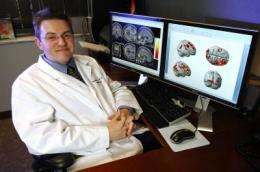
Ronald Cowan, M.D., Ph.D., and colleagues report in the May issue of Neuropsychopharmacology that recreational Ecstasy use is associated with a chronic change in brain function. Credit: Vanderbilt University
the illegal "rave" drug that produces feelings of euphoria and emotional warmth has been in the news recently as a potential therapeutic. Clinical trials are testing Ecstasy in the treatment of post-traumatic stress disorder.
But headlines like one in Time magazine's health section in February "Ecstasy as therapy: have some of its negative effects been overblown?" concern Ronald Cowan, M.D., Ph.D., associate professor of Psychiatry.
His team reports in the May issue of Neuropsychopharmacology that recreational Ecstasy use is associated with a chronic change in brain function.
"There's tension in the fields of psychiatry and psychotherapy between those who think Ecstasy could be a valuable therapeutic that's not being tested because of overblown fears, and those who are concerned about the drug's potentially harmful effects," Cowan said.
"We're not on one side or the other; we're just trying to find out what's going on in the brain is there any evidence for long-lasting changes in the brain?"
The message in news reports needs to be accurate, Cowan said. His team's studies suggest that the current message should be: "If you use Ecstasy recreationally, the more you use, the more brain changes you get."
Cowan and his colleagues examined brain activation during visual stimulation, using functional magnetic resonance imaging (fMRI), in subjects who had previously used Ecstasy (but not in the two weeks prior to imaging) and in subjects who had not previously used Ecstasy.
They found increased brain activation in three brain areas associated with visual processing in Ecstasy users with the highest lifetime exposure to the drug. The findings were consistent with the investigators' predictions based on results from animal models: that Ecstasy use is associated with a loss of serotonin signaling, which leads to hyper-excitability (increased activation) in the brain.
The hyper-excitability suggests a loss in brain efficiency, Cowan said, "meaning that it takes more brain area to process information or perform a task."
The investigators found that this shift in brain excitability did not return to normal in subjects who had not used Ecstasy in more than a year.
"We think this shift in cortical excitability may be chronic, long-lasting, and even permanent, which is a real worry," Cowan said, noting that the Ecstasy users in the study are young (18 to 35 years old). "The question is what will happen to their brains as they age over the next 60 years."
Cowan said that the pattern of hyper-excitability is similar to that observed in fMRI studies of individuals at risk for, or with early, Alzheimer's disease.
"I'm not saying that these people are at increased risk for dementia, but that there's a loss of brain efficiency in both recreational Ecstasy use and early Alzheimer's."
The findings suggest that brain hyper-excitability (increased activation in fMRI scans) may be a useful biomarker for Ecstasy-induced neurotoxicity, which the investigators will continue to study.
"Our goal is to be able to let people know whether or not the drug is causing long-term brain damage," Cowan said. "That's really critical because millions of people are using it."
The 2009 National Survey on Drug Use and Health estimated that 14.2 million individuals 12 years or older in the United States had used Ecstasy in their lifetime; 760,000 people had used Ecstasy in the month prior to being surveyed.
Cowan is also interested in determining the doses of Ecstasy that are toxic, and whether there are genetic vulnerabilities to toxicity. If clinical trials show that the drug has therapeutic benefits, it's critical to know the risks, he said.
Provided by
Vanderbilt University Medical Center
-
Ecstasy causes depression in pigs
Mar 10, 2006 |
not rated yet |
0
-
Long-term users of ecstasy risk structural brain damage
Apr 07, 2011 |
not rated yet |
0
-
Ecstasy can harm the brains of first-time users
Nov 27, 2006 |
not rated yet |
0
-
Ecstasy deaths linked to raised body temperature
May 29, 2008 |
not rated yet |
0
-
Ecstasy may be linked to sleep apnea
Dec 02, 2009 |
not rated yet |
0
-
Limits to growth: Scientists identify key metastasis-enabling enzyme
21 hours ago |
5 / 5 (3) |
0
-
Seeing is as seeing does: Spatially-structured retinal input in early development of cortical maps
Apr 26, 2012 |
5 / 5 (4) |
1
-
Dreamless nights: Brain activity during nonrapid eye movement sleep
Apr 09, 2012 |
4.4 / 5 (12) |
0
-
Take your time: Neurobiology sheds light on the superiority of spaced vs. massed learning
Mar 28, 2012 |
4.5 / 5 (21) |
3
-
Your brain on 'shrooms: fMRI elucidates neural correlates of psilocybin psychedelic state
Feb 29, 2012 |
4.9 / 5 (42) |
45
-
Poor nutrition leading to overeating?
6 hours ago
-
Math and dyslexia?
May 21, 2012
-
portable metabolism meter?
May 21, 2012
-
Rare medical conditions on 20/20 tonight
May 18, 2012
-
"Good" Cholesterol in Doubt
May 17, 2012
-
A couple of questions about schizophrenia
May 17, 2012
- More from Physics Forums - Medical Sciences
More news stories
Barrow researchers use magic for discoveries
Researchers at Barrow Neurological Institute at St. Joseph's Hospital and Medical Center have unveiled how and why the public perceives some magic tricks in recent studies that could have real-world implications in military ...
Neuroscience
13 hours ago |
not rated yet |
0
GPS for the brain: Researchers develop new brain map
University of Georgia researchers have developed a map of the human brain that shows great promise as a new guide to the inner workings of the body's most complex and critical organ.
Neuroscience
20 hours ago |
not rated yet |
0
|
Learning and memory: The role of neo-neurons revealed
(Medical Xpress) -- Researchers at the Institut Pasteur and the CNRS have recently identified in mice the role played by neo-neurons formed in the adult brain. By using selective stimulation the researchers ...
Neuroscience
20 hours ago |
4.8 / 5 (4) |
0
|
Newly discovered protein makes sure brain development isn't 'botched'
(Medical Xpress) -- Johns Hopkins scientists have discovered a protein that appears to play an important regulatory role in deciding whether stem cells differentiate into the cells that make up the brain, as well as countless ...
Neuroscience
23 hours ago |
5 / 5 (1) |
0
|
The heart rules the head when we make financial decisions
(Medical Xpress) -- Our 'gut feelings' influence our decisions, overriding 'rational' thought, when we are faced with financial offers that we deem to be unfair, according to a new study. Even when we are ...
Neuroscience
May 21, 2012 |
not rated yet |
0
Molecular 'on-off' switch for Parkinson's disease discovered
(Medical Xpress) -- Scientists at the Medical Research Council (MRC) Protein Phosphorylation Unit at the University of Dundee have discovered a new molecular switch that acts to protect the brain from developing Parkinson's ...
Scientists turn patients' skin cells into heart muscle cells to repair their damaged hearts
For the first time scientists have succeeded in taking skin cells from heart failure patients and reprogramming them to transform into healthy, new heart muscle cells that are capable of integrating with existing heart tissue.
Simple motions, complex tool New robot successfully performs surgical closure in a beating heart
A new robotic device may be the solution to a longstanding surgical dilemma: how to precisely manipulate tools within the delicate tissues of a beating heart, report researchers at Boston Children’s Hospital. The team’s ...
Scientists start explaining Fat Bastard's vicious cycle
Fat Bastard's revelation "I eat because I'm depressed and I'm depressed because I eat" in the Austin Powers film series may be explained by sophisticated neuroscience research being undertaken by scientists affiliated with ...
Socioeconomics may affect toddlers' exposure to flame retardants
A Duke University-led study of North Carolina toddlers suggests that exposure to potentially toxic flame-retardant chemicals may be higher in nonwhite toddlers than in white toddlers.
Hair loss pathology identified in pityriasis versicolor lesions
(HealthDay) -- Patients with pityriasis versicolor (PV) lesions may experience hair thinning and/or loss within the lesion, according to a study published online May 10 in the Journal of the American Academy of ...
May 03, 2011
Rank: not rated yet
Might ecstasy lead to late-manifesting/adult ADHD?
May 04, 2011
Rank: 5 / 5 (1)