Training to promote health
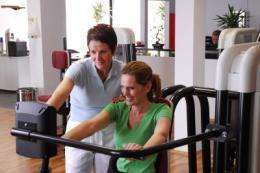
Targeted machine-based training helps patients recover more quickly after accidents. A new information platform facilitates the exchange of fitness data between doctors and trainers. Credit: Ergo-Fit
Many people use fitness studios to get back into shape after an injury. Fraunhofer researchers are now developing a system that will provide doctors with data on the exercises people do on the various machines. This should help them plan better training programs.
Marianne has constant pain in her right knee at the moment she hurt it when she took a tumble skiing in the Swiss Alps. Everything happened so quickly: The searing pain, the helicopter ride to hospital, the operation the following day, and then a week later the return home with crutches to rest in a reclining chair. Her aim now is to mobilize the operated knee and regain full mobility of the joint something she'll achieve by following a targeted machine-based training plan drawn up by a physiotherapist.
In order to be able to devise training programs properly, physiotherapists and medical experts require detailed information on the progress of muscle build-up, the degree of mobility and the overall physical condition of the patient. Marianne's general physician, in particular, needs to know how well her knee is recovering. But that's not easy, because qualified data from the training machines she uses is not automatically made available to him. There is no direct connection between the software systems used by physiotherapists or rehabilitation specialists and general medical practices, and as a result, a great deal of potential is wasted. "The quality of treatment can be greatly improved if medical experts are able to assess training data," explains Sven Meister, project manager at the Fraunhofer Institute for Software and Systems Engineering ISST in Dortmund. He and his team of co-workers have developed an interface that is able to transfer patient fitness training data to a medical practice computer system or hospital information system.
By developing their 'eTraining' system, the ISST scientists are seeking to promote a better flow of information between doctors, health insurance companies and training specialists when it comes to the personal efforts made by so many individuals to promote their own health. For the Fraunhofer IT experts, the basic imperative was to create a standardized information platform that would allow personal measurement data such as pulse, weight used, speed, duration and 'range of motion' of orthopedic rehabilitation measures to be sent to medical information systems. "eTraining combines a patient's training plan with their current training data and makes the information available to authorized viewers," says Meister. The scientists are counting on specific standards to render their solution compatible with all IT systems used by healthcare providers. Their chosen model for linking external training data into a hospital network is U.S. standard Health Level Seven (HL7). In cooperation with fitness equipment manufacturer Ergo-Fit, they have created a data model that amalgamates training-related data with medical treatment data using the HL7 Clinical Document Architecture (CDA). And together, the partners have developed a CDA-based training plan that specialists can use to assess how successful any given fitness training plan is from the medical point of view.
But exactly what information is needed if medical experts are to be able to assess physical training? "We're currently holding discussions with various bodies of experts in order to reach agreement on an industry-wide standard that also takes into account the needs of health insurance companies," reports IT expert Meister. If this exchange of information is developed further, it could potentially give rise to new business models, for example by transferring a greater proportion of rehabilitation work to fitness studios. Ergo-Fit and the ISST are convinced that "networking the health markets will improve the quality of machine-based training efforts in both rehabilitation and preventive medicine," says Meister.
Provided by
Fraunhofer-Gesellschaft
-
CeBIT 2011: Electronic Fitness Trainer
Feb 08, 2011 |
not rated yet |
0
-
Fitness@home – A training center in your living room
Feb 29, 2008 |
not rated yet |
0
-
To work your brain, work your body
Mar 13, 2009 |
not rated yet |
0
-
Long neglected nutritional training for doctors at all levels needed now
Mar 18, 2010 |
not rated yet |
0
-
Speedier recovery from joint-related problems following resort training
Nov 23, 2010 |
not rated yet |
0
-
Motion perception revisited: High Phi effect challenges established motion perception assumptions
Apr 23, 2013 |
3 / 5 (2) |
2
-
Anything you can do I can do better: Neuromolecular foundations of the superiority illusion (Update)
Apr 02, 2013 |
4.5 / 5 (11) |
5
-
The visual system as economist: Neural resource allocation in visual adaptation
Mar 30, 2013 |
5 / 5 (2) |
9
-
Separate lives: Neuronal and organismal lifespans decoupled
Mar 27, 2013 |
4.9 / 5 (8) |
0
-
Sizing things up: The evolutionary neurobiology of scale invariance
Feb 28, 2013 |
4.8 / 5 (10) |
14
-
Classical and Quantum Mechanics via Lie algebras
Apr 15, 2011
- More from Physics Forums - Independent Research
More news stories
Consumers largely underestimating calorie content of fast food
People eating at fast food restaurants largely underestimate the calorie content of meals, especially large ones, according to a paper published today in BMJ.
Health
4 hours ago |
not rated yet |
0
It's not your imagination: Memory gets muddled at menopause
Don't doubt it when a woman harried by hot flashes says she's having a hard time remembering things. A new study published online in Menopause, the journal of The North American Menopause Society (NAMS), helps confirm with o ...
Health
5 hours ago |
not rated yet |
0
Farm bill: Senate rejects GMO labeling amendment
The Senate has overwhelmingly rejected an amendment allowing states to require labeling of genetically modified foods.
Health
5 hours ago |
not rated yet |
1
McDonald's can't shake criticism about nutrition
(AP)—McDonald's once again faced criticism that it's a purveyor of junk food that markets to children at its annual shareholder meeting Thursday.
Health
6 hours ago |
not rated yet |
0
Economic incentives increase blood donation without negative consequences
Can economic incentives such as gift cards, T-shirts, and time off from work motivate members of the public to increase their donations of blood?
Health
8 hours ago |
not rated yet |
0
|
Controlling mood through the motions of mitochondria
(Medical Xpress)—Regulating the distribution of power in neurons is done by a system that makes the national electric grid look simple by comparison. Each neuron has several thousand mitochondria confined ...
Multiple research teams unable to confirm high-profile Alzheimer's study
Teams of highly respected Alzheimer's researchers failed to replicate what appeared to be breakthrough results for the treatment of this brain disease when they were published last year in the journal Science.
Scientists discover molecule triggers sensation of itch
Scientists at the National Institutes of Health report they have discovered in mouse studies that a small molecule released in the spinal cord triggers a process that is later experienced in the brain as ...
Motion quotient: IQ predicted by ability to filter motion (w/ video)
A brief visual task can predict IQ, according to a new study. This surprisingly simple exercise measures the brain's unconscious ability to filter out visual movement. The study shows that individuals whose ...
Researchers find common childhood asthma unconnected to allergens or inflammation
Little is known about why asthma develops, how it constricts the airway or why response to treatments varies between patients. Now, a team of researchers at Weill Cornell Medical College, Columbia University Medical Center ...
Diabetes' genetic underpinnings can vary based on ethnic background, studies say
Ethnic background plays a surprisingly large role in how diabetes develops on a cellular level, according to two new studies led by researchers at the Stanford University School of Medicine.