Slow road to a synapse: Researchers explain why some neuronal proteins take their time getting to the terminal
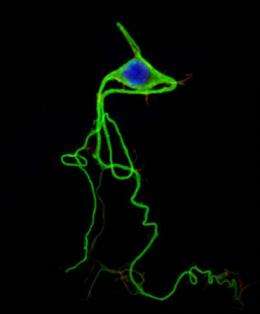
Grappling with a question that has defied scientific explanation for decades, a small team of researchers from the University of California, San Diego School of Medicine offers the first evidence-based model to explain how certain proteins in neurons travel from the central body of the cell (where they are made) down its axon to the terminal synapse – the junction where neurons communicate with each other.
The research, led by Subhojit Roy, MD, PhD, a cell biologist and neuropathologist in the department of neurosciences at UC San Diego School of Medicine and the Shiley Marcos Alzheimer's Disease Research Center, appears in the May 12 issue of the journal Neuron.
To function and survive, the central bodies of neurons operate like tiny factories, constantly manufacturing proteins that are shipped via the cell's long, thin axon to distant synapses.
"It can be quite a journey," said Roy. "Axons may be 10,000 times longer than the neuron's body is wide. Typically, they have thousands of times more volume. If you imagine my office as the cell-body, the axon would end in San Francisco. So the cell has to constantly ship things back and forth over comparatively enormous distances."
Some proteins make this journey via "fast axonal transport." They ride in motor-driven intracellular sacs called vesicles that speed to the synapses like an express train. But hundreds of other "cytosolic" proteins that do not anchor to vesicles take much longer to make the trip, and until now, no one has had a plausible explanation of how these soluble cargoes undertake "slow axonal transport."
In the 1970s, using pulse-chase radiolabeling, scientists discovered that cytosolic proteins (so-called because they reside in the cell's liquid medium, the cytosol) moved toward and through the axon in a directed, wave-like motion. Though this ruled out a passive diffusive process, scientists could not find a mechanistic explanation for the curious, slow, coordinated movement of proteins.
"The question just sort of lay there, dormant," Roy said. "The original discoverers took it as far as they possibly could, but there really was no way to address it until technology caught up."
Roy devised a strategy using photoactivatable green fluorescent proteins to monitor the bulk movement of these cytosolic proteins in living axons, simulating the slow movement. The motion was then dissected using contemporary imaging technologies, custom image-analyses tools and biochemistry and biophysical modeling. Collectively, the data indicate that soluble, cytosolic proteins assemble into larger supramolecular complexes that move out of the neuron's cell body and down the axon as a plume of proteins. The complexes themselves are transient and only move in short, vectorial spurts, making the overall motion slow.
Roy said the phenomenon was similar to the old, popular video arcade game "Frogger," which he once played as a student: "Imagine the cytosolic protein complex as the frog and think about how the frog hops on and off various fast-moving objects as it progresses forward and upward toward its goal. Remember that along the way the frogs get hit by buses or eaten by crocs, which is akin to the supramolecular complexes disassembling.
"Now imagine a thousand frogs hopping on and off fast-moving cargoes, appearing and disappearing all the time. That's sort of the picture you get with these protein plumes – a slow, coordinated overall motion resulting from seemingly chaotic behavior. To my knowledge, it's a completely new type of intracellular motion that's never been described before. And it seems likely that cytosolic proteins in all cells likely use this strategy."
The proposed model does not answer all questions. In fact, said Roy, it raises many more. It's not known, for example, how the proteins assemble into the larger complexes, their composition or what precisely moves them along. One possibility for the last item is fast axonal transport. The cytosolic complexes may be driven indirectly by the energy of speeding vesicles. Roy and colleagues say they will now turn to investigating these mysteries.
Beyond teasing out further details of how neurons (and presumably other cell types) function, the research may prove to have practical implications as well. In neurological conditions, such as Parkinson's and Lou Gehrig's disease, transport abnormalities of cytosolic proteins α-synuclein and SOD-1 have been long implicated, but the link has never been directly tested. Roy said a system that visualizes slow axonal transport may help do just that. These experiments could lead to insights into the workings of these diseases and possibly new therapeutic targets.


