Research team identifies receptor for Ebola virus
May 2, 2011 in Medical research
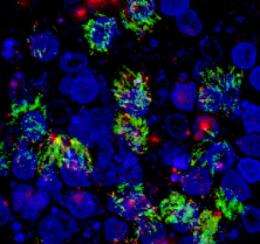
Cellular protein TIM-1 acts as a receptor for Ebola virus and Marburg virus. Microscope image shows TIM-1 expression (in green) on the surface of human airway cells. Credit: University of Iowa
A team of researchers has identified a cellular protein that acts as a receptor for Ebola virus and Marburg virus. Furthermore, the team showed that an antibody, which binds to the receptor protein, is able to block infection by both viruses.
"This is the first receptor identified for Ebola and Marburg viruses," said Wendy Maury, Ph.D., associate professor of microbiology at the University of Iowa Roy J. and Lucille A. Carver College of Medicine and senior study author. "That's important because if you can identify and understand the first step in infection - how the virus enters cells - then perhaps you can prevent the infection by nipping it in the bud."
Ebola and Marburg viruses cause hemorrhagic fever in humans and other primates. For some strains, infection can lead to death in 50 to 90 percent of cases, and there is no cure or effective treatment. The findings are published online the week of May 2 in the Proceedings of the National Academy of Sciences Early Edition.
Maury led a multidisciplinary team that included colleagues from four UI departments as well as collaborators at the National Institute of Dental and Craniofacial Research (NIDCR) in Bethesda, Md., University of Texas Medical Branch in Galveston, Texas, and Biogen Idec, in Cambridge, Mass.
The researchers used a new bioinformatics-based approach, developed by John Chiorini at NIDCR, to identify a protein called TIM-1 as a receptor for Ebola and Marburg viruses. Subsequent experiments proved that both Ebola and Marburg viruses use TIM-1 is a receptor for infecting cells.
The study also showed that TIM-1 protein is widely expressed on epithelial cells that line various tissues in the body including mucosal surfaces of the airways and in the eyes.
Maury noted that these locations are consistent with some of the ways the Ebola virus is thought to be transmitted -- inhalation of aerosolized droplets and hand-to-eye contact.
A further collaboration with Paul Rennert, Ph.D., at Biogen Idec, a biotech company based in Cambridge, Mass., provided the team with antibodies targeted to TIM-1 and the team found that one of these antibodies, ARD5, very effectively blocks Ebola and Marburg virus entry into cells.
Finally, work performed by Robert Davey, Ph.D., in a BSL-4 lab (the highest level of biocontainment) at University of Texas Medical Branch verified that the ARD5 antibody blocks infection by infectious Zaire Ebola Virus in cells that express the TIM-1 protein.
The results suggest that being able to block Ebola's entry into epithelial cells, perhaps with a human-compatible version of the ARD5 antibody, might provide a way to prevent initial infection and potentially limit the spread of the disease during an outbreak.
Importantly, the study found that TIM-1 protein is not expressed on all the cell types that are infected by Ebola and Marburg.
"It's clear that there are other receptors for Ebola because while TIM-1 is found on a number of epithelial cells in the body, it is not found on some important cell types that are infected by Ebola," Maury said. "Ultimately, epithelial cells are not as important a target for the virus as some other cell types, but they may be the first entry point for Ebola, so they may provide a conduit that allows Ebola access to those other cells within the body."
Provided by University of Iowa Health Care
-
Combination vaccine protects monkeys from ebola and Marburg viruses
Feb 26, 2008 |
not rated yet |
0
-
Small molecules may prevent ebola infection
Jan 19, 2011 |
not rated yet |
0
-
New study identifies how ebola virus avoids the immune system
Jan 27, 2009 |
not rated yet |
0
-
Vaccine for Ebola virus
Mar 31, 2008 |
not rated yet |
0
-
Scientists uncover Ebola cell-invasion strategy
Sep 03, 2008 |
not rated yet |
0
-
Motion perception revisited: High Phi effect challenges established motion perception assumptions
Apr 23, 2013 |
3 / 5 (2) |
2
-
Anything you can do I can do better: Neuromolecular foundations of the superiority illusion (Update)
Apr 02, 2013 |
4.5 / 5 (11) |
5
-
The visual system as economist: Neural resource allocation in visual adaptation
Mar 30, 2013 |
5 / 5 (2) |
9
-
Separate lives: Neuronal and organismal lifespans decoupled
Mar 27, 2013 |
4.9 / 5 (8) |
0
-
Sizing things up: The evolutionary neurobiology of scale invariance
Feb 28, 2013 |
4.8 / 5 (10) |
14
-
Pressure-volume curve: Elastic Recoil Pressure don't make sense
9 hours ago
-
If you became brain-dead, would you want them to pull the plug?
May 17, 2013
-
MRI bill question
May 15, 2013
-
Ratio of Hydrogen of Oxygen in Dessicated Animal Protein
May 13, 2013
-
Alcohol and acetaminophen
May 13, 2013
-
Marie Curie's leukemia
May 13, 2013
- More from Physics Forums - Medical Sciences
More news stories
Now we know why old scizophrenia medicine works on antibiotics-resistant bacteria
In 2008 researchers from the University of Southern Denmark showed that the drug thioridazine, which has previously been used to treat schizophrenia, is also a powerful weapon against antibiotic-resistant bacteria such as ...
Medical research
19 hours ago |
3.7 / 5 (3) |
0
|
SUMO wrestling cells reveal new protective mechanism target for stroke
Scientists investigating the interaction of a group of proteins in the brain responsible for protecting nerve cells from damage have identified a new target that could increase cell survival.
Medical research
May 17, 2013 |
5 / 5 (1) |
0
How serotonin receptors can shape drug effects, from LSD to migraine medication
New findings by researchers carrying out experiments at the U.S. Department of Energy Office of Science's Advanced Photon Source (APS) help explain why some drugs that interact with two kinds of human serotonin ...
Medical research
May 17, 2013 |
not rated yet |
0
|
Preventing blood poisoning
Peptide molecules derived from the body's natural immune system can help boost the body's defence against life-threatening blood poisoning, joint University research has uncovered.
Medical research
May 17, 2013 |
4 / 5 (1) |
0
|
New mechanism to prevent type 2 diabetes in obese individuals
A new Montréal study conducted by Dr. May Faraj, associate research professor at the Université de Montréal and invited scientist at the IRCM, along with her research team and medical collaborators, shows ...
Medical research
May 17, 2013 |
not rated yet |
0
|
New research identifies risks, interventions for children's GI health
An increasing number of U.S. children are experiencing gastrointestinal issues that require interventions to resolve, according to research presented at Digestive Disease Week (DDW).
New colonoscope provides ground-breaking view of colon
A ground-breaking advance in colonoscopy technology signals the future of colorectal care, according to research presented today at Digestive Disease Week(DDW). Additional research focuses on optimizing the minimal withdrawal ...
AIDS science at 30: 'Cure' now part of lexicon
Big names in medicine are set to give an upbeat assessment of the war on AIDS on Tuesday, 30 years after French researchers identified the virus that causes the disease.
For combat veterans suffering from post-traumatic stress disorder, 'fear circuitry' in the brain never rests
Chronic trauma can inflict lasting damage to brain regions associated with fear and anxiety. Previous imaging studies of people with post-traumatic stress disorder, or PTSD, have shown that these brain regions can over-or ...
Melon focus headband turns to Kickstarter for rollout plans
(Medical Xpress)—What if the quality of your work depends more on your focus on the piano keys or canvas or laptop than your musical or painting or computing skills? If target users can be convinced, they ...
Temporal processing in the olfactory system
The neural machinery underlying our olfactory sense continues to be an enigma for neuroscience. A recent review in Neuron seeks to expand traditional ideas about how neurons in the olfactory bulb might encode information about ...