Australians develop 'smart' bandage
June 6, 2011 in Medical research
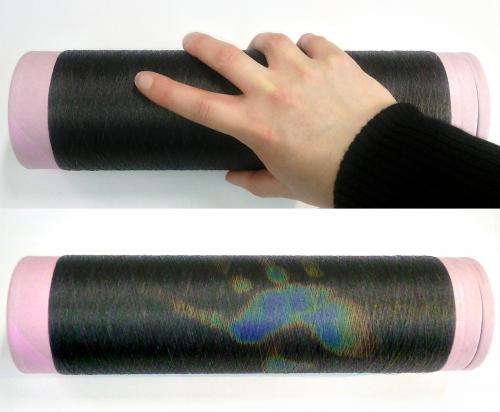
Spool of temperature sensitive fibre
(PhysOrg.com) -- Melbourne researchers have developed smart bandages that change colour to reveal the state of the wound beneath. Their invention could reduce the $500 million cost of chronic wound care in Australia.
We hope that the dressing could lead to more rapid and effective treatment of chronic wounds such as leg ulcers, saving time and money, as well as improving patient well-being, says the lead inventor Louise van der Werff, a CSIRO materials scientist and Monash University PhD student.
Weve created a fabric that changes colour in response to temperature showing changes of less than 0.5 of a degree. We expect that, when incorporated into a bandage it will allow nurses to quickly identify healing problems such as infection or interruptions to the blood supply, which are typically accompanied by a local increase or decrease in temperature, she says.

So far the team has created the fabric. Within six months theyll have turned it into a bandage, and then theyll work with industry to trial the new bandages. A manufacturer of bandages is supporting the research.
Up to 3 per cent of Australians suffer from chronic wounds, costing the healthcare system more than $500 million each year. Reduced blood supply due to systemic diseases such as diabetes, or inflammation as a result of infection, can lead to significant delays in healing.
If problems are not quickly identified and treated, Louise says, Wounds can persist for months or years resulting in a major reduction in quality of life. And the average cost of treatment is over $25,000 per wound.
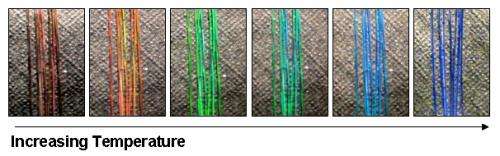
Temperature sensitive fibre changing colour as the temperature is increased
The colour-changing material the researchers have developed is in the form of a fibre, which may be woven or knitted into a loose textile product for incorporation into a wound dressing. It will allow both patients and clinicians to determine the temperature across the wound and surrounding tissue without using electronic equipment. They simply compare the colour of the fibres with a calibrated chart.This could lead to more timely, effective and relevant treatments by doctors and nurses and to limited self-diagnosis by patients allowing faster closure of the wounds.
Having the ability to collect a broader range of data on a wounds status will have a significant impact on the understanding of chronic wounds and how best to treat them, says Mr Robin Cranston, the leader of the joint research project.
Provided by Science in Public
-
Artificial skin system can heal wounds
Dec 20, 2007 |
not rated yet |
0
-
Gene Therapy Hastens Healing Process in Chronic Leg Ulcers
Dec 03, 2009 |
not rated yet |
0
-
Licking your wounds: Scientists isolate compound in human saliva that speeds wound healing
Jul 23, 2008 |
not rated yet |
0
-
Bacteria toxic to wound-treating maggots
Feb 04, 2010 |
not rated yet |
0
-
Skin care: new research into scar-free healing
Jan 21, 2008 |
not rated yet |
0
-
Limits to growth: Scientists identify key metastasis-enabling enzyme
May 22, 2012 |
5 / 5 (3) |
0
-
Seeing is as seeing does: Spatially-structured retinal input in early development of cortical maps
Apr 26, 2012 |
5 / 5 (4) |
1
-
Dreamless nights: Brain activity during nonrapid eye movement sleep
Apr 09, 2012 |
4.4 / 5 (12) |
0
-
Take your time: Neurobiology sheds light on the superiority of spaced vs. massed learning
Mar 28, 2012 |
4.5 / 5 (21) |
3
-
Your brain on 'shrooms: fMRI elucidates neural correlates of psilocybin psychedelic state
Feb 29, 2012 |
4.9 / 5 (42) |
45
-
A question about drug tolerance
20 hours ago
-
Poor nutrition leading to overeating?
May 23, 2012
-
Math and dyslexia?
May 21, 2012
-
portable metabolism meter?
May 21, 2012
-
Rare medical conditions on 20/20 tonight
May 18, 2012
-
"Good" Cholesterol in Doubt
May 17, 2012
- More from Physics Forums - Medical Sciences
More news stories
The cells' petrol pump is finally identified
The oxygen and food we consume are converted into energy by tiny organelles present in each cell, the mitochondria. These 'power plants' must be continuously supplied with fuel, to maintain all vital functions. A team led ...
Medical research
1 hour ago |
5 / 5 (1) |
0
Researchers identify protein necessary for behavioral flexibility
Researchers have identified a protein necessary to maintain behavioral flexibility, which allows us to modify our behaviors to adjust to circumstances that are similar, but not identical, to previous experiences. Their findings, ...
Medical research
3 hours ago |
5 / 5 (1) |
1
|
From stem cell to brain cell - new technique mimics the brain
A new technique that converts stem cells into brain cells has been developed by researchers at Lund University. The method is simpler, quicker and safer than previous research has shown and opens the doors to a shorter route ...
Medical research
5 hours ago |
5 / 5 (1) |
0
A revealing hand
What did you have for lunch yesterday? How many times a month do you eat nuts? How about your kids -- how many servings of vegetables did they consume today?
Medical research
8 hours ago |
5 / 5 (2) |
0
Stem-cell-growing surface enables bone repair
(Medical Xpress) -- University of Michigan researchers have proven that a special surface, free of biological contaminants, allows adult-derived stem cells to thrive and transform into multiple cell types. ...
Medical research
May 23, 2012 |
5 / 5 (9) |
1
|
Boundary stops molecule right where it needs to be
A molecule responsible for the proper formation of a key portion of the nervous system finds its way to the proper place not because it is actively recruited, but instead because it can't go anywhere else.
Thioridazine kills cancer stem cells in human while avoiding toxic side-effects of conventional cancer treatments
A team of scientists at McMaster University has discovered a drug, thioridazine, successfully kills cancer stem cells in the human while avoiding the toxic side-effects of conventional cancer treatments.
Researcher calls for new approach to regulating probiotics
In today's Nature scientific journal Dr. Gregor Reid, Director of the Canadian R&D Centre for Probiotics at Lawson Health Research Institute and a scientist at Western University, calls for a Category Tree system to be imp ...
Male fertility genes discovered
A new study has revealed previously undiscovered genetic variants that influence fertility in men. The findings, published by Cell Press on May 24th in the American Journal of Human Genetics, shed much-needed light on hum ...
Knowing genetic makeup may not significantly improve disease risk prediction
Harvard School of Public Health (HSPH) researchers have found that detailed knowledge about your genetic makeupthe interplay between genetic variants and other genetic variants, or between genetic variants and environmental ...
A boost in microRNA may protect against sepsis and other inflammatory diseases
Acute inflammatory diseases, such as sepsis, as well as chronic inflammatory diseases like diabetes and arthritis, develop as a result of sustained inflammation of the blood vessel wall. Researchers at Brigham and Women's ...