Fear boosts activation of young, immature brain cells
June 14, 2011 in Psychology & Psychiatry
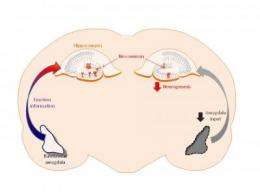
Emotional information from the amygdala promotes maturation of adult neural stem cells into new neurons in the hippocampus. These neurons can be activated by fear during a critical 2-4 week period after birth, helping to imprint a memory of the fearful situation. Without input from the amygdala (right), the hippocampus produces fewer new neurons. Credit: Daniela Kaufer lab, UC Berkeley
(PhysOrg.com) -- Fear burns memories into our brain, and new research by University of California, Berkeley, neuroscientists explains how.
Scientists have long known that fear and other highly emotional experiences lead to incredibly strong memories. In a study appearing online today (Tuesday, June 14) in advance of publication in the journal Molecular Psychiatry, UC Berkeley's Daniela Kaufer and colleagues report a new way for emotions to affect memory: The brain's emotional center, the amygdala, induces the hippocampus, a relay hub for memory, to generate new neurons.
In a fearful situation, these newborn neurons get activated by the amygdala and may provide a "blank slate" to strongly imprint the new fearful memory, she said. In evolutionary terms, it means new neurons are likely helping you to remember the lion that nearly killed you.
"We remember emotional events much more strongly than daily experiences, and for a long time we have known that connections between the amygdala and hippocampus help to encode this emotional information," said Kaufer, an assistant professor of integrative biology and a member of UC Berkeley's Wills Neuroscience Institute. "Our research shows that amygdala input actually pushes the hippocampus to make new neurons from a unique population of neural stem cells. This provides completely new cells that get activated in response to emotional input."
The finding has implications for post traumatic stress disorder (PTSD) and other problems caused by faulty regulation of emotional memory.
"Many affective disorders involve disordered emotional memories like PTSD, depression and anxiety. We think that newborn neurons may play a role in creating these emotional memories," she said.
The finding comes a year after brain researcher Fred Gage at the Salk Institute for Biological Studies in La Jolla, Calif., showed that the formation of new memories is associated with increased activation of two-week-old newborn nerve cells in the hippocampus that are derived from adult neural stem cells. Adult stem cells appear to differentiate continually into new nerve cells nearly 100 each day yet half of those newborn neurons are slated for death within four weeks after their birth. If they are highly activated, however such as in learning new complex information many more of them will survive and presumably help in establishing new memories in the brain.
Kaufer, who conducts research on the effects of stress on the brain, knew that many types of positive and negative experiences, such as exercise and stress, affect the rate of neurogenesis in the hippocampus. Along with graduate students Elizabeth Kirby, the lead author of the study, and Aaron Friedman, she was intrigued by the idea that emotions might affect neurogenesis in the hippocampus, since the brain's clearinghouse for emotions, the amygdala, is connected to the hippocampus via multiple neural circuits. To test this, Kirby focused on the basolateral amygdala, the region of the almond-shaped structure that handles negative emotions, including stress, anxiety and fear.
Using rats, Kirby surgically destroyed the basolateral amygdala and discovered that the production of new nerve cells in the hippocampus decreased. To make sure that the cell damage created when the amygdala was surgically destroyed was not affecting the experiment, the researchers borrowed a gene therapy technique from Robert Sapolsky's lab at Stanford University to genetically introduce potassium channels into the amygdala, which shut down the activity of the nerve cells without causing injury. This also decreased neurogenesis in the hippocampus.
They next tested Gage's theory that new neurons are especially sensitive to input two weeks after they form. Kirby and Kaufer labeled hippocampal cells created over a three-day period in a group of rats, and then conditioned a fear response in these rats two weeks later. They then confronted the rats with the same fearful situation or a neutral yet novel context the next day. When they examined the brains, they found that the newborn neurons had been specifically activated by the fearful situation. However, when they destroyed the basolateral amygdala, new neurons were no longer activated in response to the fearful memory.
"The research suggests that newborn neurons play a role not only in the formation of memory, but also in helping to create the emotional context of memory," Kirby said. It also suggests that the basolateral amygdala drives the ability of new neurons to be part of an emotional memory.
The team now plans to see whether other negative stimuli, such as stress and anxiety, similarly cooperate with amygdala activity to alter neurogenesis in the hippocampus.
Provided by
University of California - Berkeley
-
To make memories, new neurons must erase older ones
Nov 12, 2009 |
not rated yet |
0
-
Stress and nerve cells survival in rats; finding may open widow for depression treatment
Mar 13, 2007 |
not rated yet |
0
-
When memory-related region of brain is damaged, other areas compensate, study finds
Aug 02, 2010 |
not rated yet |
0
-
Stem cells are good for the brain
Jul 15, 2008 |
not rated yet |
0
-
Nurturing newborn neurons sharpens minds in mice
Apr 03, 2011 |
not rated yet |
0
-
Motion perception revisited: High Phi effect challenges established motion perception assumptions
Apr 23, 2013 |
3 / 5 (2) |
2
-
Anything you can do I can do better: Neuromolecular foundations of the superiority illusion (Update)
Apr 02, 2013 |
4.5 / 5 (11) |
5
-
The visual system as economist: Neural resource allocation in visual adaptation
Mar 30, 2013 |
5 / 5 (2) |
9
-
Separate lives: Neuronal and organismal lifespans decoupled
Mar 27, 2013 |
4.9 / 5 (8) |
0
-
Sizing things up: The evolutionary neurobiology of scale invariance
Feb 28, 2013 |
4.8 / 5 (10) |
14
-
Why is zone 1 in liver more prone to ischemic injury?
May 23, 2013
-
How can there be villous adenoma in colon, if there are no villi there
May 22, 2013
-
How can there be a term called "intestinal metaplasia" of stomach
May 21, 2013
-
Pressure-volume curve: Elastic Recoil Pressure don't make sense
May 18, 2013
-
If you became brain-dead, would you want them to pull the plug?
May 17, 2013
-
MRI bill question
May 15, 2013
- More from Physics Forums - Medical Sciences
More news stories
Storm chasers: born to be wild?
(HealthDay)—We've all seen them: the surfers who race to the beach when a hurricane hits, the guy who decides to ride out the storm in his overmatched boat, the tornado chasers who fearlessly steer their ...
Psychology & Psychiatry
May 24, 2013 |
not rated yet |
0
Hormone levels may provide key to understanding psychological disorders in women
Women at a particular stage in their monthly menstrual cycle may be more vulnerable to some of the psychological side-effects associated with stressful experiences, according to a study from UCL.
Psychology & Psychiatry
May 24, 2013 |
4 / 5 (4) |
4
|
Are there atheists in foxholes? Study says they're the minority
Ernie Pyle – an iconic war correspondent in World War II – reportedly said "There are no atheists in foxholes." A new joint study between two brothers at Cornell and Virginia Wesleyan found that only ...
Psychology & Psychiatry
May 24, 2013 |
2.5 / 5 (4) |
2
Breathing exercises help veterans find peace after war, scholar says
(Medical Xpress)—Research by Stanford scholar Emma Seppala at the Center for Compassion and Altruism Research and Education found that post-traumatic stress disorder decreased in veterans who participated ...
Psychology & Psychiatry
May 24, 2013 |
5 / 5 (1) |
1
Depression raises diabetics' risk of severe low blood sugar episodes
(Medical Xpress)—Patients with diabetes who are depressed are much more likely to develop episodes of dangerously low blood sugars, or hypoglycemia, than are those who are not depressed, a new study has ...
Psychology & Psychiatry
May 24, 2013 |
not rated yet |
0
|
First drug to improve heart failure mortality in over a decade
Coenzyme Q10 decreases all cause mortality by half, according to the results of a multicentre randomised double blind trial presented today at Heart Failure 2013 congress. It is the first drug to improve heart failure mortality ...
Heart failure accelerates male 'menopause'
Heart failure accelerates the aging process and brings on early andropausal syndrome (AS), according to research presented today at the Heart Failure Congress 2013. AS, also referred to as male 'menopause', was four times ...
Seniors more likely to crash when driving with pet, study finds
(HealthDay)—Animals make great companions for senior citizens, but elderly people who always drive with a pet in the car are far more likely to crash than those who never drive with a pet, researchers have ...
New immune system discovered
(Medical Xpress)—A research team, led by Jeremy Barr, a biology post-doctoral fellow, unveils a new immune system that protects humans and animals from infection.
Death highest in heart failure patients admitted in January, on Friday, and overnight
Mortality and length of stay are highest in heart failure patients admitted in January, on Friday, and overnight, according to research presented today at the Heart Failure Congress 2013. The analysis of nearly 1 million ...
Feds fight morning-after pill age ruling in NY
(AP)—Department of Justice lawyers have again asked a federal appeals court in New York to delay lifting age restrictions and prescription requirements on an emergency contraceptive popularly known as the morning-after ...