Researchers look for ingredients of happiness around the world
June 29, 2011 in Psychology & Psychiatry
Researchers look for ingredients of happiness around the world

Enlarge

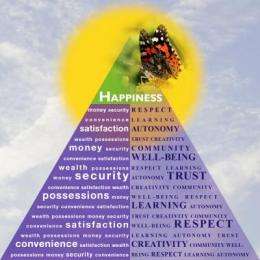
Abraham Maslow's "hierarchy of needs" suggests that basic needs must be fulfilled before higher needs are pursued, but a new study indicates that people benefit from satisfying any of these needs in any order. Credit: Debra Bolgla

In 1943, American psychologist Abraham Maslow proposed that all humans seek to fulfill a hierarchy of needs, which he represented with a pyramid. The pyramid's base, which he believed must come first, signified basic needs (for food, sleep and sex, for example). Safety and security came next, in Maslow's view, then love and belonging, then esteem and, finally, at the pyramid's peak, a quality he called
"self-actualization." Maslow wrote that people who have these needs fulfilled should be happier than those who don't.

In a new study, researchers at the University of Illinois put Maslow's ideas to the test with data from 123 countries representing every major region of the world.

"Anyone who has ever completed a psychology class has heard of Abraham Maslow and his theory of needs," said University of Illinois professor emeritus of psychology Ed Diener, who led the study. "But the nagging question has always been: Where is the proof? Students learn the theory, but scientific research backing this theory is rarely mentioned."

The researchers turned to the Gallup World Poll, which conducted surveys in 155 countries from 2005 to 2010, and included questions about money, food, shelter, safety, social support, feeling respected, being self-directed, having a sense of mastery, and the experience of positive or . Diener, a senior scientist for the Gallup Organization, helped design the survey.

The researchers found that fulfillment of a diversity of needs, as defined by Maslow, do appear to be universal and important to individual happiness. But the order in which "higher" and "lower" needs are met has little bearing on how much they contribute to life satisfaction and enjoyment, Diener said.

They also found that the fulfillment of more basic needs – for money, food or shelter, for example – was more closely linked to a positive life evaluation, the way an individual ranked his or her life on a scale from worst to best. The satisfaction of higher needs – for social support, respect, autonomy or mastery – was "more strongly related to enjoying life – having more positive feelings and less negative feelings," Diener said.

An important finding, Diener said, is that the research indicated that people have higher life evaluations when others in society also have their needs fulfilled.

"Thus is not just an individual affair, but depends substantially also on the quality of life of one's fellow citizens," he said.

"Our findings suggest that Maslow's theory is largely correct. In cultures all over the world the fulfillment of his proposed needs correlates with ," Diener said. "However, an important departure from Maslow's theory is that we found that a person can report having good social relationships and self-actualization even if their basic needs and safety needs are not completely fulfilled."

"Another revision of his theory is that we found that different needs produce different types of well-being," Diener said.

More information: The paper, "Needs and Subjective Well-Being Around the World," in the Journal of Personality and Social Psychology.

Provided by University of Illinois at Urbana-Champaign search and more info website

5 /5 (3 votes)  

Rank 5 /5 (3 votes)
Relevant PhysicsForums posts
  • A question about drug tolerance
    createdMay 23, 2012
  • Poor nutrition leading to overeating?
    createdMay 23, 2012
  • Math and dyslexia?
    createdMay 21, 2012
  • portable metabolism meter?
    createdMay 21, 2012
  • Rare medical conditions on 20/20 tonight
    createdMay 18, 2012
  • "Good" Cholesterol in Doubt
    createdMay 17, 2012
  • More from Physics Forums - Medical Sciences

More news stories

Feeling strong emotions makes peoples' brains 'tick together'

Experiencing strong emotions synchronises brain activity across individuals, research team at Aalto University and Turku PET Centre in Finland has revealed.

Psychology & Psychiatry created 9 hours ago | popularity not rated yet | comments 0

Formal recognition of PMDD will lift stigma for women

A decision to recognise premenstrual dysphoric disorder as a genuine psychiatric condition will finally provide “validation for this awful and poorly understood” syndrome and alleviate the stigma ...

Psychology & Psychiatry created 11 hours ago | popularity 2 / 5 (1) | comments 0

Long-term meditation leads to different brain organization

(Medical Xpress) -- People who practice mindfulness meditation learn to accept their feelings, emotions, and states of mind without judging or resisting them. They simply live in the moment.

Psychology & Psychiatry created 11 hours ago | popularity 5 / 5 (1) | comments 0 | with audio podcast

Older African-Americans use religious songs to cope with stress, study shows

(Medical Xpress) -- New research from the University of North Carolina Chapel Hill School of Nursing has shown that older African-Americans use religious songs in a personal way to cope with stressful life events. Songs long ...

Psychology & Psychiatry created 12 hours ago | popularity not rated yet | comments 0

Spatial configuration can spark deja vu, psychology study reveals

(Medical Xpress) -- Déjà vu - that strange feeling of having experienced something before - is more likely to occur when a scene's spatial layout resembles one in memory, according to groundbreaking new research ...

Psychology & Psychiatry created 13 hours ago | popularity not rated yet | comments 0 | with audio podcast


Amino acid consumption associated with how fast cancer cells divide

For almost a century, researchers have known that cancer cells have peculiar appetites, devouring glucose in ways that normal cells do not. But glucose uptake may tell only part of cancer's metabolic story. Researchers from ...

'Personality genes' may help account for longevity

"It's in their genes" is a common refrain from scientists when asked about factors that allow centenarians to reach age 100 and beyond. Up until now, research has focused on genetic variations that offer a physiological advantage ...

Gene discovery points towards non-hormonal male contraceptive

A new type of male contraceptive could be created thanks to the discovery of a key gene essential for sperm development.

Thioridazine kills cancer stem cells in human while avoiding toxic side-effects of conventional cancer treatments

A team of scientists at McMaster University has discovered a drug, thioridazine, successfully kills cancer stem cells in the human while avoiding the toxic side-effects of conventional cancer treatments.

Brentuximab vedotin effective in large-cell lymphoma

(HealthDay) -- More than half of patients with relapsed or refractory systemic anaplastic large-cell lymphoma (ALCL) treated with the CD30-directed antibody-drug conjugate brentuximab vedotin achieve a complete ...

Cyber exercise partners help you go the distance: Motivation gains can double

A new study testing the benefits of a virtual exercise partner shows the presence of a moderately more capable cycling partner can significantly boost the motivation – by as much as 100 percent – ...