Nerve cells grown from stem cells give new insight into Parkinson's
June 20, 2011 in Medical research
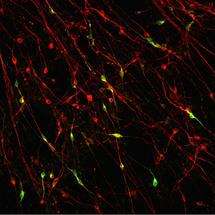
Dopamine neurons (in green) grown using stem cell technology.
Oxford University researchers have succeeded in using stem cell technology to grow nerve cells in the laboratory from initial skin samples taken from Parkinsons patients. Its the first large-scale effort of its kind in the UK.
The advance will allow nerve cells that are just like those of the people with Parkinsons to be studied intensively in the laboratory in ways that werent possible before.
The study aims to investigate what processes are making specific nerve cells, called dopamine neurons, die off as the disease progresses.
"We cant take bits of peoples brains when they are alive, of course," says Dr. Richard Wade-Martins of the Oxford Parkinsons Disease Centre, who led the work. "So we never have been able to study dopamine neurons from a patient."
"We now have a platform to understand what happens in the cells in disease and identify new pathways that could lead to potential targets for new therapies."
BBC News followed the steps in the process with one patient from Oxfordshire. A skin biopsy was provided by Mr Derek Underwood, who used to work for a manufacturer of MRI scanners before his early retirement through Parkinsons.
Skin cells from Mr. Underwoods biopsy were then grown up in the lab. At the appropriate point, using an approach recently developed by Japanese scientists, the skin cells were reprogrammed to revert back to a stem-cell-like state.
The great power of these induced pluripotent stem cells, or iPS cells, is that they are able to form just about any of the specialised types of cell present in the body. That allowed the Oxford team to guide the iPS cells to develop, or differentiate, into nerve cells that are essentially identical to the Mr. Underwoods own nerve cells in his brain.
Some of the nerve cells generated are dopamine neurons, the ones involved in Parkinsons disease.
Each of the stages in the process skin cells to iPS cells to nerve cells are visible under the microscope as they all look very different. The clearly defined circular colony of stem cells gradually breaks up as nerve cells with their long thread-like projections appear, down which electrical signals can be transmitted.
Being able to access large numbers of the dopamine neurons in the lab should allow the study of all the biological processes that go wrong in Parkinsons, giving greater insight into the causes of the disease.
"The brain is an inaccessible organ and you can't get bits of people's brain to study very easily," Dr. Richard Wade-Martins told BBC News. "But what we have here is a disease in a dish [where the cells] are just like Derek's brain cells but are accessible and can be produced in unlimited quantities."
Dr. Wade-Martins and colleagues now have samples from 20 different patients with Parkinsons disease, all at different stages in the stem cell process. This gives a bank of samples for study.
The stem cell work is part of a bigger clinical study funded by Parkinsons UK involving around 2000 people with Parkinsons disease in the Thames Valley region.
The study is using a series of approaches blood screens, gene sequencing, cell cultures, and MRI scans to get a lot of clinical data about this set of patients to really probe the origins and causes of the condition.
"Were interested in biomarkers that can be predictors of disease, whether thats aberrant proteins in the blood or MRI imaging signatures," explains Dr. Wade-Martins.
"Its not a clinical trial of a drug, nor are we using stem cells as a therapy. What we will get is a fantastically well-characterised cohort of people that should help us pinpoint disease mechanisms."
Provided by
Oxford University
-
Skin cells could help discover cause of Parkinson's disease
Jul 14, 2010 |
not rated yet |
0
-
Stem cells reverse disease in a model of Parkinson's disease
May 16, 2011 |
not rated yet |
0
-
Parkinson’s disease protein impedes nerve signaling long before brain cells die
Oct 05, 2010 |
not rated yet |
0
-
Identification of dopamine 'mother cells' could lead to future Parkinson's treatments
Apr 07, 2008 |
not rated yet |
0
-
New discovery in Parkinson's research
Nov 24, 2010 |
not rated yet |
0
-
Limits to growth: Scientists identify key metastasis-enabling enzyme
May 22, 2012 |
5 / 5 (3) |
0
-
Seeing is as seeing does: Spatially-structured retinal input in early development of cortical maps
Apr 26, 2012 |
5 / 5 (4) |
1
-
Dreamless nights: Brain activity during nonrapid eye movement sleep
Apr 09, 2012 |
4.4 / 5 (12) |
0
-
Take your time: Neurobiology sheds light on the superiority of spaced vs. massed learning
Mar 28, 2012 |
4.5 / 5 (21) |
3
-
Your brain on 'shrooms: fMRI elucidates neural correlates of psilocybin psychedelic state
Feb 29, 2012 |
4.9 / 5 (42) |
45
-
A question about drug tolerance
May 23, 2012
-
Poor nutrition leading to overeating?
May 23, 2012
-
Math and dyslexia?
May 21, 2012
-
portable metabolism meter?
May 21, 2012
-
Rare medical conditions on 20/20 tonight
May 18, 2012
-
"Good" Cholesterol in Doubt
May 17, 2012
- More from Physics Forums - Medical Sciences
More news stories
The cells' petrol pump is finally identified
The oxygen and food we consume are converted into energy by tiny organelles present in each cell, the mitochondria. These 'power plants' must be continuously supplied with fuel, to maintain all vital functions. A team led ...
Medical research
7 hours ago |
5 / 5 (1) |
0
Researchers identify protein necessary for behavioral flexibility
Researchers have identified a protein necessary to maintain behavioral flexibility, which allows us to modify our behaviors to adjust to circumstances that are similar, but not identical, to previous experiences. Their findings, ...
Medical research
9 hours ago |
5 / 5 (1) |
1
|
From stem cell to brain cell - new technique mimics the brain
A new technique that converts stem cells into brain cells has been developed by researchers at Lund University. The method is simpler, quicker and safer than previous research has shown and opens the doors to a shorter route ...
Medical research
11 hours ago |
5 / 5 (1) |
0
A revealing hand
What did you have for lunch yesterday? How many times a month do you eat nuts? How about your kids -- how many servings of vegetables did they consume today?
Medical research
15 hours ago |
5 / 5 (2) |
0
Stem-cell-growing surface enables bone repair
(Medical Xpress) -- University of Michigan researchers have proven that a special surface, free of biological contaminants, allows adult-derived stem cells to thrive and transform into multiple cell types. ...
Medical research
May 23, 2012 |
5 / 5 (9) |
1
|
Amino acid consumption associated with how fast cancer cells divide
For almost a century, researchers have known that cancer cells have peculiar appetites, devouring glucose in ways that normal cells do not. But glucose uptake may tell only part of cancer's metabolic story. Researchers from ...
'Personality genes' may help account for longevity
"It's in their genes" is a common refrain from scientists when asked about factors that allow centenarians to reach age 100 and beyond. Up until now, research has focused on genetic variations that offer a physiological advantage ...
Gene discovery points towards non-hormonal male contraceptive
A new type of male contraceptive could be created thanks to the discovery of a key gene essential for sperm development.
Thioridazine kills cancer stem cells in human while avoiding toxic side-effects of conventional cancer treatments
A team of scientists at McMaster University has discovered a drug, thioridazine, successfully kills cancer stem cells in the human while avoiding the toxic side-effects of conventional cancer treatments.
Cyber exercise partners help you go the distance: Motivation gains can double
A new study testing the benefits of a virtual exercise partner shows the presence of a moderately more capable cycling partner can significantly boost the motivation by as much as 100 percent ...
Brentuximab vedotin effective in large-cell lymphoma
(HealthDay) -- More than half of patients with relapsed or refractory systemic anaplastic large-cell lymphoma (ALCL) treated with the CD30-directed antibody-drug conjugate brentuximab vedotin achieve a complete ...