Radionuclide treatment against small tumors and metastases
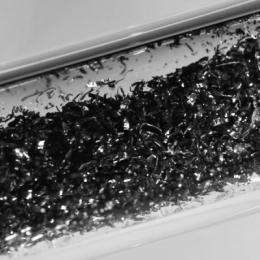
Medicine could very soon have a new ally in the fight against cancer: Terbium-161. Its most important weapon: Conversion and Auger electrons. Researchers at the Technische Universitaet Muenchen have developed a new treatment method based on terbium-161 to treat smaller tumors and metastases in a more targeted way. The nuclide was produced at the TUM's research neutron source. In cooperation with the Paul Scherrer Institute it has been tested on cancer cells successfully.
A cancer diagnosis is not necessarily a death sentence. There are now quite a number of possibilities to treat cancer. In addition to radiotherapy and chemotherapy, so-called radionuclide treatment has also become an important component in the fight against the mutated cells. It involves injecting radioactive elements, so-called nuclides, into the patient's circulatory system. Bonded to special molecules which preferentially attach themselves to cancer cells, the nuclides are pumped through the body by the heart until they finally find their target: a cancer cell. Having arrived there, they attach themselves to its cell walls, decay and thus release radiation into their surroundings. This attacks the cancer cells at close range and ideally destroys them.
Lutetium-177 is a nuclide already used for clinical applications. As it decays, fast electrons, so-called beta particles, are generated. In human tissue they have a range of up to 100 micrometers, five times the diameter of a tumor cell. They can therefore also damage healthy tissue in the vicinity. Dr. Silvia Lehenberger, a radiochemist at the TUM, has now succeeded in producing the Terbium-161 nuclide pure enough and in quantities sufficient for therapeutic applications. The nuclide emits not only the beta particles, but also conversion and Auger electrons, which have a range of only 0.5 to 30 micrometers. Their ranges match the size of tumor cells, making them ideal for the treatment of small tumors and metastases. "Moreover, the nuclide has a higher energy content than comparable particles," explains Silvia Lehenberger. "This means smaller doses can be administered to the patient, which in turn means a reduction in the radiation exposure."
Like lutetium or neodymium, which is familiar from high-power magnets, terbium is one of the so-called rare earth metals. The elements of the rare earths are extremely similar in chemical terms. Moreover, the raw material contains impurities which would not be permissible for a clinical application. It was therefore essential to develop suitable separation methods in order to be able to isolate the desired terbium-161 in as pure a state as possible. Coauthor and TUM colleague Christoph Barkhausen played a crucial role in the development of the separation method. The similarity of the rare earth elements also has an advantage, however: The medical application worked out for Lutetium-177 can also be used for Terbium-161.
A cooperation between Silvia Lehenberger and researchers at the Paul Scherrer Institute in Villingen (Switzerland) has already been able to prove the effectiveness of the nuclide on cancer cells in the laboratory. This is only the first step on the road to the final medication, however. It must pass a great many tests before it can be administered to people in hospital.
The researchers produced the Terbium-161 nuclide from Gadolinium-160 by neutron irradiation at the Garching FRM II research neutron source. Terbium-161 is ideal for therapeutic purposes because it has a half-life of only 6.9 days. This has the advantage that, after it has been produced, it can be transported to the clinic where it is to be used without losing much of its activity; it also means that the radiation has already decayed to about one percent of its original value after 50 days.
The work was undertaken as part of a cooperation between Radiochemistry Munich (RCM) at the TUM and the Laboratory for Radiochemistry and Environmental Chemistry and the Center for Radiopharmaceutical Sciences at the Paul Scherrer Institute (Villingen/Switzerland). The Terbium-161 was mainly produced at the neutron source of the Technische Universitaet Muenchen in Garching and additionally at the Institut Laue-Langevin in Grenoble and in the neutron source of the Helmholtz Center Berlin. Lutetium-177 for comparative tests was provided by Isotope Technologies Garching GmbH, which has been providing this nuclide to hospitals for many years for therapeutic purposes.
More information: Silvia Lehenberger, Christoph Barkhausen, Susan Cohrs, Eliane Fischer, Jürgen Grünberg, Alexander Hohn, Ulli Köster, Roger Schibli, Andreas Türler, Konstantin Zhernosekov, The low-energy β− and electron emitter 161Tb as an alternative to 177Lu for targeted radionuclide therapy, Journal of Nuclear Medicine and Biology, DOI: 10.1016/j.nucmedbio.2011.02.007


