Unraveling the ins and outs of brain development
June 10, 2011 in Neuroscience
Unraveling the ins and outs of brain development

Enlarge

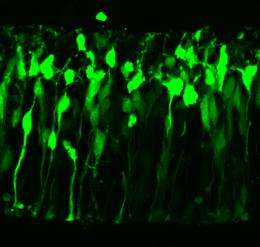
Figure 1: Cell nuclei of brain cells accumulate at the outer surface of the ventricular zone when the cell cycle is blocked. Credit: Reproduced from Ref. 1 2011 Yoichi Kosodo et al.

The embryonic nervous system is a hollow tube consisting of elongated neural progenitor cells, which extend from the inner to the outer surface of the tube. In a section inside the tube called the ventricular zone (VZ), these cells divide and produce immature neurons that migrate outwards. This involves well-characterized movements that are coupled to cell division. After a cell divides at the inner-most VZ region, the nuclei migrate to the outer region, where they synthesize new DNA before returning. 

To determine how the direction of movement is coupled to the cell division cycle, Yoichi Kosodo and colleagues in Matsuzaki's group at RIKEN Center for Developmental Biology labeled nuclei in the embryonic mouse brain with green fluorescent protein. This enabled them to not only track their movements in cultured brain slices using a video-imaging system, but also correlate their positions with phases of the cell cycle. They found that outward nuclear migration involves back and forth ‘ratcheting’ motions and occurs more slowly than inward migration. 

Importantly, they discovered that blocking the cell cycle before synthesis caused nuclei to accumulate at the outer VZ surface (Fig.1), and reduced outward migration. Nuclei migrating back inwards normally crowd out those just finished dividing, thus pushing them away from the inner VZ surface.

Examining their results further, the researchers computationally modeled nuclear migration, and incorporated fluorescent magnetic beads into the inner VZ surface. They observed the beads moving away from the inner VZ surface, and remaining at its outer region.

The researchers also showed that inward migration is closely linked to microtubule reorganization orchestrated by a protein called Tpx2, which is initially expressed in the nuclei of progenitors before moving to the mitotic spindle. This separates newly duplicated chromosomes. Translocation of Tpx2 to the cell region nearest the inner VZ surface promotes migration of the nucleus in that direction by microtubule re-organization. Reducing Tpx2 activity lowered the velocity of inward migration, but introducing the human Tpx2 gene into the lacking Tpx2 restored normal speed.

The researchers conclude that two mechanisms maintain brain structure during development. One couples cell migration to the , and occurs independently of other cells, with Tpx2 providing an active driving force; and the other involves interactions between the in the VZ.

More information: Kosodo, Y., et al. Regulation of interkinetic nuclear migration by cell cycle-coupled active and passive mechanisms in the developing brain. The EMBO Journal 30, 1690–1704 (2011).

Provided by RIKEN search and more info website

not rated yet  

Rank not rated yet
Relevant PhysicsForums posts
  • A question about drug tolerance
    createdMay 23, 2012
  • Poor nutrition leading to overeating?
    createdMay 23, 2012
  • Math and dyslexia?
    createdMay 21, 2012
  • portable metabolism meter?
    createdMay 21, 2012
  • Rare medical conditions on 20/20 tonight
    createdMay 18, 2012
  • "Good" Cholesterol in Doubt
    createdMay 17, 2012
  • More from Physics Forums - Medical Sciences

More news stories

Of mice and mental models: Neuroscientific implications of risk-optimized behavior in the mouse

(Medical Xpress) -- Regardless of an organism’s biological complexity, every encephalized animal continuously makes under-informed behavioral choices that can have serious consequences. Despite its ubiquity, ...

Neuroscience created 47 minutes ago | popularity not rated yet | comments 0 | with audio podcast feature

Persistent sensory experience is good for aging brain

Despite a long-held scientific belief that much of the wiring of the brain is fixed by the time of adolescence, a new study shows that changes in sensory experience can cause massive rewiring of the brain, even as one ages. ...

Neuroscience created 21 hours ago | popularity not rated yet | comments 0

Boundary stops molecule right where it needs to be

A molecule responsible for the proper formation of a key portion of the nervous system finds its way to the proper place not because it is actively recruited, but instead because it can't go anywhere else.

Neuroscience created 21 hours ago | popularity not rated yet | comments 0 | with audio podcast

Locating ground zero: How the brain's emergency workers find the disaster area

Like emergency workers rushing to a disaster scene, cells called microglia speed to places where the brain has been injured, to contain the damage by 'eating up' any cellular debris and dead or dying neurons. ...

Neuroscience created 21 hours ago | popularity 5 / 5 (2) | comments 0 | with audio podcast

Genetic 'reset switch' enables signaling pathway to induce multiple developmental outcomes for olfactory neurons

Within the nervous system, a handful of signaling pathways modulate development of a cornucopia of different neuronal subtypes. “Even small alterations in neuron differentiation pathways can disrupt subsequent ...

Neuroscience created May 24, 2012 | popularity not rated yet | comments 0


Researchers identify key brain cell in antidepressant action

(Medical Xpress) -- Antidepressant medications such as Prozac have helped improve mood and lessen anxiety in millions of people with major depression. But scientists know surprisingly little about how these drugs work.

Questionable research practices surprisingly common

(Medical Xpress) -- Not all scientific misconduct is flat-out fraud. Much falls into the murkier realm of “questionable research practices.” A new study finds that in one field, psychology, these practices are surprisingly ...

New prostate cancer screening guidelines face a tough sell, study suggests

(Medical Xpress) -- Recent recommendations from the U.S. Preventive Services Task Force (USPSTF) advising elimination of routine prostate-specific antigen (PSA) screening for prostate cancer in healthy men are likely to encounter ...

Energy levels link sleep control mechanisms

Sleep, or lack of it, can determine level of cognitive performance which is linked with accidents as well as increased risk of serious health problems. Links between cell energy levels, gene transcription ...

Routine care for Crohn's disease in children should include measurement of bone age

(Medical Xpress) -- Measuring bone age should be a standard practice of care for pediatric patients with Crohn’s disease, in order to properly interpret growth status and improve treatment, according to a new study from ...

Rockefeller scientists pioneer new method to determine mechanisms of drug action

(Medical Xpress) -- Knowing that a drug works is great. Knowing how it works is a luxury. And until now, determining a drug’s mechanism of action has been a tedious and difficult process for scientists.