Alzheimer's debate: Test if you can't treat it?
Picture yourself in Barbara Lesher's shoes: 54 years old and fearing you are developing Alzheimer's disease.
"I don't remember if I had a bath," said Lesher, who lives north of Harrisburg, Pa. "It took me two hours to follow a recipe. I drove to my childhood homestead the other week instead of my own home. It's really scary."
Doctors are arguing about whether to test patients for signs of the incurable disease and tell them the results.
The debate raged this past week at the Alzheimer's Association International Conference in France, where research on new methods - easier brain scans, an eye test, a blood test - made it clear there soon may be more such tools available.
Here's why it's an issue: Many people have brain plaques, suggesting they might be developing Alzheimer's even if they don't have any symptoms. This plaque can be seen decades beforehand and does not ensure someone will get the disease. Many also won't live long enough to develop symptoms.
For those who do have Alzheimer's, there are no good treatments. Current drugs ease symptoms - they work for half who try them and for less than a year on average. Most experts think treatment starts too late, but there's no evidence that starting sooner or learning you have brain plaque will help. Experts are divided.
"We have to look for patients or signatures of the disease at earlier stages," urged Dr. Harald Hampel of the University of Frankfurt, Germany.
But Dr. Kenneth Rockwood of Dalhousie University in Halifax, Nova Scotia, Canada, says there is no data "to show that knowing makes any difference in outcomes. Until we do, this is going to be a tough sell."
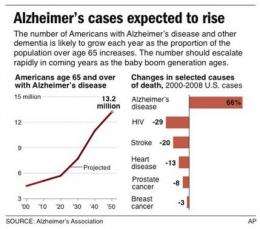
More than 35 million people worldwide have Alzheimer's, the most common form of dementia. In the U.S., more than 5 million do - 13 percent of those 65 and over, and 43 percent of those 85 and up, a rapidly growing group.
Still, half of people who meet medical criteria for dementia have not been diagnosed with it, the Alzheimer's Association estimates. And many who are told they have Alzheimer's or are assumed to have it really don't.
Even when researchers use the best cognitive tests to enroll people in clinical trials, about 10 percent ultimately are discovered not to have the disease, said William Thies, the Alzheimer's Association's scientific director.
"The Alzheimer's drugs don't work in these folks, so there's no reason to expose them to those risks," said Thies, long an advocate of early diagnosis.
Misdiagnosis is a lost opportunity to help. A new medication or combination of medications may suddenly make someone appear demented. Brain fog can occur after surgery and abate over time. Sleep problems are common in older people and can cause profound confusion that can be misinterpreted as dementia, according to research presented at the conference by Dr. Kristine Yaffe of the University of California, San Francisco.
"Some of these are treatable" by avoiding naps during the day or treating sleep apnea, in which brief interruptions of breathing cause people to wake during the night, Yaffe said. Snoring is a big sign. Older people with sleep problems are more likely to be put in nursing homes, she said.
Dr. R. Scott Turner, director of the memory disorders program at Georgetown University Medical Center, has seen that all too often.
"I'm certainly in the camp that screening should be done," he said. Many patients are simply declared to have dementia without testing to see if they have another condition.
"Sometimes it's thyroid disease, or depression, or vitamin B-12 deficiency - something that's very treatable," he said.
Testing someone with symptoms is far less controversial than testing people with no symptoms but a lot of fear. Doctors worry that these newer methods, such as an easier type of brain scan that's expected to be available within months, will be directly marketed to the public, prompting expensive and excessive testing based on fear.
"The phrase you often hear is that the 'Big A' (Alzheimer's) has replaced the 'Big C' (cancer)" as a major source of fear, said Dr. Jason Karlawish, a University of Pennsylvania ethicist specializing in dementia issues.
Recent guidelines by the U.S. National Institute on Aging and the Alzheimer's Association say these tests should be used only in research until they have been standardized and validated as useful and accurate tools.
A researcher using one of these tests, such as a spinal fluid check for a substance that may predict Alzheimer's risk, has no obligation to disclose the results to a patient until there is a meaningful treatment for the disease, Karlawish argued at the conference.
The more symptoms a patient has, the more justified it is to help understand what is known about possible reasons, he said.
Lynda Hogg of Edinburgh, Scotland, is very glad her doctors diagnosed her Alzheimer's in 2006. She is doing exceptionally well on one of the existing drugs and is in a clinical trial for an experimental one she hopes will help her and help advance knowledge in the field.
At a discussion connected with the conference, she said the early diagnosis helped her get financial and legal matters in order and serve on the Scottish Dementia Working Group and the board of Alzheimer's Disease International.
"I am certain involvement keeps me focused and involved in society," she said.
The Alzheimer's Association says early diagnosis and evaluation can bring the following benefits:
- Treatment of reversible causes of impairment.
- Access to drugs that help treat symptoms.
- Inclusion in clinical trials that give expert care.
- Avoiding drugs that can worsen cognition.
- Letting others know of a need for help managing medicines and daily life.
- Easing anxiety about the cause of symptoms.
- Access to education, training and support services.
- The ability to plan for the future.
Lesher, the woman from Pennsylvania, wishes she had a clearer picture of what lies ahead for her.
"Not being able to get diagnosed is the must frustrating thing in the world," she said.
More information:
National Institute on Aging: http://www.nia.nih.gov/Alzheimers
Alzheimer's Association: http://www.alz.org
National Alzheimer's Plan: http://bit.ly/fFWWCT
©2011 The Associated Press. All rights reserved. This material may not be published, broadcast, rewritten or redistributed.


