Researchers engineer functioning small intestine in laboratory experiments
July 5, 2011 in Medical research
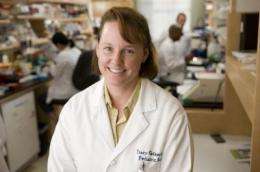
Tracy C. Grikscheit, MD works at the Saban Research Institute of Children's Hospital Los Angeles. Credit: Photo courtesy of Children's Hospital Los Angeles
Researchers at The Saban Research Institute of Children's Hospital Los Angeles have successfully created a tissue-engineered small intestine in mice that replicates the intestinal structures of natural intestine -- a necessary first step toward someday applying this regenerative medicine technique to humans.
The study led by Tracy C. Grikscheit, MD "A Multicellular Approach Forms a Significant Amount of Tissue-Engineered Small Intestine in the Mouse" has been published in the July issue of Tissue Engineering Part A, a premier biomedical journal.
"In this paper, we are able to report that we can grow tissue-engineered intestine in a mouse model, which opens the doors of basic biology to understand how to grow this tissue better," said Dr. Grikscheit, who is also an assistant professor of surgery at the Keck School of Medicine of the University of Southern California.
As a pediatric surgeon, Dr. Grikscheit is concerned with finding solutions for some of her more vulnerable patientsnewborns. Infants born prematurely are at increased risk for a gastrointestinal disease called necrotizing enterocolitis (NEC), which occurs when the intestine is injured. The cause is unknown.
Early treatment of NEC is essential to stop the potentially life-threatening leakage of bacteria into the abdomen. Often, the only solution is surgical removal of the small intestine. However, this option leaves the baby dependent on intravenous feeding and at risk for liver damage from subsequent intravenous nutrition. Organ transplants are possible but not a long-term solution, with only a 50 percent chance the grafted intestine will last past the child's 5th birthday.
Dr. Grikscheit, a member of The Saban Research Institute's Developmental Biology and Regenerative Medicine program, envisions a better solution. "The small intestine is an exquisitely regenerative organ. The cells are constantly being lost and replaced over the course of our entire lives," she explained. "Why not harness that regenerative capacity to benefit these children?"
Working in the laboratory, the research team took samples of intestinal tissue from mice. This tissue was comprised of the layers of the various cells that make up the intestine including muscle cells and the cells that line the inside, known as epithelial cells. The investigators then transplanted that mixture of cells within the abdomen on biodegradable polymers or "scaffolding."
What the team wanted to happen did new, engineered small intestines grew and had all of the cell types found in native intestine. Because the transplanted cells had carried a green label, the scientists could identify which cells had been provided and all of the major components of the tissue-engineered intestine derived from the implanted cells. Critically, the new organs contained the most essential components of the originals.
"What is novel about this research is that this tissue-engineered intestine contains every important cell type needed for functional intestine. For children with intestinal failure, we are always looking for long-term, durable solutions that will not require the administration of toxic drugs to ensure engraftment. This tissue-engineered intestine, which has all of the critical components of the mature intestine, represents a truly exciting albeit preliminary step in the right direction," said Henri Ford, MD, Vice President and Surgeon-in-Chief at Children's Hospital Los Angeles.
"We demonstrated that we are providing all of the important cellsthe muscle, nerve, epithelium, and some of the blood vessels," noted Frédéric Sala, PhD, lead author. "All of these are critical to proper functioning of the tissue, and now we know their origins." Next up are additional tissue-growing experimentseach one of which may bring that much closer the prospects of clinical testing and a solution for babies in need.
Provided by Children's Hospital Los Angeles
-
The making of an intestinal stem cell
Mar 05, 2009 |
not rated yet |
0
-
Stem cells turned into complex, functioning intestinal tissue in lab
Dec 12, 2010 |
not rated yet |
0
-
New research may help patients with intestinal failure, other malabsorptive disorders
May 04, 2010 |
not rated yet |
0
-
Researchers to activate anti-cancer gene
Aug 30, 2010 |
not rated yet |
0
-
Friend or Foe? Scientists Determine How the Intestine Keeps Us Safe From Microbial Invaders
Feb 21, 2007 |
not rated yet |
0
-
Limits to growth: Scientists identify key metastasis-enabling enzyme
May 22, 2012 |
5 / 5 (3) |
0
-
Seeing is as seeing does: Spatially-structured retinal input in early development of cortical maps
Apr 26, 2012 |
5 / 5 (4) |
1
-
Dreamless nights: Brain activity during nonrapid eye movement sleep
Apr 09, 2012 |
4.4 / 5 (12) |
0
-
Take your time: Neurobiology sheds light on the superiority of spaced vs. massed learning
Mar 28, 2012 |
4.5 / 5 (21) |
3
-
Your brain on 'shrooms: fMRI elucidates neural correlates of psilocybin psychedelic state
Feb 29, 2012 |
4.9 / 5 (42) |
45
-
A question about drug tolerance
May 23, 2012
-
Poor nutrition leading to overeating?
May 23, 2012
-
Math and dyslexia?
May 21, 2012
-
portable metabolism meter?
May 21, 2012
-
Rare medical conditions on 20/20 tonight
May 18, 2012
-
"Good" Cholesterol in Doubt
May 17, 2012
- More from Physics Forums - Medical Sciences
More news stories
Like curry? New biological role identified for compound used in ancient medicine
Scientists have just identified a new reason why some curry dishes, made with spices humans have used for thousands of years, might be good for you.
Medical research
6 hours ago |
4 / 5 (3) |
1
|
The cells' petrol pump is finally identified
The oxygen and food we consume are converted into energy by tiny organelles present in each cell, the mitochondria. These 'power plants' must be continuously supplied with fuel, to maintain all vital functions. A team led ...
Medical research
17 hours ago |
5 / 5 (1) |
0
Researchers identify protein necessary for behavioral flexibility
Researchers have identified a protein necessary to maintain behavioral flexibility, which allows us to modify our behaviors to adjust to circumstances that are similar, but not identical, to previous experiences. Their findings, ...
Medical research
19 hours ago |
5 / 5 (2) |
1
|
From stem cell to brain cell - new technique mimics the brain
A new technique that converts stem cells into brain cells has been developed by researchers at Lund University. The method is simpler, quicker and safer than previous research has shown and opens the doors to a shorter route ...
Medical research
21 hours ago |
5 / 5 (1) |
0
A revealing hand
What did you have for lunch yesterday? How many times a month do you eat nuts? How about your kids -- how many servings of vegetables did they consume today?
Medical research
May 24, 2012 |
5 / 5 (2) |
0
New study should end debate over magnesium treatment for preventing poor outcome after haemorrhagic stroke
An international randomised trial and meta-analysis published Online First in The Lancet should put an end to the debate about the use of intravenous magnesium sulphate to prevent poor outcomes after haemorrhagic stroke. The in ...
Australia defiant on WTO cigarette challenge
Australia said Friday it would "vigorously defend" itself against complaints about its plan for plain cigarette packaging made by Honduras and Ukraine to the World Trade Organisation.
Progestin treatment for polycystic ovarian syndrome may reduce pregnancy chances
(Medical Xpress) -- The hormone progestin, often given as a first step in infertility treatment for polycystic ovary syndrome (PCOS), appears to decrease the odds of conception and of giving birth, according to a study by ...
World 'no tobacco day' puts spotlight on dangers of smoking
Its not just smokers who are at-risk when it comes to tobacco smoke exposureand the health concerns of smoking cigarettes are not limited to the most known consequence: lung cancer.
Nonsmoking lung cancer survivor encourages others to consider risk
Carol Seibert had an upper respiratory infection she just couldnt seem to shake. The timing of her illness was awful, as she had just returned from a trip to Florida for her youngest sons surgery and was preparing ...
Amino acid consumption associated with how fast cancer cells divide
For almost a century, researchers have known that cancer cells have peculiar appetites, devouring glucose in ways that normal cells do not. But glucose uptake may tell only part of cancer's metabolic story. Researchers from ...