Gardening in the brain: Specialist cells prune connections between neurons
July 21, 2011 in Medical research

Gardening in the brain: Specialist cells prune connections between neurons

Enlarge

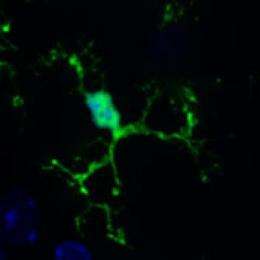
This is microglia (green) in a mouse brain. The nuclei of all cells in the brain are labeled blue. Credit: EMBL/R.Paolicelli

Gardeners know that some trees require regular pruning: some of their branches have to be cut so that others can grow stronger. The same is true of the developing brain: cells called microglia prune the connections between neurons, shaping how the brain is wired, scientists at the European Molecular Biology Laboratory (EMBL) in Monterotondo, Italy, discovered. Published online today in Science, the findings could one day help understand neurodevelopmental disorders like autism.

"We're very excited, because our data shows microglia are critical to get the connectivity right in the brain," says Cornelius Gross, who led the work: "they 'eat up' to make space for the most effective contacts between neurons to grow strong."

Microglia are related to the that engulf pathogens and cellular debris, and scientists knew already that microglia perform that same clean-up task when the brain is injured, 'swallowing up' dead and dying neurons. Looking at the developing mouse brain under the microscope, Gross and colleagues found proteins from synapses – the connections between neurons – inside microglia, indicating that microglia are able to engulf synapses too.

To probe further, the scientists introduced a mutation that reduced the number of microglia in the developing mouse brain.

"What we saw was similar to what others have seen in at least some cases of in humans: many more connections between ," Gross says. "So we should be aware that changes in how microglia work might be a major factor in that have altered brain wiring."

Gardening in the brain: Specialist cells prune connections between neurons
Enlarge

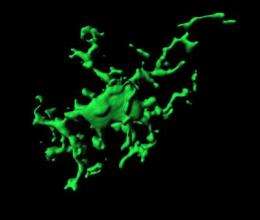
This is a 3-dimensional reconstruction of a single microglia cell. Credit: EMBL/ R.Paolicelli

The microglia-limiting mutation the EMBL scientists used has only temporary effects, so eventually the number of microglia increases and the mouse brain establishes the right connections. However, this happens later in development than it normally would, and Gross and colleagues would now like to find out if that delay has long-term consequences. Does it affect the behaviour of the mice behaviour, for example? At the same time, Gross and colleagues plan to investigate what microglia do in the healthy adult brain, where their role is essentially unknown.

Provided by European Molecular Biology Laboratory search and more info website

5 /5 (4 votes)  

Filter


Move the slider to adjust rank threshold, so that you can hide some of the comments.


Display comments: newest first

hush1
Aug 28, 2011

Rank: not rated yet
Congratulations. Kudos
Rank 5 /5 (4 votes)
Related Stories
Relevant PhysicsForums posts

More news stories

Study reveals new mechanism for estrogen suppression of liver lipid synthesis

By discovering the new mechanism by which estrogen suppresses lipid synthesis in the liver, UC Irvine endocrinologists have revealed a potential new approach toward treating certain liver diseases.

Medical research created 21 hours ago | popularity not rated yet | comments 0 | with audio podcast

MRI-based measurement helps predict vascular disease in the brain

Aortic arch pulse wave velocity, a measure of arterial stiffness, is a strong independent predictor of disease of the vessels that supply blood to the brain, according to a new study published in the June issue the journal ...

Medical research created 21 hours ago | popularity not rated yet | comments 0

Antibiotics: A new understanding of sulfonamide nervous system side effects

Since the discovery of Prontosil in 1932, sulfonamide antibiotics have been used to combat a wide spectrum of bacterial infections, from acne to chlamydia and pneumonia. However, their side effects can include serious neurological ...

Medical research created 23 hours ago | popularity not rated yet | comments 0 | with audio podcast

Scientists discover molecule triggers sensation of itch

Scientists at the National Institutes of Health report they have discovered in mouse studies that a small molecule released in the spinal cord triggers a process that is later experienced in the brain as ...

Medical research created 23 hours ago | popularity 5 / 5 (2) | comments 0 | with audio podcast

Discarded immune cells induce the relocation of stem cells

Spanish researchers have discovered that the daily clearance of neutrophils from the body stimulates the release of hematopoietic stem cells from the bone marrow into the bloodstream, according to a report published today ...

Medical research created May 23, 2013 | popularity 5 / 5 (2) | comments 0


Hormone levels may provide key to understanding psychological disorders in women

Women at a particular stage in their monthly menstrual cycle may be more vulnerable to some of the psychological side-effects associated with stressful experiences, according to a study from UCL.

Storm chasers: born to be wild?

(HealthDay)—We've all seen them: the surfers who race to the beach when a hurricane hits, the guy who decides to ride out the storm in his overmatched boat, the tornado chasers who fearlessly steer their ...

Bulletin provides guidelines for second-trimester abortion

(HealthDay)—New evidence-based guidelines provide guidance on medical and surgical methods for second-trimester abortion and management of associated complications, according to a practice bulletin published ...

Modulating the immune system to combat metastatic cancer

Cancer cells spread and grow by avoiding detection and destruction by the immune system. Stimulation of the immune system can help to eliminate cancer cells; however, there are many factors that cause the immune system to ...

New fluorescent tools for cancer diagnosis

In recent years, microRNAs (miRNAs) and other non-coding RNAs are small molecules that help control the expression of specific proteins. In recent years they have emerged as disease biomarkers. miRNA profiles have been used ...

Top-ranked golfer beats scoliosis

(HealthDay)—As a world-class golfer, Stacy Lewis' accomplishments are remarkable. But it was a physical challenge in her childhood that defined her ascent to the top of her sport.