Immunity restrained by ion influx
July 22, 2011 in Medical research
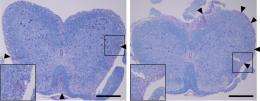
Figure 1: Spinal cord sections from a mouse model of multiple sclerosis (left) display increased autoimmune damage when B cells in these mice lack the genes encoding STIM1 and STIM2 (right). Arrowheads indicate regions of inflammatory damage, with inset images offering a magnified view of boxed regions. Scale bars, 100μm. Credit: 2011 Elsevier Inc.
B cells maintain stockpiles of calcium ions (Ca2+), which are released during the course of the immune response. When the presence of a foreign antigen stimulates the B cell receptor (BCR) complex, these internal reserves of Ca2+ get released into the cell, subsequently triggering the opening of channels in the cell membrane that allow the entry of even more Ca2+.
Immunologists generally considered these ions as essential currency for many key cellular processes. Ca2+ signaling in B cells is widely assumed to be responsible for functions including B cell development, immune response and antibody production, says Yoshihiro Baba of the Immunology Frontier Research in Osaka University and formerly with the RIKEN Research Center for Allergy and Immunology in Yokohama. However, the direct effects of this bulk Ca2+ entry, also known as store-operated Ca2+ (SOC) influx, are poorly understood.
To examine the importance of this mechanism, Baba and colleagues genetically engineered mice whose B cells lack the genes encoding STIM1 or STIM2, two proteins involved with SOC influx. Their results suggest that this pathway plays a far more narrowly defined role than was previously expected.
The researchers determined that these two proteins cooperatively contribute to the management of Ca2+ influx, and facilitate B cell proliferation following BCR-mediated signaling. However, they appear to have no role in the actual immune response, as mice with STIM1- and STIM2-deficient B cells were still capable of mounting an antibody response against foreign antigens.
On the other hand, both factors proved important for the function of regulatory B cells, which produce anti-inflammatory factors such as interleukin-10 (IL-10) and help prevent the immune system from over-reacting or attacking host tissues. Without these STIM proteins, mouse B cells produced only minimal amounts of IL-10. Baba and colleagues determined that the absence of STIM1 and STIM2 greatly exacerbates the incidence and severity of inflammatory pathology in a mouse model of multiple sclerosis (Fig. 1). Since the action of IL-10 suppresses a variety of autoimmune conditions, these findings may indicate a general mechanism that could be targeted for the treatment of such disorders. Our study suggests that a failure to balance Ca2+ levels may lead to autoimmune disease. This is a very exciting finding, says Baba.
He and his colleagues are now keen to better understand the Ca2+-dependent anti-inflammatory B cells. We are trying to show when and where regulatory B cells function, and what cells are targeted by them, he says, and to understand what type of inflammationchronic or acuteis sensitive to IL-10-producing B cells.
More information: Matsumoto, M., et al. The calcium sensors STIM1 and STIM2 control B cell regulatory function through interleukin-10 production. Immunity 34, 703714 (2011).
Provided by
RIKEN
-
Transcription factor regulates protein that dampens immune responses
Jun 17, 2011 |
not rated yet |
0
-
Awaiting orders to retaliate
Jun 24, 2011 |
not rated yet |
0
-
Neighboring immune-system genes: Maintaining independence
Jan 31, 2011 |
not rated yet |
0
-
Researchers find novel role for calcium channels in pacemaker cell function
Mar 09, 2011 |
not rated yet |
0
-
New role for protein molecule that inhibits response of immune-system cells
Nov 09, 2010 |
not rated yet |
0
-
Of mice and mental models: Neuroscientific implications of risk-optimized behavior in the mouse
3 hours ago |
not rated yet |
0
-
Limits to growth: Scientists identify key metastasis-enabling enzyme
May 22, 2012 |
5 / 5 (3) |
0
-
Seeing is as seeing does: Spatially-structured retinal input in early development of cortical maps
Apr 26, 2012 |
5 / 5 (4) |
1
-
Dreamless nights: Brain activity during nonrapid eye movement sleep
Apr 09, 2012 |
4.4 / 5 (12) |
0
-
Take your time: Neurobiology sheds light on the superiority of spaced vs. massed learning
Mar 28, 2012 |
4.5 / 5 (21) |
3
-
A question about drug tolerance
May 23, 2012
-
Poor nutrition leading to overeating?
May 23, 2012
-
Math and dyslexia?
May 21, 2012
-
portable metabolism meter?
May 21, 2012
-
Rare medical conditions on 20/20 tonight
May 18, 2012
-
"Good" Cholesterol in Doubt
May 17, 2012
- More from Physics Forums - Medical Sciences
More news stories
Implantable pain disk may help those with cancer
An estimated 3.5 million cancer patients around the globe are in severe pain from their disease, but many get no relief.
Medical research
1 hour ago |
not rated yet |
0
|
Energy levels link sleep control mechanisms
Sleep, or lack of it, can determine level of cognitive performance which is linked with accidents as well as increased risk of serious health problems. Links between cell energy levels, gene transcription ...
Medical research
3 hours ago |
not rated yet |
0
Researchers identify key brain cell in antidepressant action
(Medical Xpress) -- Antidepressant medications such as Prozac have helped improve mood and lessen anxiety in millions of people with major depression. But scientists know surprisingly little about how these drugs work.
Medical research
3 hours ago |
not rated yet |
0
|
Rockefeller scientists pioneer new method to determine mechanisms of drug action
(Medical Xpress) -- Knowing that a drug works is great. Knowing how it works is a luxury. And until now, determining a drugs mechanism of action has been a tedious and difficult process for scientists.
Medical research
4 hours ago |
not rated yet |
0
|
Like curry? New biological role identified for compound used in ancient medicine
Scientists have just identified a new reason why some curry dishes, made with spices humans have used for thousands of years, might be good for you.
Medical research
11 hours ago |
4 / 5 (3) |
1
|
More mental health care urged for kids who self-harm
(HealthDay) -- Doctors have long known that some kids suffering severe emotional turmoil find relief in physical pain -- cutting or burning or sticking themselves with pins to achieve a form of release.
Neck strength, cervical spine mobility don't predict pain
(HealthDay) -- Neither isometric neck muscle strength nor passive mobility of the cervical spine, two physical capacity parameters found to be associated with neck pain in other studies, predicts later neck ...
P&G to add latches to make detergent packs safer
(AP) -- Procter & Gamble says it will change the design of packaging for its miniature laundry detergent product to deter children from eating the brightly colored packets that look like candy.
Cancer may require simpler genetic mutations than previously thought
Chromosomal deletions in DNA often involve just one of two gene copies inherited from either parent. But scientists haven't known how a deletion in one gene from one parent, called a "hemizygous" deletion, can contribute ...
Inherited DNA change explains overactive leukemia gene
A small inherited change in DNA is largely responsible for overactivating a gene linked to poor treatment response in people with acute leukemia.
Of mice and mental models: Neuroscientific implications of risk-optimized behavior in the mouse
(Medical Xpress) -- Regardless of an organism’s biological complexity, every encephalized animal continuously makes under-informed behavioral choices that can have serious consequences. Despite its ubiquity, ...